
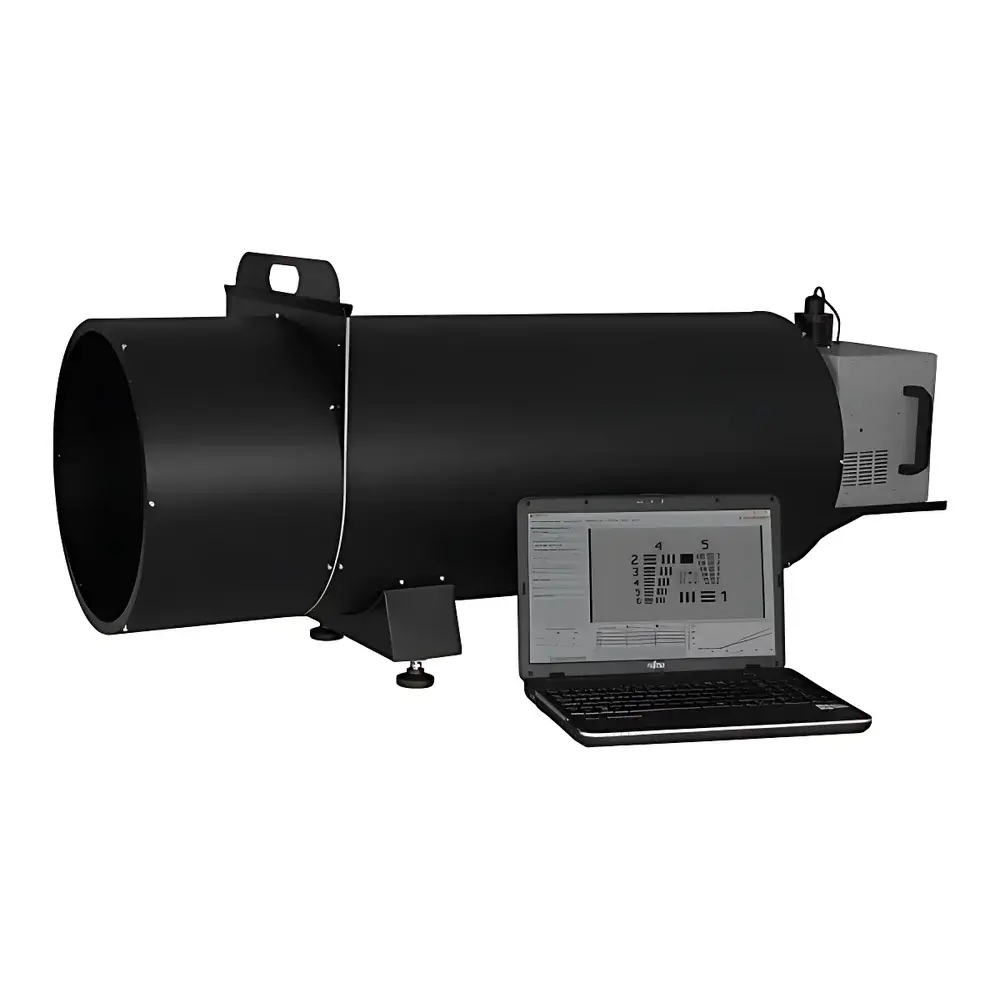
Inframet LOF Mobile Visible-Near-Infrared Camera Test System
| Brand | Inframet |
|---|---|
| Origin | Poland |
| Model | LOF |
| Light Source | DAL Series |
| Projection System | CLO3075 |
| Target Set | Five-Contrast USAF 1951, Knife-Edge, Distortion/FOV Targets |
| Light Spectrum | 400–1100 nm (calibrated to DUT spectral response) |
| Luminance Range | 30 µcd/m² – 3 kcd/m² |
| Illuminance Simulation Range | 100 µlx – 10,000 lx |
| Color Temperature Modes | 2856 K (halogen), 5000 K (white LED) |
| Uniform Aperture Diameter | 250 mm |
| Total System Mass | 22 kg |
| Dimensions (W×D×H) | 350 × 350 × 1100 mm |
| Operating Temperature | 5–40 °C |
| Storage Temperature | 5–55 °C |
| Relative Humidity | Up to 95% RH (non-condensing) |
| Power Supply | AC 230 V / 110 V (DC 12 V optional) |
| Video Input Interfaces | PAL, NTSC, FireWire, USB 2.0 |
| Control Interface | RS-232 / USB 2.0 |
| Software | TAS-V Test Automation Suite, DAL Light Source Control Software |
| Test Capabilities (LOF-A) | Resolution, Minimum Resolvable Contrast (MRC) |
| (LOF-B) | Adds MTF, Sensitivity, Noise Equivalent Irradiance (NEI), Fixed Pattern Noise (FPN), Non-Uniformity, SNR, Geometric Distortion, Field of View (FOV) |
Overview
The Inframet LOF Mobile Visible-Near-Infrared Camera Test System is a field-deployable optical metrology platform engineered for quantitative performance evaluation of electro-optical imaging systems operating across the 400–1100 nm spectral band. Unlike laboratory-based collimator-based testers, the LOF employs a projection-based architecture optimized for outdoor or semi-controlled environments—enabling verification of camera performance at operational standoff distances. Its core measurement principle relies on high-fidelity projection of standardized test targets onto the device under test (DUT), followed by image acquisition and algorithmic analysis using the TAS-V software suite. This approach captures real-world system-level behaviors—including geometric distortion, spatial frequency response, contrast transfer, and radiometric fidelity—without requiring optical coupling or vacuum-compatible integration. The system is specifically designed for short- to mid-range visible-NIR imagers used in surveillance, reconnaissance, driver assistance (ADAS), and scientific remote sensing applications where environmental adaptability and traceable calibration are critical.
Key Features
- Modular mobile architecture: Fully self-contained in a ruggedized transport case with integrated tripod mount and adjustable height stand for rapid field deployment.
- Dual-mode calibrated light source (DAL series): Precisely controllable halogen (2856 K) and white LED (5000 K) emitters, enabling simulation of diurnal lighting conditions—from twilight to full daylight—with luminance range spanning 30 µcd/m² to 3 kcd/m².
- CLO3075 high-resolution projection system: Delivers diffraction-limited target projection with uniform irradiance over a 250 mm effective aperture, minimizing edge falloff and ensuring repeatable MTF and resolution measurements.
- Comprehensive target set: Includes five-contrast USAF 1951 charts (for resolution and MRC), knife-edge targets (for edge spread function derivation), and geometric distortion/FOV charts—all manufactured to ISO 12233-compliant tolerances.
- Multi-standard video interface support: Native compatibility with PAL, NTSC, FireWire (IEEE 1394), and USB 2.0; optional expansion to HD-SDI, Camera Link, LVDS, and GigE facilitates integration with industrial and military-grade cameras.
- Traceable radiometric calibration: All light output and target reflectance values are NIST-traceable and documented per unit serial number, supporting ISO/IEC 17025-aligned validation workflows.
Sample Compatibility & Compliance
The LOF system supports imaging sensors with pixel pitches from 1.4 µm to 15 µm and focal lengths ranging from 4 mm to 150 mm. It accommodates both global and rolling shutter architectures and is compatible with monochrome, Bayer-pattern, and multispectral NIR-enhanced sensors. All test procedures and reporting outputs comply with key international standards including ISO 12233 (resolution), ISO 15739 (noise and dynamic range), ISO 17850 (MRC), and ASTM E1242 (infrared imaging performance). The TAS-V software includes audit-trail logging and user-access controls aligned with FDA 21 CFR Part 11 requirements for regulated environments, and supports GLP/GMP documentation templates for quality assurance departments.
Software & Data Management
TAS-V is a Windows-based test automation platform providing automated acquisition, parameter extraction, statistical trending, and report generation. Each test sequence is scriptable and repeatable, with built-in algorithms for MTF calculation (via slanted-edge method per ISO 12233 Annex A), non-uniformity correction mapping, FPN quantification, and SNR computation across multiple exposure levels. Raw image data is stored in TIFF-64 or FITS format with embedded EXIF metadata (exposure time, gain, temperature, light source settings). Export options include PDF reports compliant with MIL-STD-810G Annex G, CSV for SPC analysis, and XML for integration into enterprise LIMS or PLM systems. DAL light source control software enables closed-loop luminance stabilization and spectral mode switching via RS-232 or USB 2.0.
Applications
- Field verification of EO/IR camera performance prior to mission deployment in defense and security operations.
- Production line acceptance testing for automotive night-vision and surround-view systems.
- Calibration validation of scientific NIR imagers used in vegetation health monitoring and material classification.
- Supporting ISO 16508-compliant reliability testing through periodic MTF and sensitivity drift monitoring over thermal cycling.
- Independent third-party verification for camera vendors seeking CE marking or STANAG 4347 compliance documentation.
FAQ
What is the minimum recommended working distance between the LOF projector and the DUT?
The optimal projection distance ranges from 1.5 m to 10 m, depending on DUT focal length and required target subtense; detailed guidance is provided in the TAS-V setup wizard.
Can the LOF system be used indoors under controlled lighting?
Yes—its active illumination design eliminates ambient light dependency, making it equally suitable for cleanroom labs, anechoic chambers, or hangar environments.
Is radiometric calibration included with the system shipment?
Each LOF unit ships with a factory calibration certificate referencing NIST-traceable standards; annual recalibration services are available directly from Inframet’s Warsaw metrology lab.
Does the LOF-B configuration support real-time MTF calculation during live video streaming?
MTF is computed post-acquisition from static frame captures; however, TAS-V supports automated burst capture at up to 60 fps for temporal noise analysis and dynamic range profiling.
Are custom target patterns supported?
Yes—TAS-V accepts user-defined bitmap targets (BMP/PNG) with defined physical dimensions and contrast ratios; custom projection masks can be ordered as optional accessories.





