
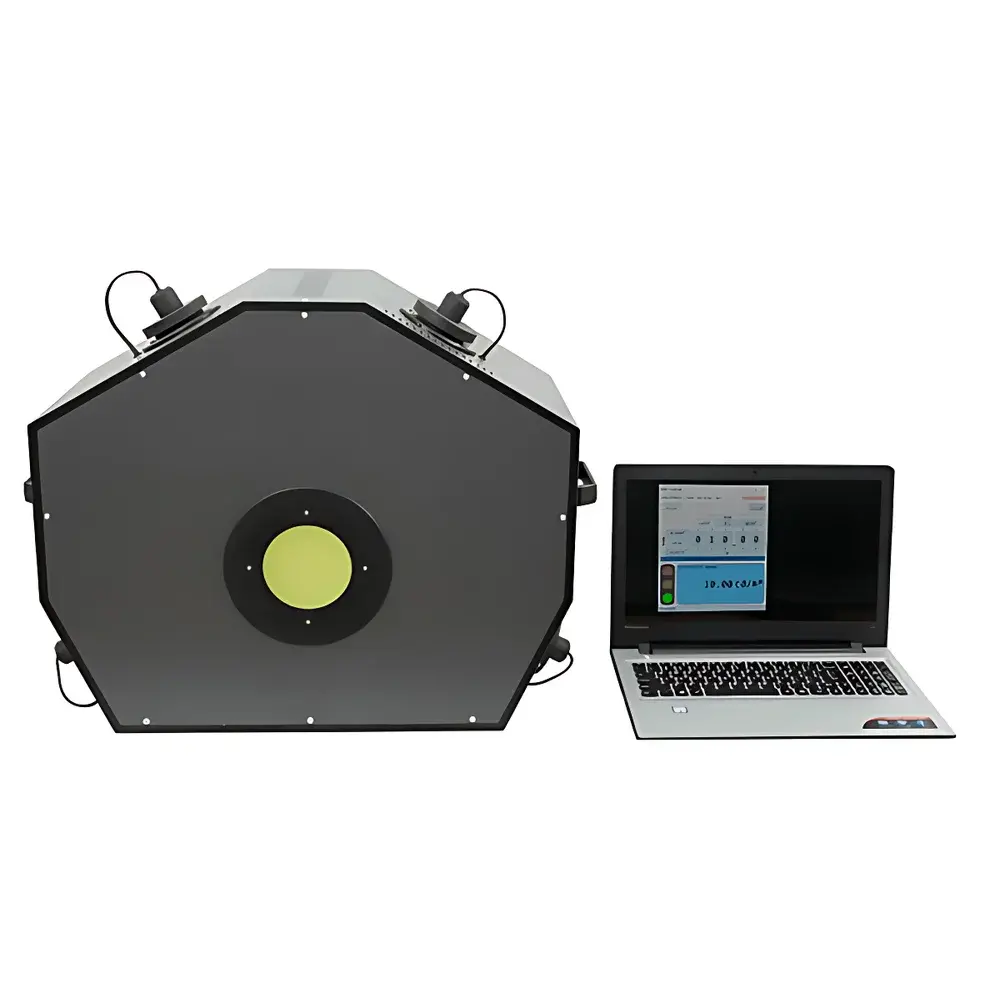
Inframet LS-LAM-100C Computerized Standard Lambertian Light Source
| Brand | Inframet |
|---|---|
| Origin | Poland |
| Model | LS-LAM-100C |
| Aperture | 100 mm |
| Spectral Range | 400–2000 nm |
| Correlated Color Temperature | 2856 K (visible–NIR) |
| Luminance Uniformity | ≥98% |
| Luminance Range | 1 mcd/m² to 10 kcd/m² |
| Illuminance Simulation Range (for 100% reflectance target) | 3 mlx to 30 klx |
| Total Dynamic Range | 10⁷ |
| Luminance Adjustment Resolution | ≤10 mcd/m² |
| Temporal Stability | <1% (over 8 h) |
| Operating Temperature | +5°C to +35°C |
| Storage Temperature | −5°C to +55°C |
| Relative Humidity | <90% RH (non-condensing) |
| Dimensions | 430 × 490 × 290 mm |
| Weight | 15 kg |
| Power Supply | 110/220 VAC, 50 Hz |
Overview
The Inframet LS-LAM-100C is a computer-controlled, high-stability Lambertian light source engineered for radiometric and photometric calibration of visible-to-short-wave infrared (VIS–SWIR) imaging sensors, cameras, and optical detectors with an entrance aperture up to 100 mm. Based on an integrating sphere architecture with a precisely characterized halogen lamp emitter, the LS-LAM-100C delivers spatially uniform, spectrally stable, and temporally reproducible output across a broad spectral band from 400 nm to 2000 nm. Its defining feature is a continuous, high-resolution luminance control system—implemented via PC-driven mechanical attenuators—that enables seamless simulation of illumination conditions ranging from starlight-level intensities (1 mcd/m²) to bright daylight (10 kcd/m²), corresponding to illuminance levels from 3 mlx to 30 klx on a 100% Lambertian target. This 10⁷ dynamic range supports traceable calibration workflows in both low-light and high-flux regimes, making the LS-LAM-100C suitable for laboratory-grade validation of sensor linearity, dynamic range, MTF, SNR, and non-uniformity correction (NUC) algorithms.
Key Features
- Integrating sphere-based Lambertian source with 100 mm output port diameter, optimized for collimated or near-collimated optical coupling into VIS–SWIR imagers.
- Stabilized tungsten-halogen lamp with correlated color temperature of 2856 K across the visible–NIR spectrum, ensuring compatibility with CIE standard observer functions and common detector quantum efficiency profiles.
- High spatial uniformity ≥98% across the full exit aperture, verified per ISO 9050 and ASTM E308 procedures using calibrated imaging photometers.
- Motorized, multi-stage neutral-density attenuation system enabling continuous, repeatable luminance adjustment with resolution ≤10 mcd/m² and long-term temporal stability <1% over 8-hour operation cycles.
- Integrated thermal management and power regulation to maintain spectral and radiometric consistency across ambient temperatures from +5°C to +35°C.
- Compliant with IEC 61000-6-3 (EMC emission) and IEC 61000-6-2 (immunity), designed for integration into metrology-grade cleanroom or controlled-lab environments.
Sample Compatibility & Compliance
The LS-LAM-100C is validated for use with charge-coupled device (CCD), complementary metal-oxide-semiconductor (CMOS), indium gallium arsenide (InGaAs), and mercury cadmium telluride (MCT) focal plane arrays operating within the 400–2000 nm band. It meets requirements for calibration traceability under ISO/IEC 17025:2017 when operated with NIST-traceable reference detectors. The unit supports compliance with MIL-STD-810G (environmental testing), DO-160G (avionics lighting test), and EN 62676-3 (video surveillance equipment verification). Its radiometric output is fully compatible with photometric units (cd/m², lx) and radiometric units (W·sr⁻¹·m⁻²·μm⁻¹), facilitating dual-mode calibration protocols required by aerospace, defense, and automotive ADAS sensor certification frameworks.
Software & Data Management
The LS-LAM-100C interfaces via USB 2.0 and Ethernet (TCP/IP) with Inframet’s proprietary LAMS v4.2 calibration software suite. This platform provides real-time luminance monitoring, automated step-and-hold sequences, scheduled stability logging, and export of time-stamped radiometric datasets in HDF5 and CSV formats. Audit trails—including operator ID, timestamp, instrument configuration, and environmental metadata—are recorded in accordance with FDA 21 CFR Part 11 and EU Annex 11 requirements. Software supports scripting via Python API for integration into automated test benches compliant with GLP and GMP documentation standards.
Applications
- Factory and field calibration of electro-optical/infrared (EO/IR) surveillance systems and targeting pods.
- Validation of SWIR camera response linearity and saturation thresholds for semiconductor wafer inspection tools.
- Development and verification of automatic exposure control (AEC) and tone mapping algorithms in automotive vision systems.
- Reference source for inter-laboratory comparison studies under BIPM CCPR key comparisons.
- Testing of stray light rejection and veiling glare performance in high-dynamic-range optical systems.
- Supporting ISO 12232 (digital still camera sensitivity) and ISO 15739 (noise measurement) test methodologies.
FAQ
Is the LS-LAM-100C suitable for calibrating hyperspectral imagers?
Yes—the 400–2000 nm spectral coverage and high spectral stability enable characterization of spectral response functions across contiguous bands; however, users should apply appropriate monochromator-based corrections for narrowband applications.
Does the system include NIST-traceable calibration certificates?
Each unit ships with a factory calibration report traceable to PTB (Physikalisch-Technische Bundesanstalt); optional NIST-traceable recalibration services are available annually.
Can the LS-LAM-100C be integrated into a robotic optical test station?
Yes—its digital interface supports TTL-triggered intensity changes and position-synchronized exposure sequencing via external PLC or motion controller.
What maintenance is required for long-term radiometric stability?
Lamp replacement every 2,000 hours is recommended; attenuator calibration verification is advised every 12 months or after 500 operational cycles.
Is the output beam collimated or diffuse?
The source emits a highly uniform, near-Lambertian diffuse output from the 100 mm port; optional collimating optics (e.g., f/2.8 achromatic beam expanders) can be mounted externally.




