
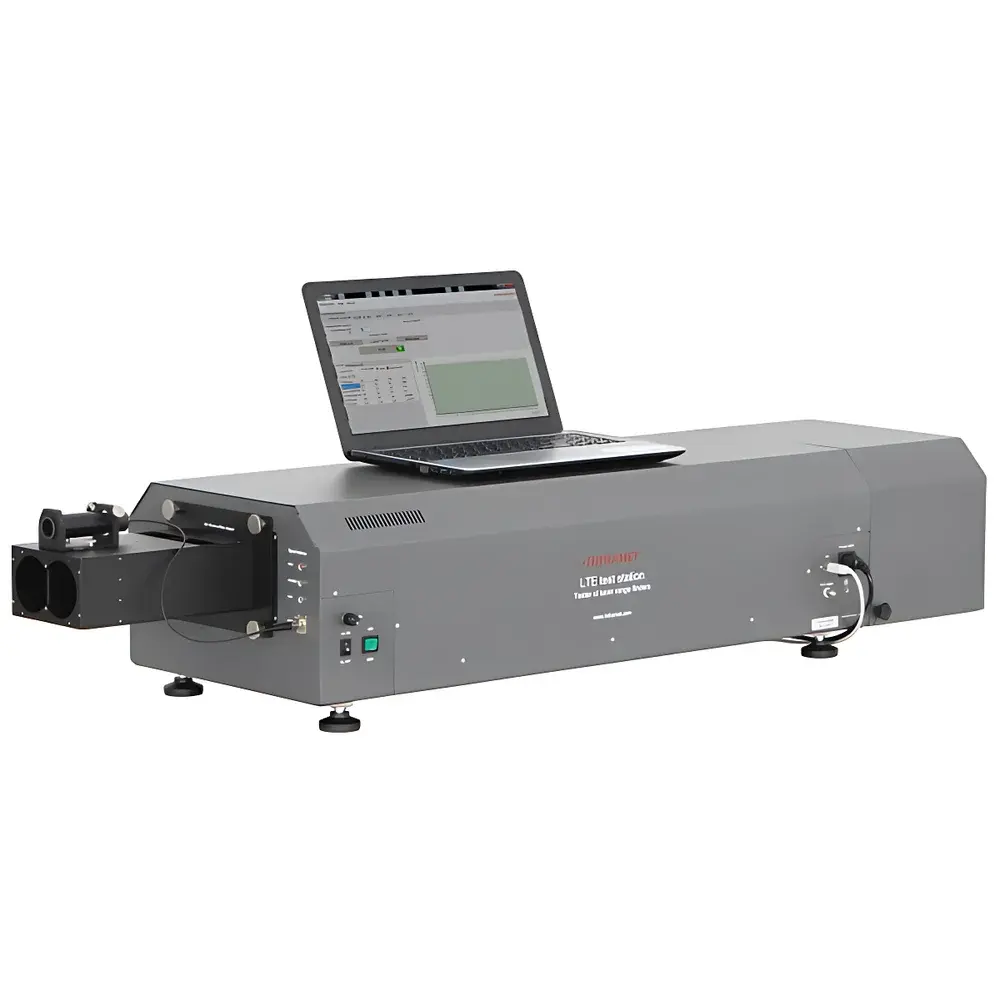
Inframet LTE Multi-Function Laser Rangefinder Test System
| Brand | Inframet |
|---|---|
| Origin | Poland |
| Model | LTE |
| Wavelength Support | 910 nm, 1060 nm, 1540 nm, 1550 nm, 1570 nm |
| Target Angular Size Adjustment Steps | 0.25, 0.5, 0.75, 1.0, 1.5, 2.0, 4.0 mrad |
| Optical Aperture | Two 70 mm incomplete circular channels |
| Detector Type | Calibrated ultrafast InGaAs photodiode |
| Interface | USB 2.0 |
| Operating Temperature | +5 °C to +35 °C |
| Storage Temperature | −5 °C to +50 °C |
| Relative Humidity | Up to 95% (non-condensing) |
| Dimensions (H × L × W) | 350 mm × 1500 mm × 445 mm (main module + platform) |
| Weight | ~59 kg (main module + platform + 10 kg auxiliary modules + PC) |
Overview
The Inframet LTE Multi-Function Laser Rangefinder Test System is a precision-engineered laboratory-grade optical test platform designed for comprehensive characterization and verification of dual-channel laser rangefinders (LRFs) equipped with integrated or external aiming channels. Based on time-of-flight (ToF) and beam alignment metrology principles, the LTE system enables simultaneous evaluation of transmitter output characteristics, receiver sensitivity, and multi-axis optical co-alignment—critical parameters for military, aerospace, and survey-grade electro-optical systems. Unlike static calibration benches, the LTE replicates field-relevant operational conditions by emulating a variable-distance, variable-angular-size target through calibrated optical attenuation and spatial filtering. Its dual 70 mm incomplete circular aperture architecture supports independent illumination and detection paths, allowing decoupled assessment of transmit pulse fidelity and receive channel response under controlled, repeatable conditions.
Key Features
- Simultaneous dual-channel characterization: Measures transmitter pulse energy, peak power, width, repetition rate, beam divergence, and receiver sensitivity in a single setup.
- Dynamic target emulation: Adjustable angular target size (0.25–4.0 mrad in discrete steps) combined with tunable optical attenuation enables realistic simulation of ranging scenarios from short-range (<1 km) to extended ranges.
- Multi-wavelength compatibility: Native support for five industry-standard LRF wavelengths—910 nm, 1060 nm, 1540 nm, 1550 nm, and 1570 nm—with manual source switching; additional bands available upon request.
- Co-alignment verification: Integrated BOR (Boresight Optimization Routine) software acquires real-time camera imagery to quantify misalignment between transmitter, receiver, and aiming channel optical axes—expressed in arcminutes or microradians.
- Time-resolved pulse analysis: Synchronized ultrafast InGaAs photodetector (calibrated, sub-nanosecond rise time) captures transient pulse profiles; pulse analysis software delivers real-time waveform acquisition, jitter measurement, and temporal parameter extraction (FWHM, leading/trailing edge times).
- Rugged modular architecture: Designed for transportable lab use—compact footprint (1500 mm length), integrated vibration-damped optical platform, and sealed environmental enclosure rated for operation up to 95% RH (non-condensing).
Sample Compatibility & Compliance
The LTE system accommodates a broad class of pulsed laser rangefinders, including those with internal coaxial aiming channels, externally mounted aiming optics, and near-field dual-channel configurations. It complies with ISO 11553-1:2013 (safety of laser products), EN 60825-1:2014 (laser classification and labeling), and supports traceable calibration workflows aligned with ISO/IEC 17025 requirements. While not a certified metrology standard itself, the system’s calibrated InGaAs detector and NIST-traceable attenuators enable users to establish in-house verification protocols compliant with MIL-STD-1472G (human engineering), STANAG 4579 (laser rangefinder performance testing), and NATO AEP-97 (electro-optical sensor test methodology). All firmware and control software are developed under version-controlled configuration management per IEC 62304 Class B guidelines.
Software & Data Management
The LTE platform operates via three dedicated Windows-based applications: LE Control Software manages hardware initialization, USB 2.0 communication, and real-time status monitoring; MET Pulse Generator Control Software configures delay timing, pulse shaping, and modulation depth for synthetic signal injection into the receiver path; and BOR Boresight Calibration Software processes live CMOS camera feeds to compute axis deviation vectors using centroid-based image registration algorithms. All software modules log metadata—including timestamp, ambient temperature, wavelength selection, and attenuation setting—to CSV and XML formats. Audit trails meet GLP/GMP documentation requirements, and raw pulse waveforms are stored in HDF5 format for post-processing interoperability with MATLAB, Python (SciPy), or LabVIEW environments. No cloud connectivity or remote telemetry is implemented—data remains fully local and export-controlled per EAR99.
Applications
- Pre-deployment verification of fire-control LRFs in armored vehicle and naval targeting systems.
- Development-stage validation of eye-safe 1550 nm rangefinders for UAV-based reconnaissance payloads.
- Root-cause analysis of ranging errors linked to thermal drift-induced boresight shift in airborne platforms.
- Receiver sensitivity mapping across varying background irradiance levels using programmable neutral density sequences.
- Inter-laboratory comparison studies supporting ISO/IEC 17025 accreditation for national defense metrology institutes.
- Training and operator certification for EO/IR maintenance technicians under controlled, repeatable conditions.
FAQ
What laser wavelengths does the LTE system support natively?
The LTE system supports five discrete wavelengths: 910 nm, 1060 nm, 1540 nm, 1550 nm, and 1570 nm. Manual source switching is required between bands; custom modules for other wavelengths (e.g., 850 nm or 2050 nm) can be integrated subject to optical design review.
Can the LTE verify dynamic ranging performance—not just static parameters?
Yes. By combining variable target angular size, calibrated optical delay lines, and synchronized pulse injection, the LTE enables functional testing of range-gating behavior, pulse-pair discrimination, and maximum unambiguous range—key dynamic metrics defined in STANAG 4579 Annex D.
Is third-party calibration certification included with delivery?
Each system ships with a factory calibration report referencing NIST-traceable standards for detector responsivity and optical attenuation. Full ISO/IEC 17025 calibration services are available as an optional add-on through Inframet’s Warsaw Metrology Center.
Does the system require external cooling or climate control?
No. The LTE operates within ambient laboratory conditions (+5 °C to +35 °C) without active thermal management. Its sealed optical path and low-power electronics minimize thermal gradients that could affect alignment stability.
How is boresight error quantified and reported?
BOR software computes deviation in both horizontal and vertical planes relative to a user-defined reference axis. Results are exported as vector components (µrad), RMS error, and graphical overlay on the acquired target image—fully compatible with MIL-STD-810G mechanical shock and vibration reporting templates.





