
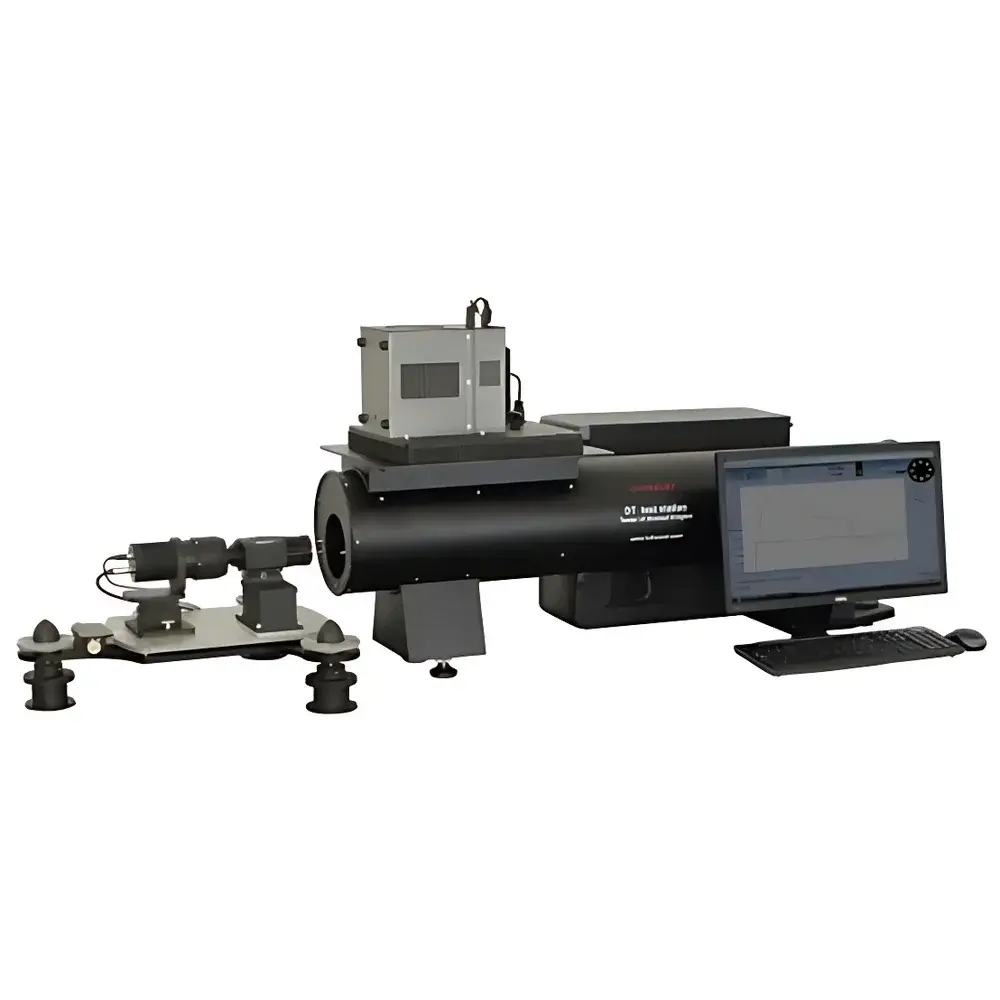
Inframet TAIM Thermal Sight and Thermal Imager Clamp Test System
| Brand | Inframet |
|---|---|
| Origin | Poland |
| Model | TAIM |
| Application | Optical performance evaluation of thermal weapon sights and thermal imager clamps |
| Core Modules | DT120 test platform (image projection & analysis), Picatinny rail fixture, dual HEC high-resolution infrared cameras, AHEC adapter ring, YNAS10 angular adjustment stage, DPM diopter meter, AT720 optical bench |
| Max Tested Device Aperture | ≤120 mm |
| Measurement Capabilities | MRTD (Minimum Resolvable Temperature Difference), diopter adjustment range & scale accuracy, eyepiece diopter calibration, focus-induced image shift (optional) |
| Compliance | Designed for ISO 12233-based spatial resolution protocols and ASTM E1213-22 for thermal imaging system characterization |
Overview
The Inframet TAIM Thermal Sight and Thermal Imager Clamp Test System is a purpose-built metrology platform engineered for the quantitative optical and electro-optical characterization of thermal weapon sights and thermal imager mounting clamps. Unlike general-purpose optical test benches, the TAIM integrates a modified DT120 base architecture with specialized mechanical, optical, and software modules to address the unique alignment, collimation, and performance validation requirements of military-grade thermal aiming systems. Its core measurement principle relies on controlled infrared scene projection via calibrated blackbody sources and high-fidelity image capture using synchronized HEC (High-Efficiency Cooled) infrared cameras—enabling traceable, repeatable evaluation of critical parameters including Minimum Resolvable Temperature Difference (MRTD), diopter scale linearity, focus-induced reticle displacement, and angular field-of-view consistency across variable focus distances. The system operates under laboratory-controlled ambient conditions and supports both direct electronic output analysis (via analog/digital video interfaces) and display-captured image evaluation (e.g., from OLED/LCD viewfinders), ensuring compatibility with legacy and modern thermal sight architectures.
Key Features
- Modular DT120 foundation with integrated image projection and real-time analysis engine
- Picatinny rail fixture compliant with MIL-STD-1913 specifications for secure, repeatable mounting of thermal sights and clamp assemblies
- Dual synchronized HEC infrared cameras (3–5 µm or 8–12 µm spectral bands, configurable) for stereo imaging, parallax correction, and multi-angle MRTD assessment
- AHEC precision adapter ring ensuring sub-arcminute camera positioning repeatability relative to the optical axis
- YNAS10 motorized angular stage enabling ±15° pitch/yaw adjustment with 0.01° resolution for off-axis performance mapping
- DPM diopter meter with ±20 D range and ±0.125 D resolution, traceable to NIST-calibrated reference standards
- AT720 vibration-isolated optical platform (600 × 900 mm surface, 0.5 µm flatness) supporting full-system integration and long-term stability
- Optional DICAN distance calibration module for automated focal plane verification at discrete ranges (1 m to ∞)
Sample Compatibility & Compliance
The TAIM system accommodates thermal sights and clamps with maximum objective apertures up to 120 mm and physical envelope dimensions within 300 × 150 × 150 mm (L×W×H). It supports devices utilizing uncooled microbolometer (VOx, a-Si), cooled MCT, or Type-II superlattice detector technologies. All measurement procedures align with internationally recognized standards: MRTD testing follows ASTM E1213-22 and ISO/IEC 17025-accredited methodologies; diopter calibration adheres to ISO 8597:2017 (Ophthalmic optics — Spectacle lenses); and optical axis stability assessments conform to MIL-STD-810H environmental test protocols when used in conjunction with climate-controlled enclosures. The system’s hardware and firmware are designed for GLP-compliant operation, supporting audit-ready metadata logging—including operator ID, timestamp, environmental sensor readings (temperature, humidity), and instrument calibration status.
Software & Data Management
The TAIM operates under Inframet’s proprietary OptiTest Suite v4.2, a Windows-based application developed for deterministic real-time image acquisition, geometric distortion correction, and standardized metric computation. The software implements FDA 21 CFR Part 11-compliant user access control (role-based permissions), electronic signature workflows, and immutable audit trails for all test sessions. Raw image data (16-bit TIFF, IEEE 1394 or GigE Vision format), processed metrics, and configuration files are stored in an encrypted SQLite database with optional synchronization to enterprise NAS or LIMS platforms via HTTPS REST API. Optional add-on modules include DICAN Distance Analysis Toolkit (for focus shift quantification) and MRTD Auto-Thresholding Engine (reducing inter-operator variability by ≥35% per ISO/IEC 17025 inter-laboratory study data).
Applications
- Pre-shipment verification of thermal sight collimation and zero retention after recoil simulation
- Development-stage validation of clamp-induced optical decentering or tilt in multi-sensor fusion systems
- Periodic metrological recalibration of field-deployed thermal weapon sights in depot-level maintenance facilities
- Comparative analysis of MRTD degradation across temperature extremes (−40 °C to +70 °C) per MIL-STD-810H Method 501.7
- Verification of diopter scale fidelity for ergonomic adaptation in variable-visibility combat environments
- Support for NATO AEP-77 compliance reporting for thermal imaging subsystems in armored vehicle integration programs
FAQ
What is the maximum aperture size supported by the TAIM system?
The TAIM accommodates thermal sights and clamps with objective apertures up to 120 mm in diameter.
Does the system support both cooled and uncooled thermal imagers?
Yes—dual-band HEC camera options (3–5 µm and 8–12 µm) ensure compatibility with MCT, InSb, VOx, and a-Si detector technologies.
Can MRTD measurements be performed without external blackbody sources?
No—MRTD evaluation requires a calibrated, temperature-stabilized infrared target projector; the DT120 module includes an integrated blackbody source with ±0.1 °C stability.
Is the software validated for regulated environments (e.g., defense contractors)?
Yes—OptiTest Suite v4.2 includes 21 CFR Part 11 compliance packages, IQ/OQ documentation templates, and change control logs meeting DoD 5000.87 and EN 9100 requirements.
What level of angular resolution does the YNAS10 stage provide?
The YNAS10 stage delivers 0.01° incremental positioning resolution and <0.005° repeatability over its ±15° range.






