
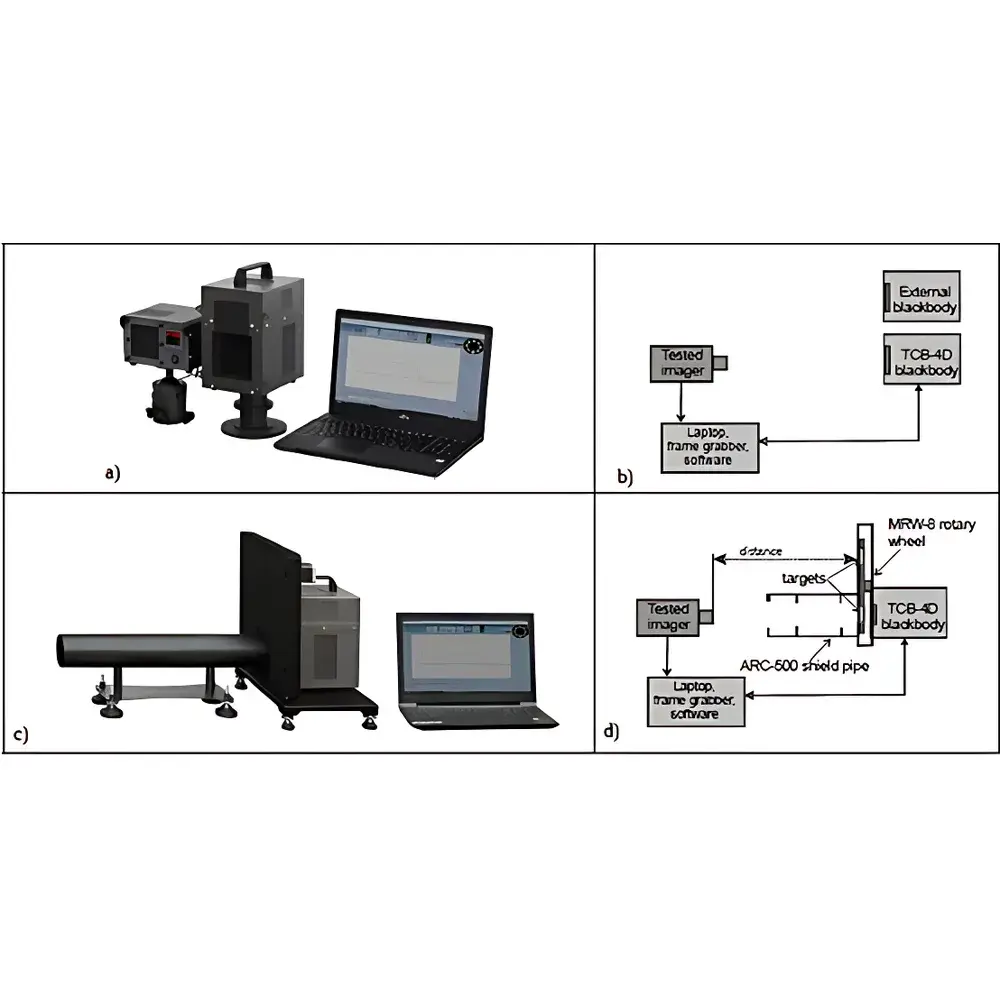
Inframet TFEV Thermal Imaging Camera Test System
| Brand | Inframet |
|---|---|
| Origin | Poland |
| Model | TFEV |
| Type | Modular Blackbody-Based Calibration and Performance Verification System for Fever-Screening Thermal Cameras |
| Compliance | IEC 60601-2-59 (Ed. 2.0, 2017) |
| Primary Function | Quantitative verification of thermal sensitivity, spatial resolution (MRTD), minimum resolvable temperature difference, target size response, and measurement repeatability of infrared fever-screening systems |
Overview
The Inframet TFEV Thermal Imaging Camera Test System is an engineered metrology platform designed for objective, repeatable, and standards-compliant performance evaluation of infrared thermal imaging systems used in human fever screening applications. It operates on the foundational principles of radiometric traceability and geometric simulation defined in IEC 60601-2-59:2017 — the international standard specifying essential safety and performance requirements for clinical thermographic equipment intended for mass fever detection. Unlike generic blackbody sources, the TFEV integrates a high-stability, high-emissivity (ε ≥ 0.998) planar blackbody (TCB-4D) with a motorized, programmable image projection subsystem to replicate both thermal contrast and spatial stimulus conditions encountered during real-world deployment. The system enables full characterization of critical parameters including thermal sensitivity (NETD), minimum resolvable temperature difference (MRTD), spatial resolution limits, target size response curves, and measurement reproducibility across varying ambient conditions and camera configurations.
Key Features
- Modular architecture supporting dual operational modes: precision blackbody calibration mode and dynamic image projection mode
- TCB-4D ultra-stable planar blackbody with active temperature control (range: 20 °C to 45 °C, stability ±0.02 °C over 30 min), uniformity <0.05 K across 100 × 100 mm aperture
- MRW-8 motorized target wheel with dual-target sets: six square apertures (for minimum detectable target size assessment) and six four-bar patterns (for MRTD evaluation per ISO 12233 and MIL-STD-1472D methodologies)
- Integrated infrared-compatible optical path: shielded tube assembly, calibrated IR target plates, and configurable field-of-view alignment fixtures
- Hardware-agnostic image acquisition: PCIe or USB3 vision frame grabber compatible with major industrial and medical thermal camera interfaces (e.g., FLIR Boson, Seek Thermal, Xenics, Axis Communications)
- TCB Control Software and TAM (Thermal Analysis Module) software suite providing automated test sequencing, data logging, statistical reporting, and compliance documentation export
Sample Compatibility & Compliance
The TFEV system is explicitly validated for use with uncooled microbolometer-based thermal cameras operating in the 7–14 µm spectral band, including fixed-mount screening stations, handheld devices, and tripod-mounted systems deployed in airports, hospitals, and border checkpoints. All hardware modules meet CE marking requirements and are constructed from non-outgassing, low-thermal-drift materials suitable for laboratory-grade metrology environments. Test procedures implemented within the TAM software align with clause 201.12.4.102 (Thermal sensitivity verification), 201.12.4.103 (Spatial resolution verification), and Annex BB (Test setup for fever-screening devices) of IEC 60601-2-59:2017. Optional audit trail and electronic signature functionality supports GLP/GMP-aligned validation protocols under FDA 21 CFR Part 11 when configured with network-licensed software and domain-authenticated user roles.
Software & Data Management
The TFEV includes two dedicated software components: TCB Control (real-time blackbody temperature setpoint management, ramp profiling, and thermal stability monitoring) and TAM (Thermal Analysis Module), a Windows-based application enabling fully automated test execution. TAM supports customizable test templates, multi-camera batch processing, automatic pass/fail classification against user-defined thresholds, and generation of PDF reports compliant with ISO/IEC 17025 documentation requirements. Raw thermal image sequences, metadata logs (timestamp, ambient temperature/humidity, blackbody setpoint, target ID), and statistical summaries (mean, SD, CV%) are stored in vendor-neutral HDF5 format for third-party analysis. Export options include CSV, Excel, and XML for integration into LIMS or enterprise quality management systems.
Applications
- Pre-deployment verification of thermal screening systems prior to regulatory submission or site commissioning
- Routine performance monitoring of installed fever-screening infrastructure in accordance with IEC 60601-2-59 maintenance clauses
- Inter-laboratory comparison studies supporting accreditation under ISO/IEC 17025
- Development and validation of AI-based temperature estimation algorithms requiring ground-truth thermal reference data
- Technical training and operator competency assessment for clinical engineering and biomedical equipment technicians
FAQ
Does the TFEV system require external calibration certificates?
Yes — the TCB-4D blackbody is supplied with a UKAS-accredited calibration certificate (traceable to PTB) valid for 12 months; annual recalibration is recommended.
Can the TFEV be used for non-medical thermal cameras?
While optimized for IEC 60601-2-59 compliance, its core blackbody and target projection capabilities support general-purpose thermal imager characterization, including NETD and MRTD testing per ASTM E1933 and ISO 18434-1.
Is remote operation supported?
Yes — TAM software supports LAN-based remote control and monitoring via secure RDP or VNC, with role-based access controls for multi-user environments.
What camera interfaces are natively supported?
Standard configurations include GenICam-compliant USB3 and GigE Vision interfaces; custom drivers can be developed for proprietary SDKs upon request.
How long does a full compliance test sequence take?
A complete IEC 60601-2-59 verification cycle (including blackbody stabilization, five target sizes, three temperature differentials, and statistical analysis) typically requires 45–60 minutes per camera unit.





