
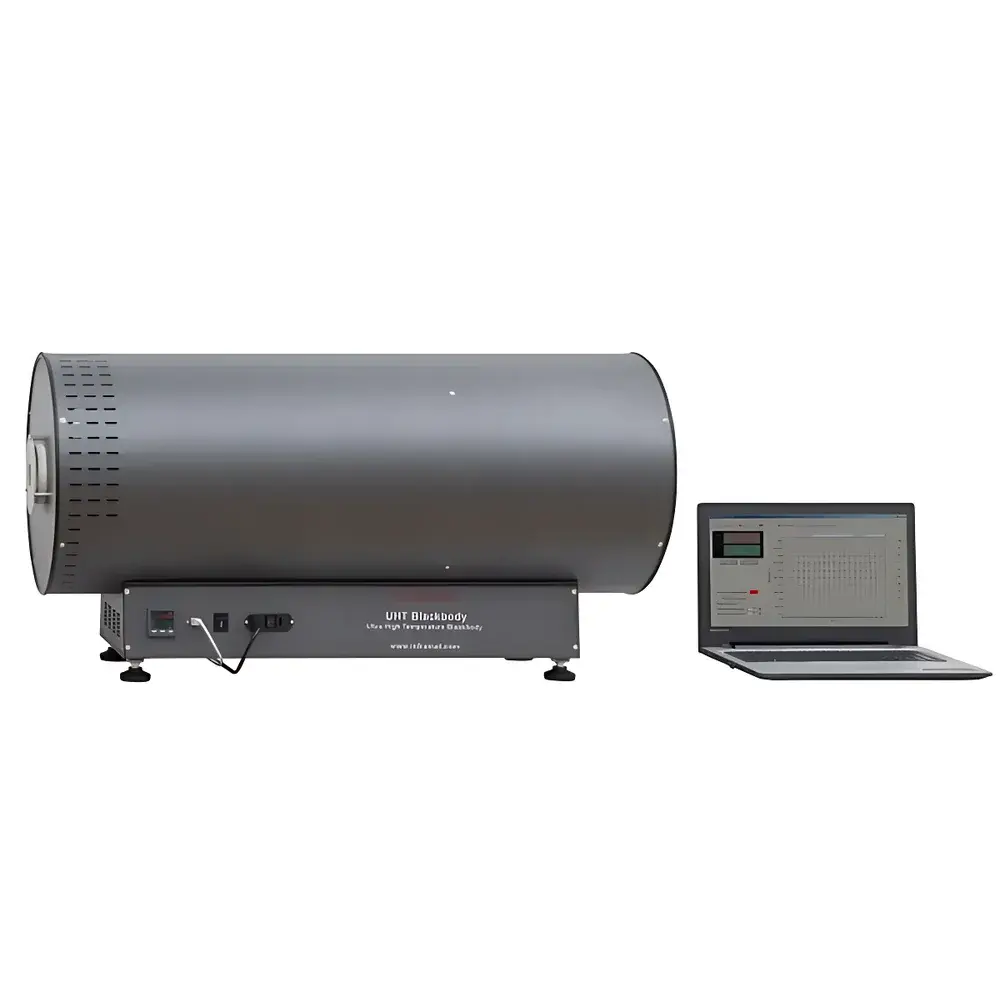
Inframet UHT-25D-1500 High-Temperature Blackbody Calibration Source
| Brand | Inframet |
|---|---|
| Origin | Poland |
| Model | UHT-25D-1500 |
| Temperature Range | 200–1500 °C (short-term up to 1550 °C) |
| Aperture Diameter | 25 mm |
| Emissivity | >0.99 (0.2–100+ µm) |
| Temperature Resolution | 0.1 °C (<1000 °C), 1 °C (>1000 °C) |
| Temperature Uncertainty | ±(0.15 °C + 1 °C) |
| Short-term Stability | ±1 °C |
| Long-term Stability | ±2 °C |
| Uniformity at 800 °C | ±1.5 °C |
| Warm-up Time to 1500 °C | <2.5 h |
| Control Interface | RS-232 |
| Power Supply | 230 V AC |
| Dimensions (L×W×H) | 109×39×47 cm |
| Weight | ~67 kg |
Overview
The Inframet UHT-25D-1500 is a high-precision, high-temperature blackbody calibration source engineered for radiometric and photometric system validation across ultraviolet (UV), visible (VIS), near-infrared (NIR), mid-infrared (MIR), far-infrared (FIR), and terahertz (THz) spectral bands. Operating on the principle of Planckian radiation, it generates spectrally stable, spatially uniform thermal emission traceable to international temperature scales (ITS-90). Its cavity-based design—featuring a precisely machined, high-emissivity graphite or ceramic-coated aperture—ensures an effective emissivity exceeding 0.99 from 0.2 µm to beyond 100 µm. This broadband performance enables its use as a primary reference standard in national metrology institutes, aerospace sensor calibration labs, and infrared camera validation facilities where spectral fidelity and thermal reproducibility are critical.
Key Features
- Extended operational temperature range: 200–1500 °C continuously, with short-term capability up to 1550 °C for transient calibration protocols.
- Optimized cavity geometry with 25 mm aperture diameter, balancing radiant flux output and spatial uniformity requirements for collimator-based and imaging radiometer setups.
- High-accuracy temperature control system with dual-stage feedback: platinum resistance thermometer (PRT) sensing combined with PID-regulated heating elements ensures resolution of 0.1 °C below 1000 °C and 1 °C above.
- Thermal uniformity of ±1.5 °C across the aperture plane at 800 °C—validated per ISO/IEC 17025-compliant procedures—supports rigorous MTF and NEDT testing of thermal imagers.
- RS-232 serial interface enables integration into automated calibration workflows; compatible with LabVIEW, Python (PySerial), and MATLAB-based control scripts.
- Robust mechanical architecture: stainless-steel housing with multi-layer insulation minimizes ambient thermal drift and supports long-term stability of ±2 °C over 8-hour operation cycles.
Sample Compatibility & Compliance
The UHT-25D-1500 is designed for calibration of radiation thermometers, FTIR spectroradiometers, hyperspectral imagers, and bolometric THz detectors. It complies with key international standards including ASTM E2758 (Standard Practice for Calibration of Blackbody Sources), ISO 18434-1 (Condition monitoring — Thermography — Part 1: General principles), and supports traceability to NIST and PTB reference scales. While not intrinsically certified for GMP or FDA 21 CFR Part 11 environments, its deterministic temperature logging (via RS-232 timestamped data packets) permits implementation of audit-ready calibration records when paired with validated software platforms. The unit meets CE marking requirements for electromagnetic compatibility (EN 61326-1) and low-voltage safety (EN 61010-1).
Software & Data Management
No proprietary software is bundled; however, Inframet provides documented ASCII command protocols for bidirectional communication (e.g., “TEMP?”, “SET 1200.0”, “EMIT?”). Users may implement custom data acquisition using open-source frameworks compliant with IEEE 1588 PTP for time-synchronized multi-instrument calibration. Temperature logs can be exported in CSV format with millisecond timestamps, supporting GLP-aligned record retention. Optional third-party integrations include Keysight PathWave, National Instruments TestStand, and MET/CAL® for fully auditable calibration certificate generation—including uncertainty budgets per GUM (JCGM 100:2008).
Applications
- Calibration of spaceborne IR sensors (e.g., VIIRS, MODIS heritage instruments) requiring high-temperature, broadband reference sources.
- Validation of industrial pyrometers used in metallurgical process control (e.g., steel annealing, silicon crystal growth).
- NEDT (Noise-Equivalent Differential Temperature) measurement of cooled and uncooled microbolometer arrays.
- Spectral responsivity characterization of UV-VIS-NIR spectroradiometers against Planckian distribution curves.
- Development and verification of radiative transfer models in atmospheric science and combustion diagnostics.
- Reference source for ISO 12233 slanted-edge MTF testing of thermal imaging systems under elevated background temperatures.
FAQ
What is the maximum recommended continuous operating temperature?
The rated continuous range is 500–1500 °C; operation above 1500 °C is limited to ≤15 minutes to preserve heater longevity and cavity emissivity stability.
Is the aperture temperature uniformity verified across the full spectral band?
Uniformity is characterized at discrete wavelengths (0.65 µm, 3.9 µm, 10.6 µm) using calibrated scanning radiometers; spatial non-uniformity remains within ±1.5 °C at all tested bands between 0.2–100 µm.
Can the UHT-25D-1500 be integrated into a Class 100 cleanroom environment?
Yes—the unit emits no outgassing contaminants, has no internal lubricants, and features sealed electronics; optional nitrogen purge ports are available upon request.
Does the system support external temperature reference input for real-time correction?
No; temperature is internally referenced via calibrated PRTs. However, users may feed external thermocouple readings into their host software for comparative analysis.
What maintenance intervals are recommended for long-term accuracy?
Annual recalibration of the internal PRT sensor against a NIST-traceable standard is advised; visual inspection of the aperture cavity for oxidation or deposition should occur every 200 operational hours.





