
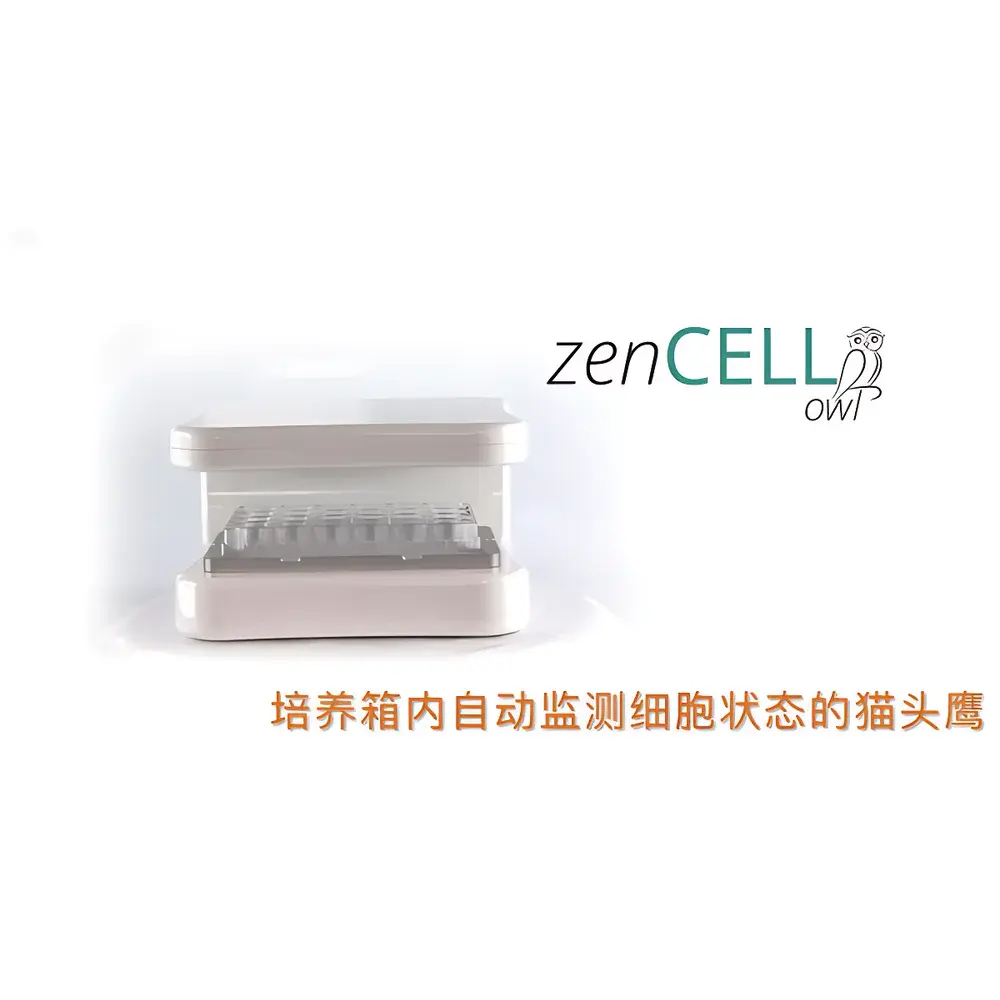
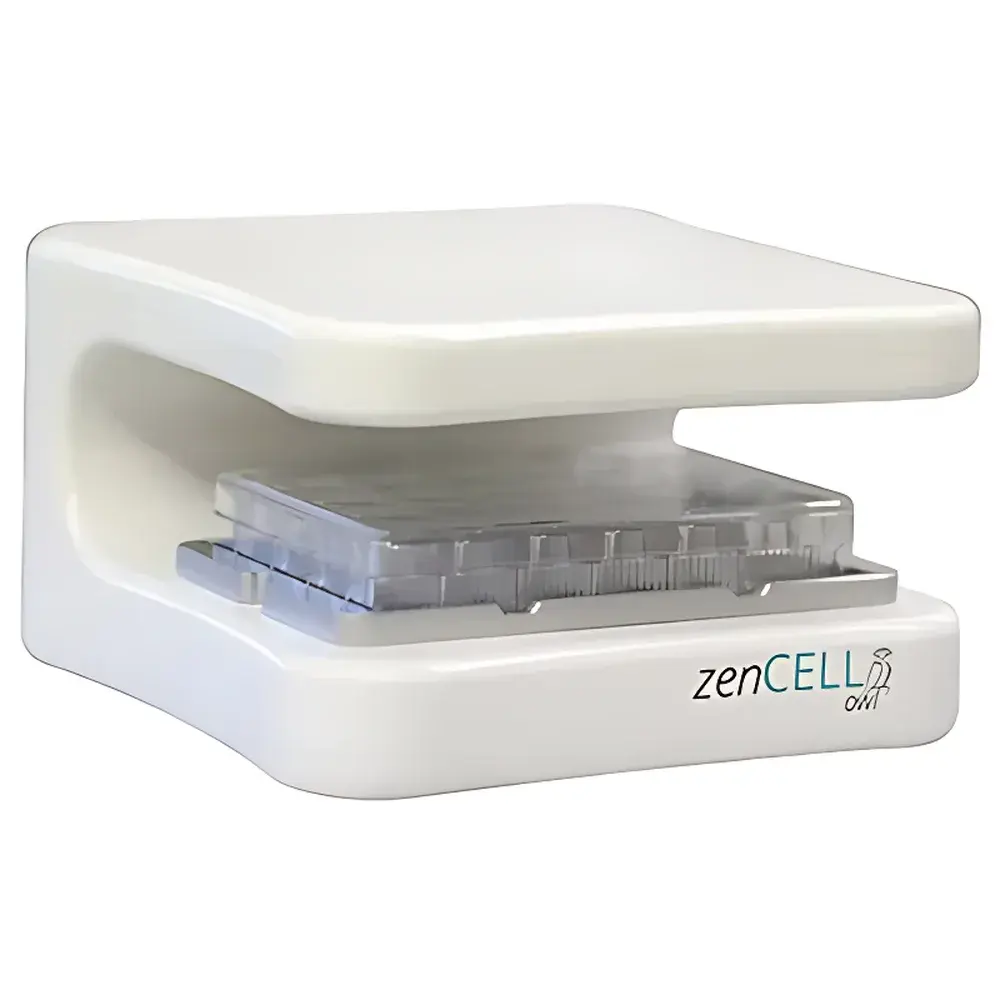
Innome zenCell owl High-Content Live-Cell Imaging and Analysis System
| Brand | Innome |
|---|---|
| Origin | Germany |
| Model | zenCell owl |
| Temperature Control | 37°C |
| Humidity Control | 20–80% RH |
| Dimensions (W×H×D) | 18 × 10.5 × 18 cm |
| Imaging Throughput | 24 independent CMOS modules |
| Acquisition Interval | 5 min – 24 h |
| Maximum Duration | Unlimited |
| Interface | USB 3.0 (power + data) |
| Environmental Tolerance | 20–45°C operating temperature, 20–95% RH |
| Imaging Modes | Brightfield & Phase Contrast |
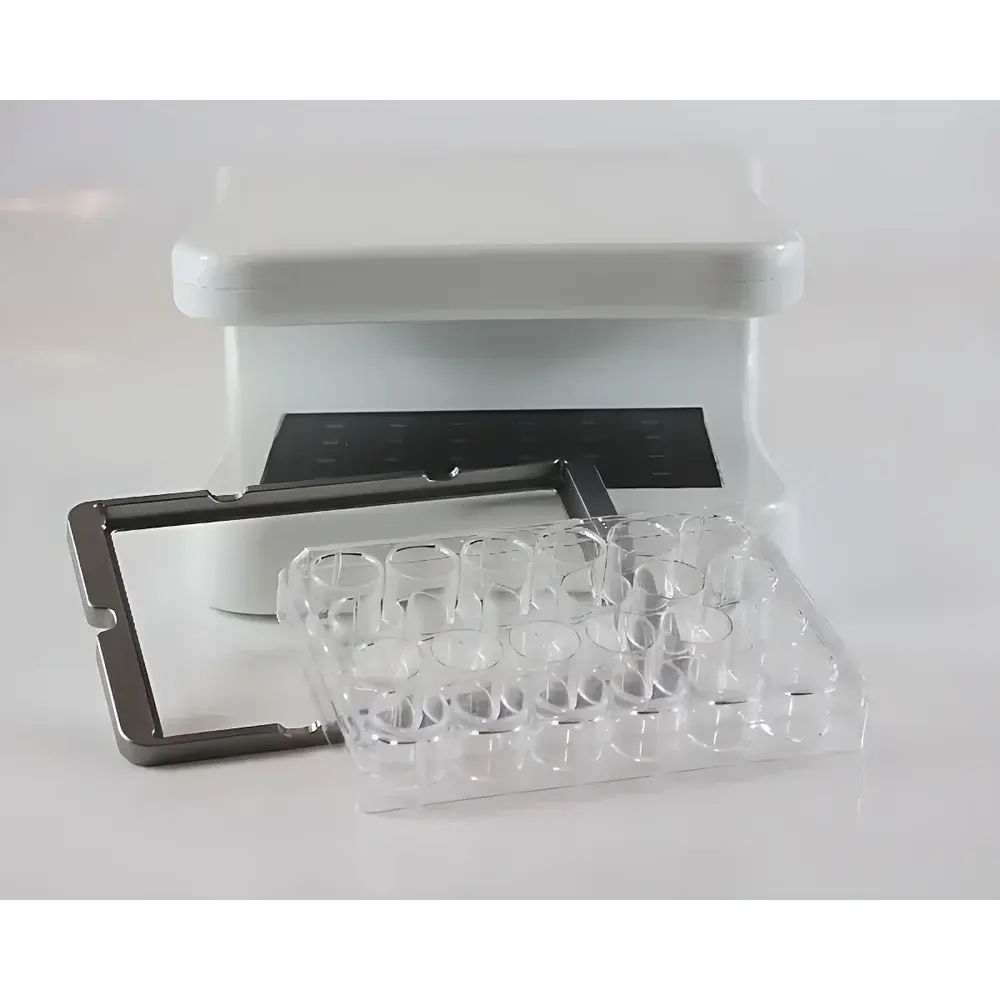
| Compatibility | Standard multiwell plates (6–96-well), Petri dishes, flasks, custom cultureware |
Overview
The Innome zenCell owl is a compact, in-incubator high-content live-cell imaging and analysis system engineered for longitudinal, label-free, non-invasive monitoring of adherent and suspension cell cultures under physiologically relevant conditions. Unlike conventional inverted microscopes requiring sample removal from the incubator, the zenCell owl integrates directly into standard CO₂ incubators—eliminating thermal, pH, and humidity perturbations during acquisition. Its core architecture employs 24 parallel, individually addressable CMOS-based imaging modules, each optically isolated and calibrated for consistent magnification (fixed 10× objective equivalent), depth of field, and illumination uniformity. Each module captures synchronized brightfield and phase contrast images at user-defined intervals—from every 5 minutes to once per day—enabling quantitative tracking of morphological dynamics, confluence progression, migration kinetics, and colony formation over days or weeks. The system operates on a closed-loop, solid-state design with no moving parts, ensuring mechanical stability, minimal vibration-induced artifacts, and zero maintenance requirements inside the humid, CO₂-rich incubator environment.
Key Features
- Compact footprint (18 × 10.5 × 18 cm) enables placement on any incubator shelf—compatible with Thermo Fisher, Eppendorf, Binder, Panasonic, and domestic Chinese incubators (e.g., Yuejin, Hengxing).
- 24 independent imaging channels: Simultaneous acquisition across all wells of 24-well plates—or configurable subsets of 6-, 12-, 48-, or 96-well formats—without cross-talk or optical crosstalk.
- USB 3.0 single-cable operation: Delivers power, real-time image streaming, and bidirectional control—no external power supply, Ethernet switch, or internal battery required.
- Robust environmental resilience: Certified for continuous operation at 20–45°C and 20–95% relative humidity—fully compatible with hypoxic chambers (5% O₂) and GMP-compliant cleanroom incubators.
- Label-free multimodal imaging: Dual-channel brightfield and phase contrast capture supports unstained cell visualization, eliminating phototoxicity and enabling repeated measurements on the same population.
- Automated metadata embedding: Timestamp, well ID, incubator temperature/humidity (via optional sensor integration), focus status, and exposure parameters are embedded in every TIFF/OME-TIFF file.
Sample Compatibility & Compliance
The zenCell owl accommodates standard sterile cell culture consumables without modification—including flat-bottom and U-bottom multiwell plates (Corning, Greiner, Sarstedt), Petri dishes (35–150 mm), T-flasks (T25–T225), and roller bottles. Its fixed working distance (≥1.2 mm) ensures compatibility with bottom-clear polystyrene, glass-bottom, and hydrogel-coated substrates. All hardware materials comply with ISO 10993-5 (cytotoxicity) and EU Directive 2011/65/EU (RoHS). Image acquisition workflows support ALP (Analytical Laboratory Practice) and GLP-aligned documentation: audit trails, user access logs, and electronic signatures are enforced via the zenControl software suite, meeting FDA 21 CFR Part 11 readiness requirements for regulated bioprocessing and preclinical assay development.
Software & Data Management
zenControl software (Windows 10/11, 64-bit) provides centralized orchestration of one or multiple zenCell owl units from a single workstation. It features a modular GUI with dedicated panels for experiment scheduling, real-time thumbnail monitoring, batch image export (TIFF, PNG, MP4), and integrated quantitative analysis. Built-in algorithms compute confluence (% area coverage), proliferation rate (doubling time), wound closure velocity (scratch assay), and motility metrics (mean squared displacement, persistence length) without third-party plugins. Raw data is stored in structured OME-TIFF format compliant with Bio-Formats and QuPath import standards. Export options include CSV time-series matrices, annotated PDF reports, and FAIR-compliant metadata (MIAME/MINSEQE extensions). Data integrity is ensured through SHA-256 checksums and optional network-attached storage (NAS) synchronization with versioned backups.
Applications
- Stem cell reprogramming kinetics: Quantify morphological transitions during iPSC induction or MSC differentiation under normoxic/hypoxic conditions.
- Long-term cytotoxicity screening: Monitor dose-dependent changes in confluence, granularity, and detachment in 96-well format over 120+ hours.
- 3D spheroid growth and invasion: Track size, circularity, and boundary irregularity in Matrigel-embedded assays using phase contrast Z-stacks (via optional motorized stage add-on).
- GMP process monitoring: Document passage consistency, contamination onset, and batch-to-batch variability in therapeutic cell manufacturing.
- Drug mechanism-of-action studies: Correlate real-time morphological phenotypes (blebbing, vacuolization, neurite outgrowth) with compound concentration and exposure duration.
FAQ
Can the zenCell owl be used inside a hypoxic incubator (e.g., 1% O₂)?
Yes—the system’s electronics and optics are rated for inert-gas environments; no performance degradation occurs below 5% O₂.
Is autofocus supported?
No—focus is manually set during installation using the included calibration slide; the fixed-focus design ensures long-term stability without drift.
Does it support fluorescence imaging?
Not natively; the current configuration is optimized for transmitted-light modalities only. Fluorescence capability is available in the zenCell owl FL variant (separate model).
How is data security managed in multi-user labs?
Each user account enforces role-based permissions (view-only, acquisition, analysis, admin); all actions are logged with timestamps and IP addresses.
What is the maximum number of zenCell owl units controllable from one PC?
Up to eight units via USB 3.0 hub (with individual 5 Gbps bandwidth allocation) or Ethernet bridge (optional).




