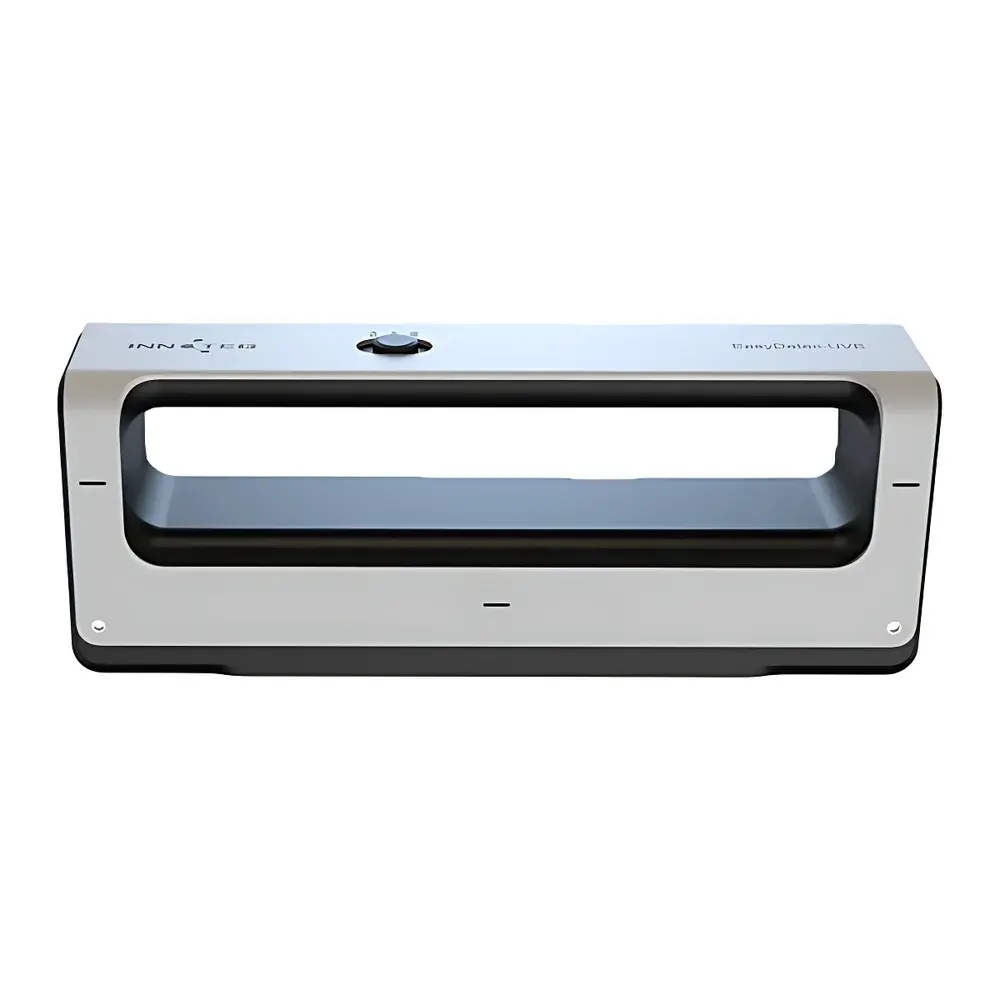
INNOTEG EasyDetec-UVE Portable Dual-Wavelength UV Transilluminator
| Brand | INNOTEG |
|---|---|
| Origin | Guangdong, China |
| Manufacturer Type | Authorized Distributor |
| Regional Classification | Domestic (China) |
| Model | EasyDetec-UVE |
| Instrument Type | Portable (Handheld) |
| Wavelength Options | 254 nm and 365 nm |
| Power Consumption | 6 W |
| Light Source | High-Efficiency UV LED |
| Rated Lifetime | ≥10,000 hours |
| Viewing Area Compatibility | 2.5 × 5 cm to 20 × 20 cm TLC plates or silica gel sheets |
| Battery | Rechargeable Li-ion (5000 mAh) |
| Filter Dimensions | Enlarged optical-grade UV-blocking filter for uniform illumination across full viewing area |
Overview
The INNOTEG EasyDetec-UVE is a compact, battery-powered dual-wavelength UV transilluminator engineered for rapid, field-deployable visualization of UV-active compounds on thin-layer chromatography (TLC) plates and preparative silica gel sheets. Unlike traditional benchtop UV cabinets requiring AC power and fixed installation, the EasyDetec-UVE employs solid-state UV-LED technology operating at two standardized excitation wavelengths—254 nm (optimal for aromatic ring detection, nucleic acid visualization, and quenching-based assays) and 365 nm (ideal for low-autofluorescence observation, safer long-duration inspection, and fluorescent dye compatibility such as ethidium bromide alternatives). Its optical architecture integrates collimated LED arrays with precision-ground, high-transmission UV-blocking filters to ensure uniform irradiance distribution across the entire viewing surface (up to 20 × 20 cm), minimizing hotspots and enabling quantitative comparative analysis under consistent illumination conditions.
Key Features
- Battery-operated mobility: Integrated 5000 mAh rechargeable lithium-ion battery supports continuous operation for >4 hours at full intensity—enabling use in fume hoods, biosafety cabinets, teaching labs, field stations, or mobile diagnostic units without AC dependency.
- Dual-wavelength flexibility: Instant switchable 254 nm / 365 nm modes via tactile button interface; no lamp replacement or mechanical filter wheel required.
- Magnetic mounting system: Rare-earth neodymium magnets embedded in the housing allow secure, tool-free attachment to stainless-steel fume hood surfaces or metal lab benches—eliminating handheld fatigue and improving ergonomic stability during prolonged observation or gel documentation.
- Optimized optical design: Enlarged 20 × 20 cm viewing window with edge-diffused UV-LED array ensures homogeneous illumination intensity (±8% deviation across active area per ISO 9241-307 visual ergonomics guidelines) and eliminates shadowing artifacts common in smaller transilluminators.
- UV safety compliance: Equipped with automatic shutter lock when lid is open (mechanical interlock) and certified UV-blocking acrylic shield (OD ≥ 4.0 at 254 nm per ANSI Z87.1-2020), meeting institutional biosafety requirements for Class I UV exposure control.
Sample Compatibility & Compliance
The EasyDetec-UVE accommodates standard analytical and preparative formats including 2.5 × 5 cm micro-TLC plates, 5 × 10 cm analytical plates, 10 × 10 cm preparative plates, and full-size 20 × 20 cm silica gel sheets. It is compatible with common UV-active compounds (e.g., aromatic hydrocarbons, coumarins, flavonoids), nucleic acid stains (SYBR Safe, GelRed, GelGreen), and protein visualization reagents (e.g., UV-absorbing tags). The device complies with IEC 61010-1:2010 for electrical safety and IEC 62471:2006 for photobiological safety (Risk Group 2 for 365 nm; Risk Group 3 for 254 nm—requiring appropriate PPE per institutional UV safety policy). It supports GLP-aligned documentation workflows when paired with external imaging systems.
Software & Data Management
While the EasyDetec-UVE operates as a standalone hardware unit without embedded firmware or onboard storage, its consistent illumination output and stable spectral profile make it fully interoperable with third-party digital documentation platforms—including smartphone-based gel capture apps (e.g., ImageJ-compatible mobile capture tools), USB-connected CCD cameras, and commercial gel documentation systems. Illumination repeatability (CV < 3.2% over 100 consecutive 30-second exposures) enables semi-quantitative densitometric comparison across timepoints or users. For regulated environments, integration with validated image acquisition software (e.g., AlphaView SA, Bio-Rad Image Lab) satisfies FDA 21 CFR Part 11 audit trail requirements when used in conjunction with appropriate system validation protocols.
Applications
- Routine TLC monitoring in synthetic organic chemistry laboratories for reaction progress assessment and intermediate purification verification.
- Teaching laboratory instruction in undergraduate biochemistry and analytical chemistry courses—supporting hands-on visualization of amino acid separation, pesticide residue screening, or natural product isolation.
- Field-deployable quality control in pharmaceutical manufacturing support labs where portable verification of excipient purity or degradation product identification is required.
- Preparative gel slicing under controlled UV exposure—magnetic fixation enables precise, vibration-free positioning during manual or motorized gel excision.
- Environmental testing labs performing PAH or PCB screening on silica-coated membranes using UV-induced fluorescence.
FAQ
Is the EasyDetec-UVE suitable for ethidium bromide-stained DNA gels?
Yes—it delivers sufficient irradiance at 302 nm equivalent (via 365 nm excitation of EtBr) for clear band visualization; however, for optimal sensitivity with low-concentration samples, we recommend supplemental long-exposure imaging with a cooled CCD camera.
Can the battery be replaced by the end user?
No—the sealed Li-ion module is non-user-replaceable per UN38.3 transport safety standards; battery service must be performed by authorized INNOTEG technical centers.
Does the device meet ISO/IEC 17025 calibration traceability requirements?
The unit does not include built-in radiometric calibration; however, optional NIST-traceable UV irradiance validation kits (model UV-CAL-254/365) are available for laboratory-performed periodic performance verification.
What is the recommended maintenance interval?
Visual inspection of filter integrity and magnet adhesion strength every 6 months; wipe-down of optical surfaces with lint-free cloth and 70% isopropanol after each use to prevent residue buildup.
Is UV leakage tested during manufacturing?
Yes—each unit undergoes 100% UV containment verification using calibrated spectroradiometry (Ocean Insight QE Pro) to confirm OD ≥ 4.0 at 254 nm across all accessible apertures, per EN 60598-1 Annex Q requirements.