
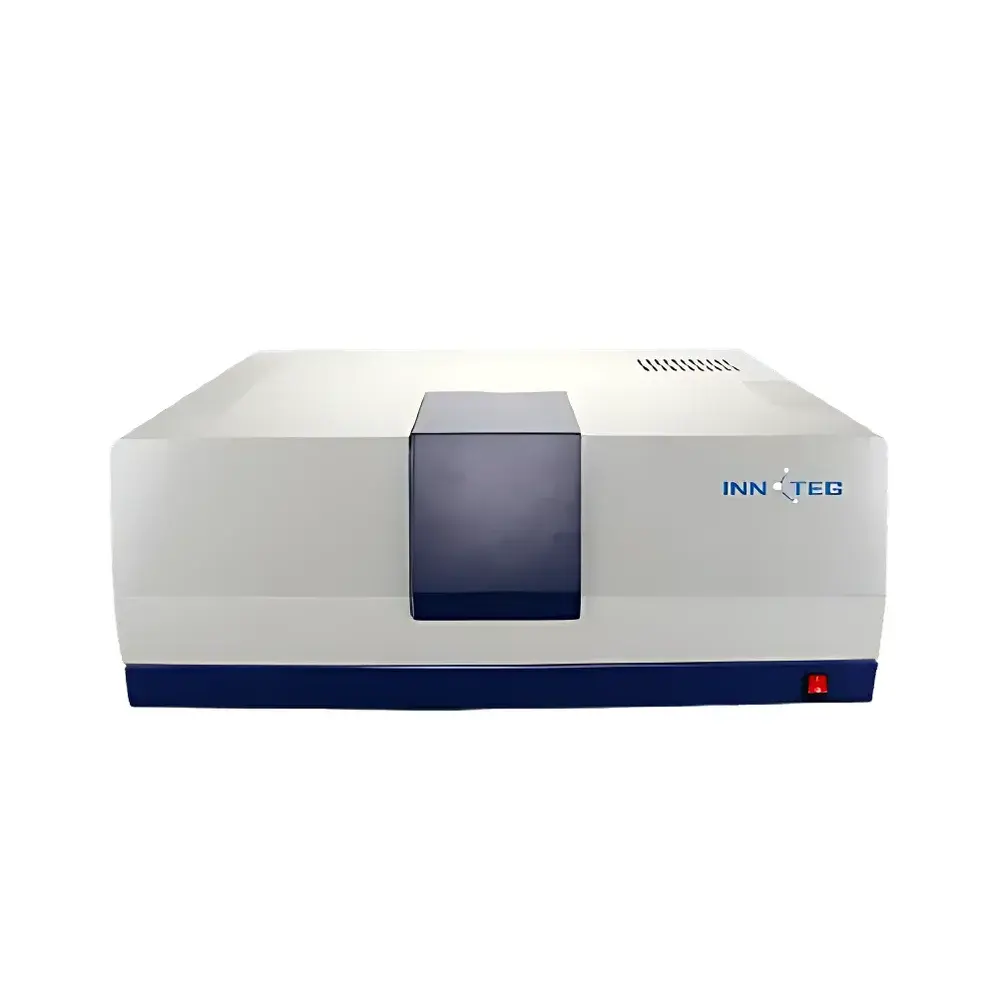
INNOTEG IUS-190 UV-Visible-Near Infrared Spectrophotometer
| Brand | INNOTEG |
|---|---|
| Origin | China |
| Manufacturer Type | Manufacturer |
| Model | IUS-190 |
| Spectral Range | 190–3200 nm |
| Bandwidth (UV-VIS) | 0.2, 0.5, 1, 2, 3, 5 nm |
| Bandwidth (NIR) | 0.8, 2, 4, 8, 12, 20 nm |
| Wavelength Accuracy | ±0.5 nm (UV/VIS), ±2.0 nm (NIR) |
| Wavelength Repeatability | ≤0.3 nm (UV/VIS), ≤1.0 nm (NIR) |
Overview
The INNOTEG IUS-190 UV-Visible-Near Infrared Spectrophotometer is a dual-beam, double-grating, dual-detector scanning spectrophotometer engineered for high-fidelity spectral characterization across an exceptionally broad range—from deep ultraviolet (190 nm) to extended near-infrared (3200 nm). It operates on the principle of dispersive absorption spectroscopy, utilizing precision optical path modulation and real-time reference beam compensation to deliver stable, low-drift photometric measurements. Designed for rigorous laboratory and industrial QA/QC environments, the IUS-190 supports quantitative and qualitative analysis of transmittance, absorbance, reflectance, and diffuse reflectance—enabling trace-level detection, film thickness estimation, and optical property mapping in compliance with international optical metrology standards.
Key Features
- Dual-beam optical architecture with independent UV-VIS and NIR optical paths, minimizing stray light and baseline drift during long-term scans.
- Double-grating monochromator system: holographic grating for UV-VIS (190–900 nm) and ruled grating for NIR (900–3200 nm), each optimized for resolution and throughput in its respective region.
- Co-located dual-detector configuration: back-thinned CCD for UV-VIS and extended-range InGaAs photodiode array for NIR, ensuring high signal-to-noise ratio (SNR) and sub-millidegree thermal stability.
- Variable slit-driven bandwidth selection: six discrete bandwidth options in UV-VIS (0.2–5 nm) and six in NIR (0.8–20 nm), programmable per scan segment to balance resolution and photometric sensitivity.
- Automated wavelength calibration using internal holmium oxide and neutral density reference standards; self-diagnostic startup routine verifies grating positioning, detector linearity, and lamp intensity stability.
- USB 2.0 high-speed interface enabling full-spectrum acquisition (190–3200 nm) in under 5 minutes with <10 ms dwell time per data point.
Sample Compatibility & Compliance
The IUS-190 accommodates solid, liquid, and semi-transparent thin-film samples via standardized 10-mm cuvette holders, integrating sphere accessories (for diffuse reflectance/transmittance), and custom sample stages for architectural glass and coated substrates. It meets the instrumental performance requirements specified in ISO 9050:2003 (glass optical properties), GB/T 2680–2021 (building glass energy parameters), GB/T 22476–2008 (coating spectral reflectance), and GB/T 36261–2018 (automotive glazing optical testing). Optional GMP-compliant software modules support 21 CFR Part 11 audit trails, electronic signatures, and user-access-controlled method locking for regulated environments.
Software & Data Management
The dedicated INNOTEG SpectraSuite software runs natively on Windows 7/10 (64-bit) and provides full instrument control, spectral acquisition, and post-processing. Key capabilities include: real-time overlay of up to eight spectra with dynamic baseline correction; batch processing with customizable pass/fail criteria; export to CSV, TXT, and native .SPC formats; import of third-party spectral data for comparative analysis; automated report generation with embedded metadata (date, operator ID, instrument serial number, calibration status). Industry-specific modules include Building Glass Solar Heat Gain Coefficient (SHGC) calculation per JGJ/T 151–2008, automotive glass luminous transmittance and haze evaluation, and pigment dispersion analysis for coating R&D.
Applications
- Architectural glazing: measurement of solar transmittance, UV blocking efficiency, and near-infrared rejection for low-emissivity (Low-E) and spectrally selective coatings.
- Optical materials R&D: characterization of antireflective films, interference filters, and transparent conductive oxides (TCOs) across full solar spectrum.
- Paint & coating formulation: quantification of pigment concentration, binder dispersion uniformity, and weathering-induced spectral shifts.
- Environmental monitoring: dissolved organic carbon (DOC) profiling via UV-Vis absorbance at 254 nm; turbidity-corrected NIR water quality indices.
- Academic spectroscopy: teaching labs requiring robust, wide-range instrumentation for molecular absorption, charge-transfer band analysis, and semiconductor bandgap determination.
FAQ
What wavelength calibration standards are supported by the IUS-190?
The instrument performs automatic calibration using built-in holmium oxide (Ho₂O₃) and didymium filters, traceable to NIST SRM 2034 and ISO 9050 reference materials.
Is the system compatible with GLP/GMP documentation workflows?
Yes—optional SpectraSuite-GxP edition includes electronic signature support, role-based access control, and immutable audit logs compliant with FDA 21 CFR Part 11 and EU Annex 11.
Can the IUS-190 measure diffuse reflectance of powders or rough surfaces?
With the optional 60-mm integrating sphere (model IS-60NIR), it achieves ASTM E1331-compliant diffuse reflectance measurements from 250 nm to 2500 nm.
What is the typical photometric accuracy and noise level?
At 1.0 nm bandwidth, UV-VIS photometric accuracy is ±0.002 A (0–0.5 A), with RMS noise <0.0003 A at 546 nm (1 s integration); NIR performance conforms to ISO 13406-2 for low-light stability.
Does the system support external triggering or synchronization with other lab equipment?
Yes—TTL-compatible trigger input/output ports enable synchronized acquisition with environmental chambers, motorized stages, or pulsed light sources.
Related Products




