
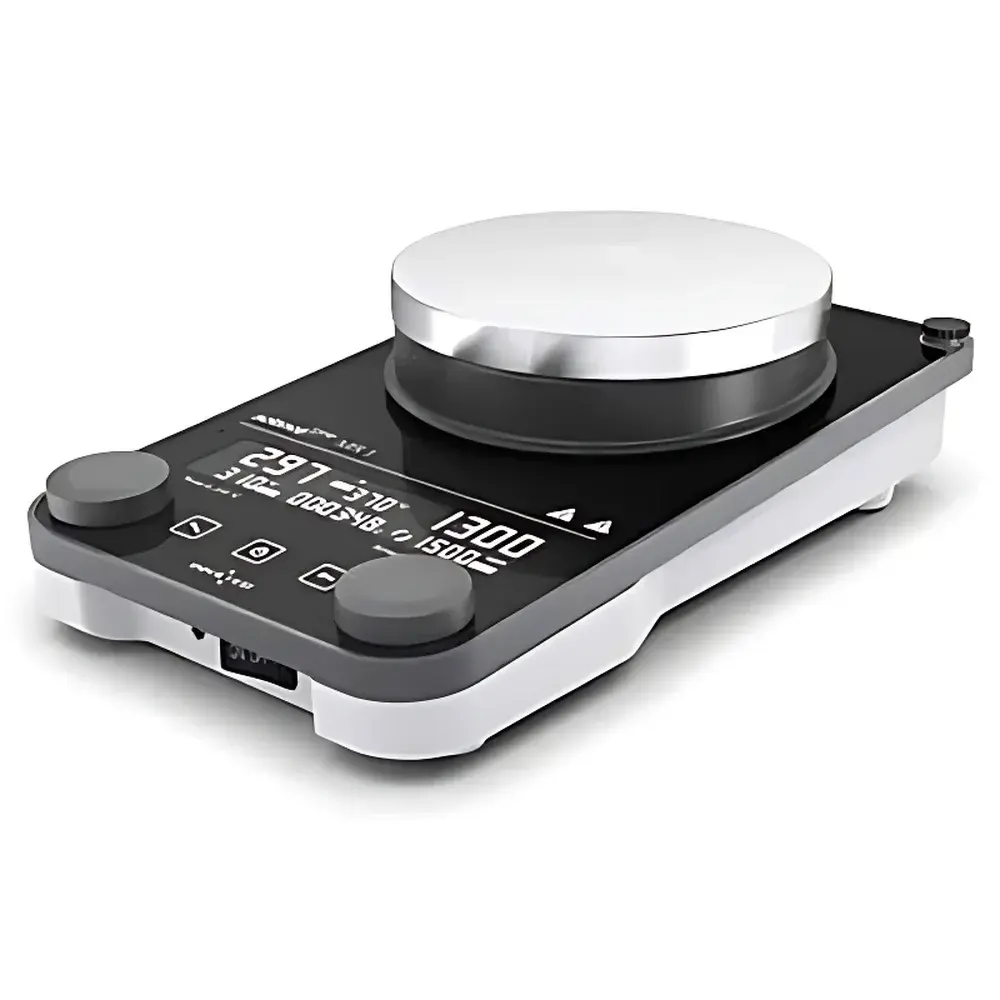
Innoteg MR1 Magnetic Stirrer
| Brand | Innoteg |
|---|---|
| Origin | Germany |
| Model | MR1 |
| Instrument Type | Magnetic Stirrer |
| Maximum Stirring Volume | 20 L |
| Speed Range | 50–1500 rpm |
| Heating Plate Temperature Range | Ambient to 310 °C |
| Heating Power | 600 W |
| Display | LCD (Digital Setpoint & Actual Value) |
| External Temperature Sensor Support | PT1000, ETS-D5, ETS-D6 |
| Adjustable Safety Temperature Limit | 50–370 °C |
| Safety Modes | 3 Configurable Profiles |
| Stirring Direction | Clockwise/Counterclockwise Selectable |
| Intermittent Operation Mode | Yes |
| Workplate Material | Anodized Aluminum with Ceramic-Coated Surface |
| Compliance | CE, RoHS, IEC 61010-1 |
Overview
The Innoteg MR1 Magnetic Stirrer is an engineered laboratory instrument designed for precise, reproducible mixing and temperature-controlled stirring of low-to-moderate viscosity liquids and heterogeneous suspensions. Based on the principle of rotating magnetic fields generated beneath a non-magnetic workplate, the device couples rotational torque to magnetic stir bars immersed in the sample vessel—enabling contactless agitation without mechanical shaft penetration. Its integrated PTC-heated ceramic-coated aluminum plate delivers uniform thermal distribution across the surface, supporting simultaneous heating and stirring operations critical for kinetic studies, dissolution testing, crystallization protocols, and reagent preparation. Designed and assembled in Germany, the MR1 meets stringent safety and electromagnetic compatibility requirements per IEC 61010-1 and carries CE and RoHS declarations—making it suitable for use in GLP-compliant laboratories, academic research facilities, and industrial QC environments.
Key Features
- High-torque magnetic drive system enabling stable operation up to 1500 rpm with consistent torque delivery across the full speed range
- Programmable dual-display LCD interface showing real-time setpoint and actual values for both speed and plate temperature
- Adjustable safety temperature limit (50–370 °C) with configurable thermal cut-off profiles to prevent overheating of samples or vessels
- Bi-directional stirring control (clockwise/counterclockwise) for optimized crystal nucleation and particle dispersion in supersaturated solutions
- Intermittent stirring mode with user-defined on/off intervals—ideal for controlled shear exposure in polymer swelling or enzymatic reactions
- External temperature feedback capability via PT1000, ETS-D5, or ETS-D6 probes for closed-loop bath or reaction vessel temperature regulation
- Rugged anodized aluminum workplate with high-adhesion ceramic coating ensures chemical resistance, thermal stability, and long-term surface integrity
Sample Compatibility & Compliance
The MR1 accommodates standard laboratory glassware including beakers (up to 20 L capacity), round-bottom flasks, and jacketed reactors. Its non-contact stirring mechanism eliminates contamination risks associated with overhead stirrers and avoids seal degradation issues common in sealed systems. The unit complies with IEC 61010-1 for electrical safety in laboratory equipment and conforms to EN 61326-1 for electromagnetic immunity in scientific instrumentation. It supports traceable temperature and speed logging when paired with compliant data acquisition software—facilitating adherence to FDA 21 CFR Part 11 requirements where electronic records are mandated. All firmware and hardware design documentation is maintained per ISO 9001 quality management standards.
Software & Data Management
While the MR1 operates as a standalone benchtop instrument, its digital interface supports optional RS232 or USB-to-serial connectivity (via external adapter) for integration into centralized lab automation platforms. When connected, users may export time-stamped speed and temperature logs—including setpoint deviations and safety event triggers—for audit trail generation. The internal memory retains last-used parameters across power cycles, reducing setup time between experiments. For regulated environments, the device supports manual calibration verification procedures using NIST-traceable thermometers and tachometers—documented in accordance with ISO/IEC 17025 calibration management frameworks.
Applications
- Kinetic studies requiring constant temperature and defined shear history (e.g., hydrolysis rate determination)
- Crystallization screening under controlled agitation direction and intermittent shear profiles
- Dissolution testing of pharmaceutical tablets per USP guidelines using calibrated stir bar geometry and speed
- Preparation of homogeneous catalyst slurries and nanoparticle dispersions in solvent-based media
- Buffer equilibration and reagent blending in molecular biology workflows
- Long-duration stability testing of emulsions and colloidal suspensions under thermal stress
FAQ
What is the maximum recommended vessel diameter for optimal magnetic coupling with the MR1?
For reliable stir bar engagement at speeds above 1000 rpm, vessels with base diameters ≤180 mm are recommended. Larger containers may require high-moment stir bars or reduced speed settings to maintain synchronization.
Can the MR1 be used with corrosive solvents such as concentrated acids or halogenated organics?
The ceramic-coated workplate provides resistance to most common laboratory solvents; however, prolonged exposure to HF, molten alkalis, or hot chlorosulfonic acid is not advised. Always verify chemical compatibility with the coating manufacturer’s technical datasheet.
Does the MR1 support external temperature probe feedback for PID-controlled sample temperature regulation?
Yes—the unit accepts analog input from PT1000, ETS-D5, and ETS-D6 sensors. When enabled, the controller adjusts heating output to maintain the probe-measured temperature rather than plate surface temperature.
Is firmware update capability available for the MR1?
Firmware updates are performed by authorized service centers using proprietary diagnostic tools. No end-user flashable update path is provided to ensure regulatory compliance and system integrity.
How does the MR1 handle overload conditions during high-viscosity mixing?
The motor driver incorporates current-limiting circuitry that automatically reduces speed if torque demand exceeds safe thresholds—preventing thermal damage while maintaining operational continuity.



