
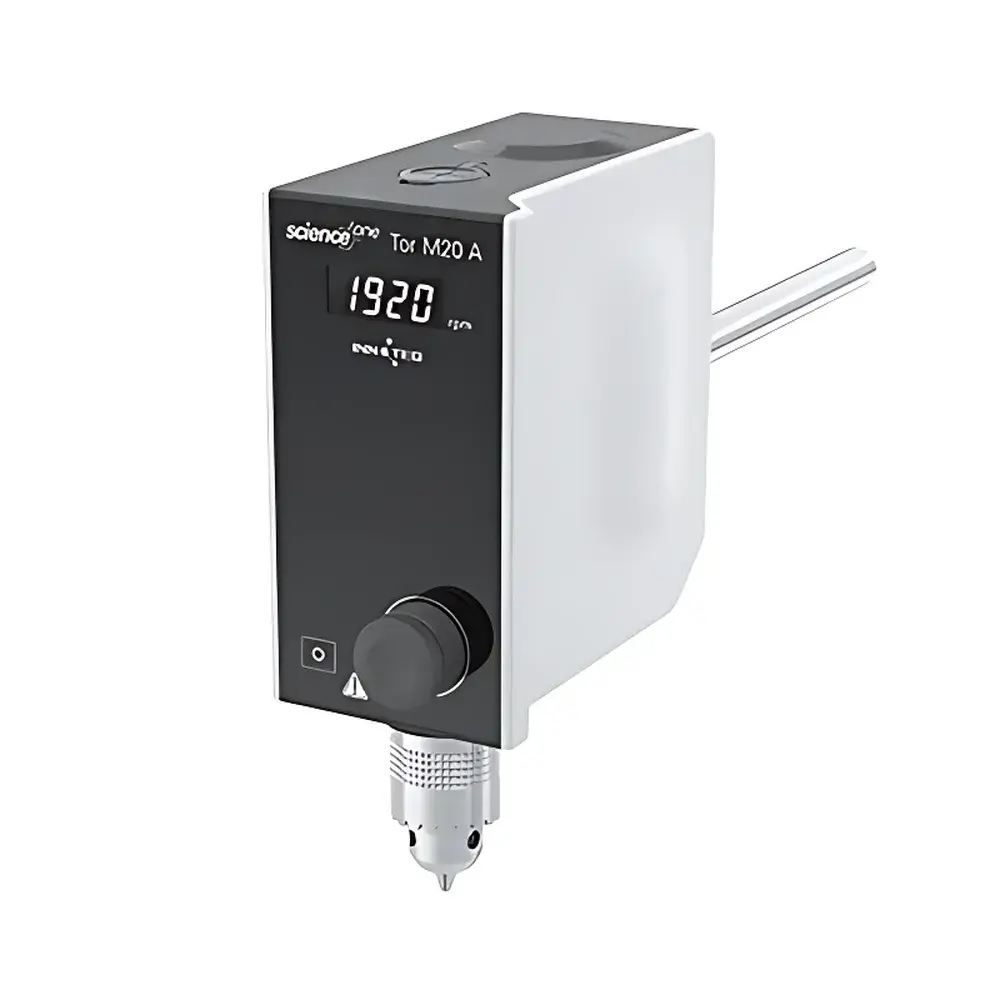
INNOTEG Tor M20A Overhead Stirrer
| Brand | INNOTEG |
|---|---|
| Origin | Germany |
| Model | Tor M20A |
| Stirrer Type | Electric Overhead Stirrer |
| Max. Stirring Volume (Water) | 15 L |
| Speed Range | 50–2000 rpm |
| Max. Viscosity | 10,000 mPa·s |
| Max. Torque | 20 N·cm |
| Motor | Brushless DC |
| Power Input/Output | 60 W / 46 W |
| Display | LED Digital |
| Housing Material | Powder-Coated Cast Aluminum |
| IP Rating | IP54 |
| Dimensions (W×H×D) | 70 × 193 × 147 mm |
| Weight | 1.56 kg |
| Operating Temperature | 5–40 °C |
| Relative Humidity | ≤80 % RH |
| Stirrer Shaft Diameter Compatibility | 0.5–8 mm |
Overview
The INNOTEG Tor M20A Overhead Stirrer is an engineered solution for precise, high-torque mechanical agitation in laboratory-scale mixing and dispersion applications. Designed around a brushless DC motor architecture, it delivers consistent rotational energy transfer across its full speed range (50–2000 rpm), enabling reliable homogenization of low- to medium-viscosity liquids—including aqueous solutions, polymer dispersions, suspensions, and viscous reaction mixtures up to 10,000 mPa·s. Unlike magnetic stirrers, the overhead configuration eliminates limitations imposed by vessel geometry, bottom heating plates, or ferromagnetic constraints, making it ideal for tall or narrow containers, jacketed reactors, and sealed systems where direct shaft coupling is required. Its compact footprint (70 × 193 × 147 mm) and lightweight construction (1.56 kg) support flexible benchtop integration without compromising structural rigidity or thermal stability during extended operation.
Key Features
- Brushless DC motor ensures maintenance-free operation, high efficiency (46 W output from 60 W input), and long service life with minimal electromagnetic interference
- Digital LED display provides real-time, high-resolution speed readout with ±1 rpm repeatability under constant load conditions
- Powder-coated cast aluminum housing offers mechanical robustness, chemical resistance, and IP54-rated protection against dust ingress and water splashing—suitable for general lab environments including fume hoods and wet benches
- 20 N·cm maximum torque enables stable stirring of dense slurries and non-Newtonian fluids without stalling, even at low speeds
- Universal chuck accepts standard stirring shafts from 0.5 mm to 8 mm diameter, supporting propeller, anchor, paddle, and helical impellers for application-specific hydrodynamic optimization
- No external controller required—fully self-contained unit with integrated speed regulation and thermal overload protection
Sample Compatibility & Compliance
The Tor M20A is compatible with glass, stainless steel, and PTFE-lined vessels ranging from 50 mL to 15 L capacity (water-equivalent). It supports Good Laboratory Practice (GLP) workflows through stable, reproducible agitation profiles essential for method validation in QC/QA laboratories. While not certified to ISO/IEC 17025 or FDA 21 CFR Part 11 out-of-the-box, its deterministic speed control and mechanical traceability make it suitable for inclusion in validated protocols where instrument performance qualification (IQ/OQ/PQ) is performed per internal SOPs. The device meets EN 61000-6-3 (EMC emission) and EN 61000-6-2 (immunity) standards, and complies with RoHS Directive 2011/65/EU regarding hazardous substances.
Software & Data Management
The Tor M20A operates as a standalone analog-controlled instrument with no embedded firmware or digital interface. All operational parameters are set manually via front-panel controls; no software installation, driver dependency, or data logging capability is provided. This design prioritizes reliability, electromagnetic compatibility, and ease of audit—eliminating cybersecurity concerns and reducing validation burden in regulated environments. For users requiring time-stamped speed logs or remote parameter adjustment, third-party analog signal acquisition modules (e.g., 0–10 V or 4–20 mA output adapters) may be interfaced externally, subject to user-defined calibration and documentation.
Applications
- Chemical synthesis: Controlled addition and mixing in exothermic or heterogeneous reactions
- Pharmaceutical formulation: Suspension stabilization, granulation fluid mixing, and dissolution media preparation per USP & Ph. Eur. guidelines
- Materials science: Dispersion of nanoparticles, carbon nanotubes, or ceramic precursors in solvent systems
- Food & beverage R&D: Emulsion development, viscosity profiling, and sensory sample preparation
- Environmental testing: Homogenization of soil/water extracts prior to ICP-MS or HPLC analysis
- Educational labs: Demonstration of shear-dependent rheology and mixing efficiency metrics (e.g., blend time, power number)
FAQ
What is the maximum recommended viscosity for continuous operation?
The Tor M20A is rated for continuous duty up to 10,000 mPa·s using appropriate impeller geometry and vessel fill level. Exceeding this limit may trigger thermal cut-off or reduce speed stability.
Can the unit be mounted on a universal stand or clamping system?
Yes—it features standardized 12 mm diameter mounting holes compliant with DIN 2817 and common lab rail systems, allowing secure vertical or angled positioning over reactors, bioreactors, or custom fixtures.
Is the motor compatible with variable-frequency drive (VFD) input?
No—the internal brushless DC motor is driven by a proprietary electronic commutation module; external AC VFDs are neither supported nor required.
Does the device include a safety stop function?
It incorporates automatic thermal shutdown at ≥75 °C internal temperature, but lacks emergency stop (E-stop) or momentary brake functionality per EN 60204-1.
What impeller types are recommended for high-viscosity applications?
Anchor or helical ribbon impellers with close-clearance clearance (≤5 mm from vessel wall) maximize bulk flow and heat transfer efficiency while minimizing dead zones in viscous media.



