
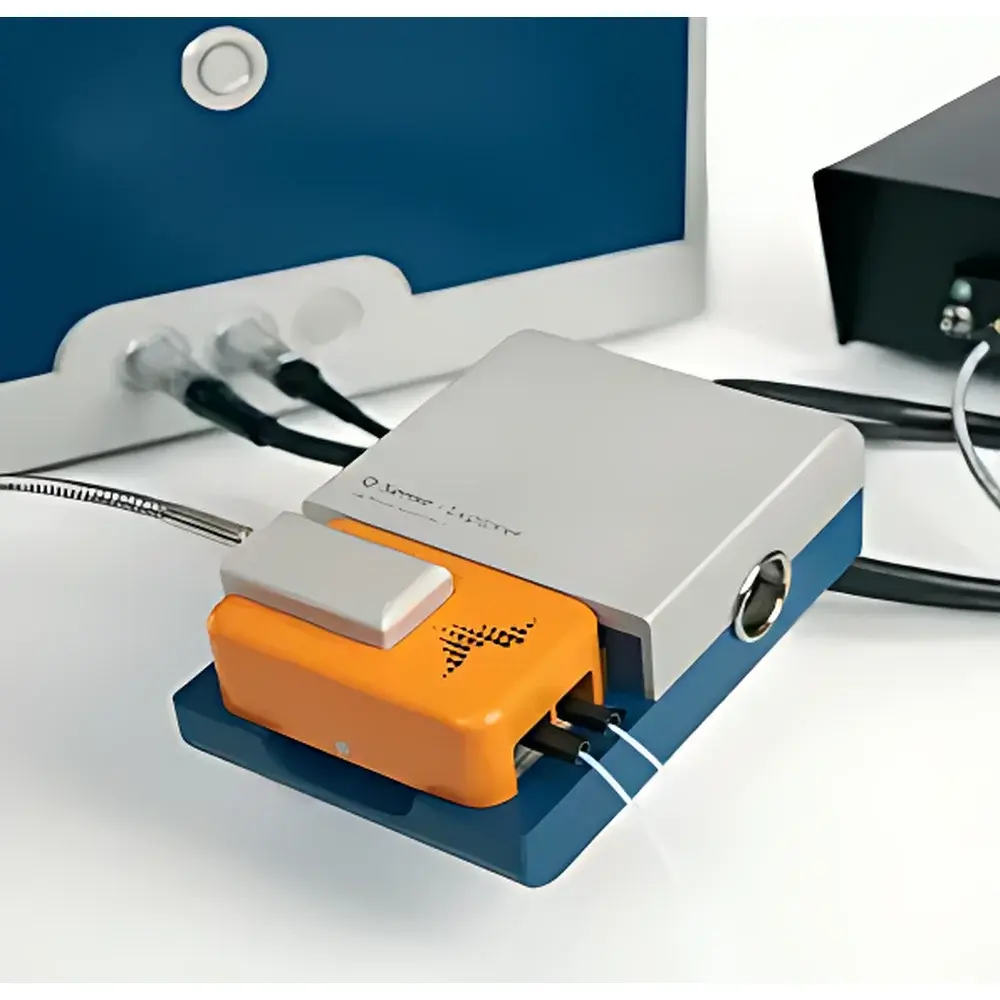
Insplorion Acoulyte Nanoplasmonic Spectroscopy & QCM-D Hybrid Molecular Interaction Analyzer
| Brand | Insplorion AB |
|---|---|
| Origin | Sweden |
| Model | Acoulyte |
| Sensor Diameter | 14 mm |
| Substrate | SiO₂-coated QCM-D crystal |
| Sensing Surface | Nanostructured gold |
| Standard Coatings | Si₃N₄, SiO₂, Al₂O₃, TiO₂ |
| Light Source | Tungsten-halogen lamp |
| Wavelength Range | 450–1000 nm |
| LSPR Sensitivity | ≤0.03 monolayer |
| Measurement Spot Diameter | 3 mm |
| Temporal Resolution | 10 Hz (10 samples/s) |
| Typical Noise Level | <0.01 nm |
| Optical Unit Dimensions (W×D×H) | 25×27×9 cm |
| Acoulyte Module Dimensions (W×D×H) | 8×5×3 cm |
| Software | Insplorer (Windows-compatible) |
| Data Export Format | ASCII text |
| Compatible Platforms | Q-Sense Explorer E1 & Analyzer E4 (with Q-Sense Window Module) |
| NPS Sensing Depth | <30 nm |
| QCM-D Hydrodynamic Penetration Depth | >300 nm |
| Simultaneous Output Parameters | LSPR resonance wavelength shift (Δλ), extinction intensity change, frequency shift (Δf), dissipation change (ΔD) |
Overview
The Insplorion Acoulyte is a hybrid molecular interaction analyzer engineered for label-free, real-time, multi-parametric surface characterization at the solid–liquid interface. It integrates two complementary physical sensing modalities—nanoplasmonic spectroscopy (NPS) based on localized surface plasmon resonance (LSPR) and dissipation-monitoring quartz crystal microbalance (QCM-D)—within a single measurement platform. Unlike sequential or co-located but decoupled systems, the Acoulyte performs truly simultaneous acquisition from identical spatial locations on the same sensor surface under identical experimental conditions. This synchronization eliminates temporal misalignment and inter-sensor variability, enabling direct correlation between optical (dry mass/refractive index) and acoustic (hydrated mass/viscoelasticity) responses during dynamic biomolecular processes. The core principle relies on LSPR-induced spectral shifts in the visible–NIR range (450–1000 nm) to report sub-nanometer-scale refractive index changes within ~30 nm of the nanostructured gold surface, while QCM-D concurrently quantifies mass uptake, swelling, and mechanical rigidity of the entire hydrated adlayer (>300 nm penetration depth). This dual-readout architecture provides unambiguous differentiation between surface adsorption, conformational rearrangement, solvent incorporation, and bulk film relaxation—critical for rigorous mechanistic interpretation in protein–ligand binding, membrane biophysics, and polymer–analyte interactions.
Key Features
- True simultaneity: Synchronized NPS and QCM-D data acquisition from the exact same 3-mm-diameter sensing area on a single SiO₂-coated, nanostructured gold QCM-D sensor.
- Multi-dimensional parameter output: Real-time tracking of LSPR peak wavelength shift (Δλ), extinction intensity, QCM frequency shift (Δf), and energy dissipation (ΔD) with 10 Hz temporal resolution.
- High surface sensitivity: NPS detection limit of ≤0.03 monolayer equivalent, enabled by optimized nanofabricated gold structures and low-noise (<0.01 nm) optical detection.
- Modular integration: Direct mechanical and electrical coupling to Q-Sense Explorer E1 and Analyzer E4 platforms via the Q-Sense Window Module—no recalibration or alignment required.
- Flexible surface chemistry: Standard sensor coatings (Si₃N₄, SiO₂, Al₂O₃, TiO₂) support diverse immobilization strategies including silane, thiol, NHS-ester, and biotin–streptavidin chemistries.
- Robust architecture: Compact optical unit (25×27×9 cm) and low-profile Acoulyte module (8×5×3 cm) enable seamless integration into standard laboratory hoods or automated liquid handling workstations.
Sample Compatibility & Compliance
The Acoulyte supports aqueous and buffered solutions across physiological pH (4–10) and temperature ranges (4–45 °C), compatible with native proteins, peptides, nucleic acids, liposomes, viruses, and synthetic polymers. Its sensor design conforms to ISO 17025-accredited calibration practices for QCM-D instrumentation and adheres to ASTM E2651-20 guidelines for surface binding assay validation. While not inherently FDA 21 CFR Part 11-compliant, the ASCII-based data export format and timestamped raw file structure facilitate implementation of audit-trail protocols required under GLP and GMP environments. All software operations—including parameter configuration, measurement initiation, and data export—are fully traceable within the Insplorer environment, supporting documentation for regulatory submissions involving binding kinetics, affinity determination (KD), and structural transition analysis.
Software & Data Management
Data acquisition and preliminary analysis are performed using Insplorer software, a Windows-native application designed specifically for Acoulyte operation. Insplorer enables synchronized control of optical and acoustic modules, real-time overlay of Δλ, Δf, and ΔD traces, and user-defined event markers for injection timing and buffer transitions. Raw outputs are saved as tab-delimited ASCII text files containing time-stamped columns for all measured parameters—ensuring full compatibility with third-party analysis tools such as MATLAB, Python (NumPy/Pandas), OriginLab, and GraphPad Prism. No proprietary binary formats or locked databases are used; users retain complete ownership and portability of primary datasets. Batch processing, baseline correction, and kinetic fitting (1:1 Langmuir, heterogeneous ligand, conformational change models) are supported through optional add-on modules validated against reference standards.
Applications
The Acoulyte excels in applications requiring orthogonal validation of interfacial phenomena. In lipid bilayer formation studies, it distinguishes vesicle adsorption (simultaneous increase in both Δλ and Δf) from rupture and spreading (Δλ increases further while Δf decreases due to loss of coupled water). For protein–carbohydrate interactions, it resolves whether binding induces rigidification (high ΔD decay post-association) or hydration-driven swelling (sustained ΔD elevation). In drug–membrane partitioning assays, it quantifies both insertion depth (via NPS signal onset relative to QCM-D mass gain) and lateral reorganization (via LSPR linewidth broadening). Additional use cases include real-time monitoring of antibody–antigen binding under shear flow, stimuli-responsive hydrogel swelling/collapse, and catalytic nanoparticle–substrate interactions in electrochemical interfaces.
FAQ
Can the Acoulyte be used with non-Q-Sense QCM-D instruments?
No—the Acoulyte is mechanically and electronically designed exclusively for integration with Q-Sense Explorer E1 and Analyzer E4 platforms equipped with the Q-Sense Window Module.
Is sensor regeneration possible between experiments?
Yes; standard cleaning protocols include mild detergent washes, piranha solution (for gold surfaces), or low-pH glycine-HCl buffers, depending on coating and immobilized layer stability.
Does NPS interfere with QCM-D signal fidelity?
No—optical illumination is spatially confined and spectrally filtered to avoid photothermal effects; QCM-D performance remains unaffected, as confirmed by ISO/IEC 17025 inter-laboratory validation reports.
What is the minimum analyte concentration detectable?
Detection limits depend on molecular weight and binding stoichiometry; typical KD-sensitive range spans 10 pM–10 µM for high-affinity protein interactions, validated using BSA–anti-BSA and streptavidin–biotin reference systems.
Are custom sensor coatings available?
Yes—Insplorion offers bespoke surface functionalization services, including PEGylation, Ni-NTA, and streptavidin pre-coating, subject to minimum order quantities and lead time.



