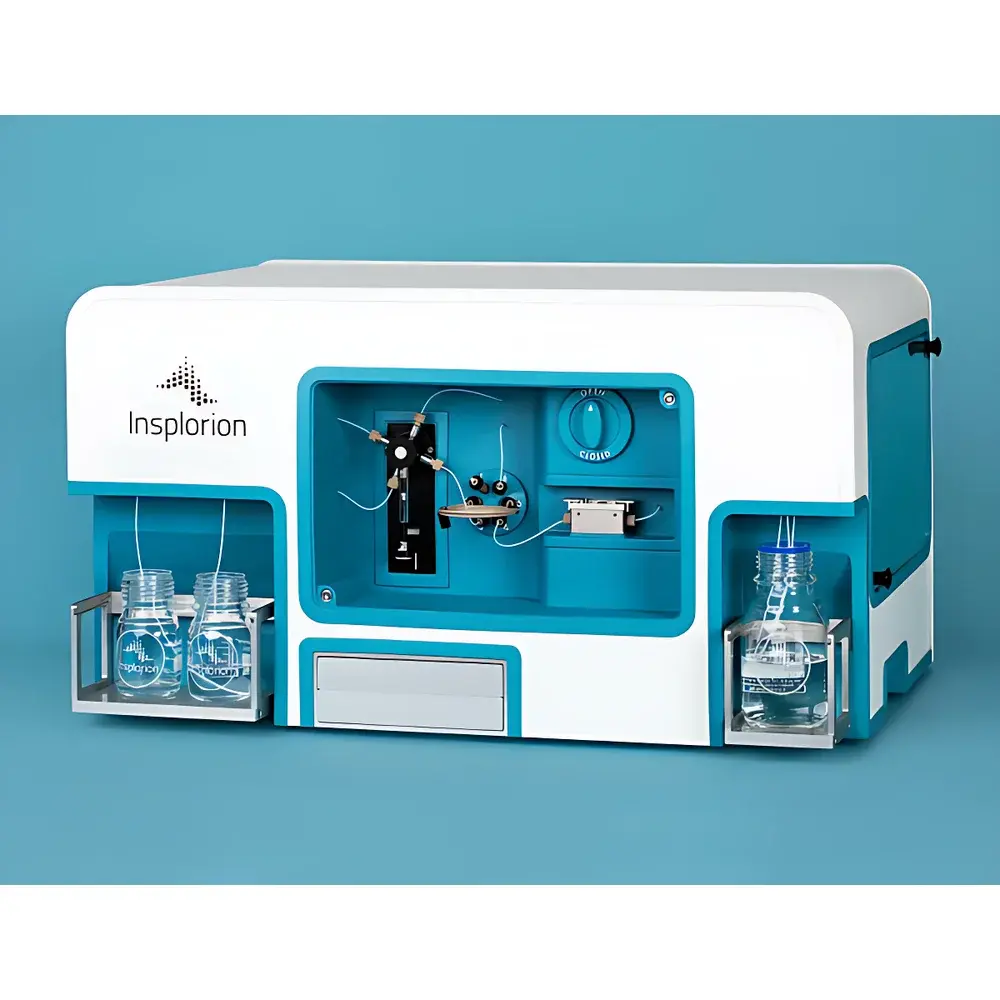
Insplorion S2 Nano-Plasmonic Sensor Analyzer
| Brand | Insplorion AB |
|---|---|
| Origin | Sweden |
| Model | S2 |
| Analysis Time | 2 s |
| Temperature Control Range | 15 °C–45 °C (±0.1 °C stability) |
| Flow Cell | Dual-channel |
| Sample Dead Volume | 20 µL |
| Standard Syringe Volume | 250 µL |
| Typical Flow Rate | 12.5–250 µL/min |
| Standard Loop Volume | 200 µL |
| Sensor Substrate | Fused Silica |
| Sensing Layer | Nanostructured Gold |
| Detection Depth | Up to 30 nm |
| Light Source | Tungsten-Halogen Lamp (≥2000 h lifetime) |
| Measurement Spot Diameter | 1.5 mm |
| Temporal Resolution | Up to 10 Hz |
| Optical Noise | <0.1 nm (at 1 Hz sampling) |
| Sensor Dimensions | 9.5 × 9.5 × 1 mm |
| System Dimensions | 65 × 42 × 36 cm |
| Weight | 30 kg |
| Software | InControl 1.0 (Windows-compatible) |
| Data Output | Proprietary CSV/TSV format |
Overview
The Insplorion S2 Nano-Plasmonic Sensor Analyzer is a high-precision, label-free optical biosensing platform engineered for real-time, surface-sensitive monitoring of molecular interactions at solid–liquid interfaces. It leverages nano-plasmonic sensing (NPS), a technique based on localized surface plasmon resonance (LSPR) shifts induced by nanoscale changes in the refractive index within ~30 nm of a functionalized gold nanostructure surface. Unlike conventional SPR systems requiring prism coupling or complex optics, the S2 employs a compact, robust architecture with integrated tungsten-halogen illumination and high-stability photodetection—enabling quantitative measurement of adsorption kinetics, conformational transitions, and interfacial assembly processes without fluorescent tags, enzymatic labels, or secondary reagents. Its dual-channel flow cell design supports comparative binding studies under identical thermal and hydrodynamic conditions, making it particularly suitable for kinetic discrimination, reference-subtracted measurements, and buffer-matched controls in demanding life science applications.
Key Features
- Dual-Channel Nanoscale Flow Cell: Precision-machined titanium and sapphire flow cell with two independent sensor positions; enables simultaneous sample/reference or parallel condition monitoring with matched fluidic paths and minimal cross-talk.
- Automated Fluid Handling: Integrated six-port injection valve, continuous-flow syringe pump, and software-commanded queue system for automated buffer exchange, surface regeneration, and multi-step assay protocols—eliminating manual intervention and improving inter-run reproducibility.
- High-Stability Thermal Control: Active Peltier-based temperature regulation from 15 °C to 45 °C with ±0.1 °C stability over time; critical for studying thermally sensitive biomolecular interactions (e.g., protein folding, lipid phase transitions) and ensuring GLP-compliant assay repeatability.
- Modular & Serviceable Sensor Architecture: Removable single-handle flow cell with user-accessible sensor tray; supports rapid sensor replacement, cleaning, and coating validation—reducing downtime and enabling routine maintenance without specialized tools.
- Optimized Optical Performance: 1.5 mm measurement spot size, up to 10 Hz temporal resolution, and sub-0.1 nm optical noise floor (at 1 Hz); delivers high signal-to-noise ratio for low-abundance analytes and shallow-binding events (e.g., weak protein–peptide interactions).
Sample Compatibility & Compliance
The S2 is compatible with a broad spectrum of biological and synthetic materials—including lipids, proteins, nucleic acids, viruses, hydrogels, biominerals, and supported lipid bilayers—without requiring chemical modification or labeling. Its chemically inert wetted path (PTFE/FPM/silicone tubing, titanium/sapphire body) ensures compatibility with aggressive buffers, organic solvents, and low-pH eluents. The system supports ISO 13485-aligned workflows and can be operated under GLP/GMP conditions when paired with audit-trail-enabled software configurations. While the InControl 1.0 software does not natively comply with FDA 21 CFR Part 11 out-of-the-box, its data export architecture (CSV/TSV) facilitates integration into validated LIMS or ELN platforms where electronic signatures and change control are enforced.
Software & Data Management
InControl 1.0 provides full instrument orchestration—including flow control sequencing, temperature ramping, sensor calibration, and real-time spectral visualization—via an intuitive Windows-native GUI. All experimental parameters (flow rates, injection volumes, dwell times, temperature setpoints) are scriptable and stored with metadata timestamps. Raw output is exported in plain-text CSV/TSV format with column headers identifying wavelength shift (nm), time (s), channel ID, and derived surface concentration units (RU-equivalent). This open-data structure enables direct import into Python (NumPy/Pandas), MATLAB, GraphPad Prism, or custom kinetic fitting engines—supporting advanced analysis such as global fitting of multi-state binding models or machine learning–assisted pattern recognition in time-resolved response traces.
Applications
- Real-time quantification of protein–ligand association/dissociation kinetics (kon, koff, KD) under physiological buffer conditions
- In situ formation and perturbation studies of supported lipid bilayers and membrane protein reconstitution
- Label-free detection of nucleic acid hybridization, aptamer–target binding, and CRISPR–guide RNA complex stability
- Monitoring biomineralization nucleation on functionalized surfaces and ion-induced conformational switching
- Characterizing virus–host receptor binding dynamics and neutralizing antibody interference
- Studying hydrogel swelling/collapse responses to pH, temperature, or analyte concentration gradients
FAQ
What is the detection depth of the S2 sensor?
The effective sensing depth is up to 30 nm from the gold nanostructure surface—optimized for interfacial phenomena such as monolayer adsorption, bilayer formation, and surface-confined conformational changes.
Can I use custom sensor coatings with the S2?
Yes. Standard options include bare gold, SiO2, Al2O3, and TiO2; custom thin-film coatings (e.g., dextran, NTA, streptavidin, or polymer brushes) and alternative plasmonic materials (e.g., silver nanostructures) are available upon request.
Is the system compatible with high-throughput screening workflows?
While the S2 is optimized for detailed kinetic characterization rather than ultra-high-throughput mode, its 2-second minimum analysis time per injection and automated fluid handling support semi-automated serial assays across 96+ samples per day when combined with external autosamplers.
Does the S2 require alignment or daily optical recalibration?
No. The optical path is factory-aligned and sealed; no user-accessible mirrors or gratings require adjustment. Routine verification uses built-in reference spectra and drift-compensated baseline tracking algorithms.
What maintenance is required for long-term operation?
Routine maintenance includes quarterly inspection of fluidic seals, annual lamp replacement (rated ≥2000 h), and periodic validation of temperature stability using NIST-traceable probes—no internal optical servicing is needed during standard operation.