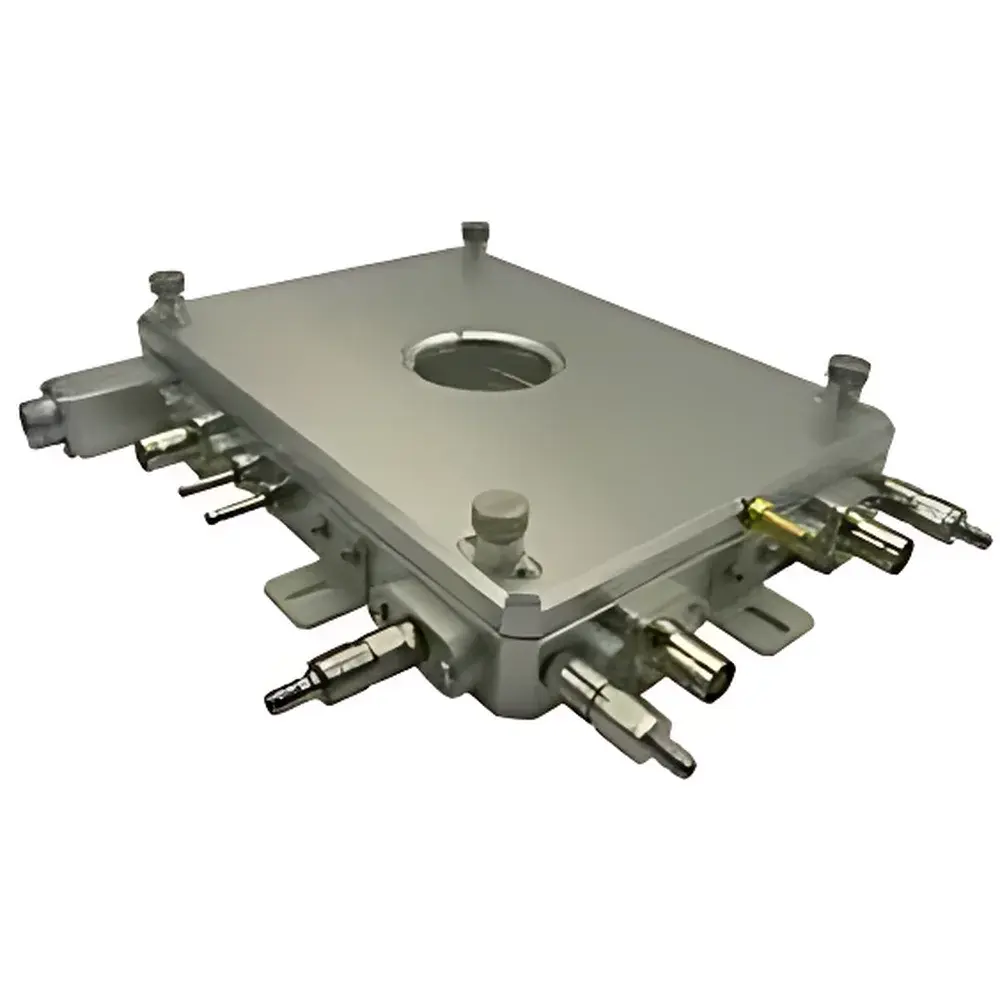
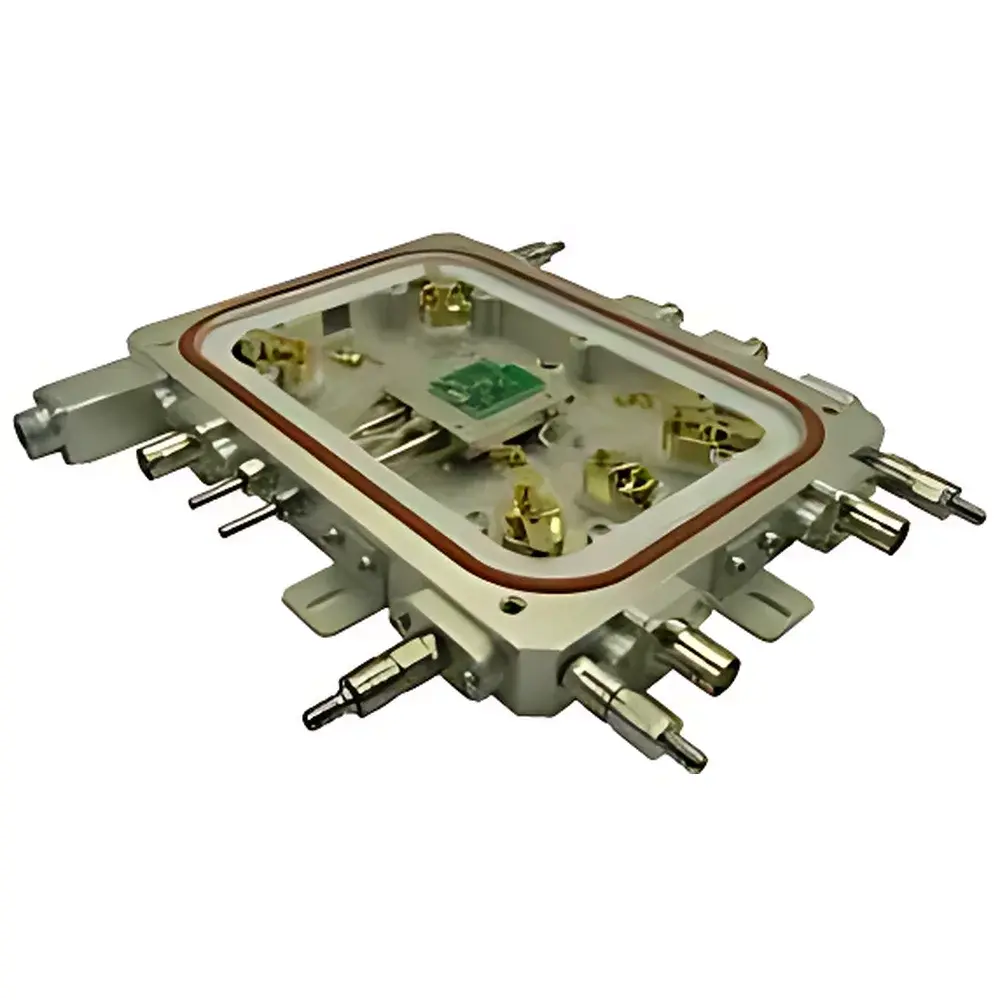
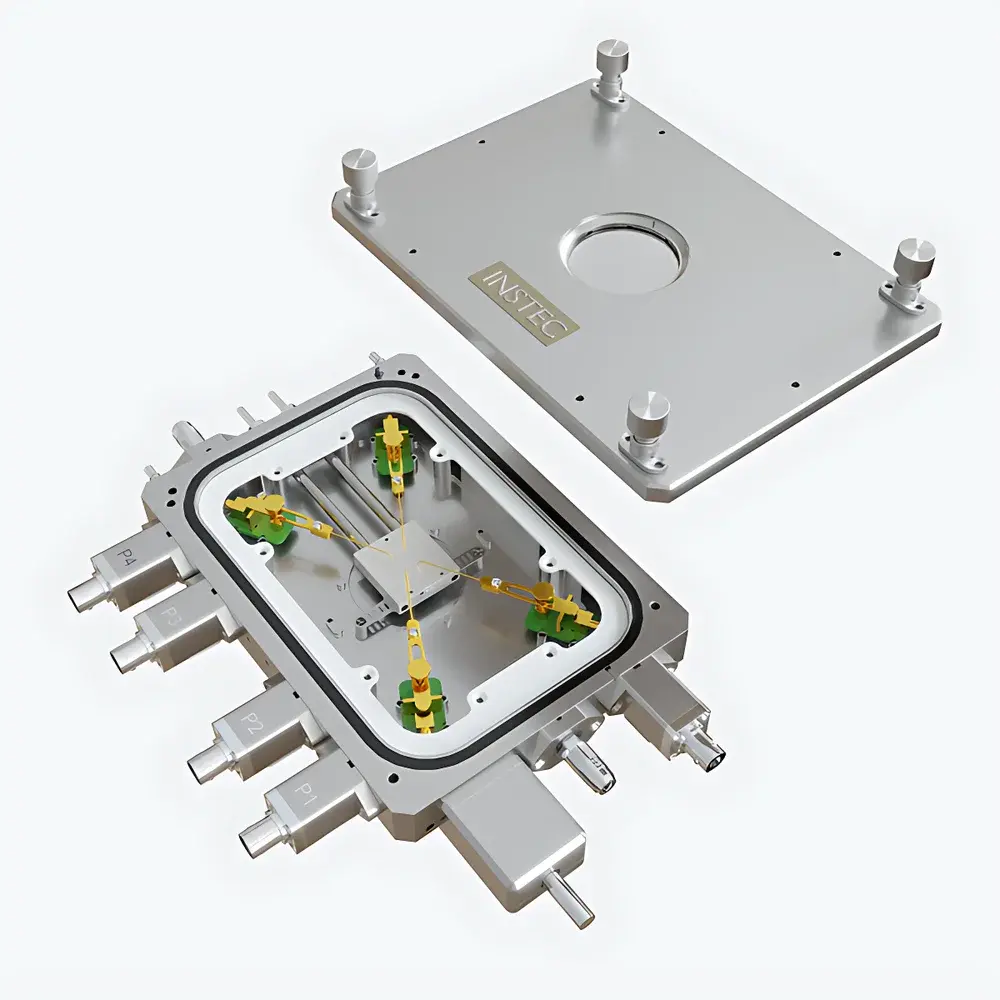
Instec HCP621G-PM Hermetic Temperature-Controlled Probe Station
| Brand | Instec |
|---|---|
| Origin | USA |
| Model | HCP621G-PM |
| Temperature Range | -190 °C to 600 °C (LN₂ required for sub-ambient operation) |
| Heating/Cooling Rate | +80 °C/min (heating at 100 °C), -50 °C/min (cooling at 100 °C) |
| Temperature Stability | ±0.05 °C (>25 °C), ±0.1 °C (<25 °C) |
| Temperature Resolution | 0.01 °C |
| Control Sensor | 100 Ω Pt RTD |
| Control Method | PID with LVDC low-noise power supply |
| Heating Area | 28 mm × 30 mm |
| Sealing | Hermetic chamber (N₂ or inert gas compatible) |
| Optical Access | Removable φ38 mm viewport, ±60.7° viewing angle, 8.5 mm objective working distance |
| Electrical Interface | Standard BNC, optional triaxial for pA-level measurements |
| Probe Type | Manual lever-actuated Re-W bent probes |
| Sample Stage Grounding | Default grounded, optional floating or triaxial back-electrode configuration |
| Optional Modifications | Non-magnetic construction, internal feedthroughs, transmission-mode optical port, in-chamber wiring posts |
| Operation Mode | Manual probe positioning |
| Compliance | Designed for ASTM F1528, ISO/IEC 17025-aligned lab environments, supports GLP/GMP traceability via software SDK |
Overview
The Instec HCP621G-PM is a high-precision, hermetically sealed temperature-controlled probe station engineered for cryogenic to high-temperature electrical characterization of semiconductor devices, thin-film materials, and microfabricated structures. It operates across an exceptionally wide thermal range—from -190 °C (achievable with integrated liquid nitrogen cooling) to +600 °C—enabling dynamic thermal stress testing, phase-transition analysis, and thermally activated transport studies. Unlike open-air or vacuum-only platforms, the HCP621G-PM integrates a fully sealed chamber formed by its top lid and base housing, allowing controlled introduction of inert gases (e.g., N₂, Ar) to suppress surface condensation during cryogenic operation and inhibit oxidation during elevated-temperature measurements. Its compact footprint (28 mm × 30 mm active heating zone) and modular optical interface support seamless integration with upright or inverted microscopes, Raman spectrometers, photoluminescence systems, and quantum optics setups. The station’s mechanical architecture employs non-ferromagnetic stainless steel components as standard, with optional full non-magnetic construction available for Hall-effect and magneto-transport applications requiring minimal magnetic interference.
Key Features
- Hermetic gas-tight chamber design enabling stable inert-atmosphere operation from -190 °C to 600 °C
- PID-controlled temperature regulation using 100 Ω platinum RTD sensor and low-voltage DC (LVDC) noise-suppressed heating circuitry
- Thermal stability of ±0.05 °C above 25 °C and ±0.1 °C below 25 °C, with 0.01 °C resolution and programmable ramp rates down to ±0.01 °C/min
- Optical compatibility: removable φ38 mm sapphire or fused silica viewport, ±60.7° field-of-view, 8.5 mm minimum objective working distance, and optional transmission-mode optical port with through-stage aperture
- Electrical interface flexibility: four standard BNC-mounted manual probes with lever-actuated Re-W bent tips; optional triaxial connectors for femtoampere-level current measurement and low-noise biasing
- Configurable sample stage grounding: default earth-grounded, optional floating potential or triaxial back-contact configuration for dual-gate or substrate-biased device testing
- Expandable electrical infrastructure: optional in-chamber feedthrough posts for direct sample wiring, eliminating external cable-induced thermal drift and noise coupling
Sample Compatibility & Compliance
The HCP621G-PM accommodates wafers up to 4″ diameter, diced dies, MEMS packages, and custom substrates mounted on standard microscope slides or ceramic carriers. Its chamber geometry permits simultaneous electrical probing, real-time optical imaging, and environmental control—critical for reliability testing of GaN HEMTs, SiC MOSFETs, perovskite solar cells, and 2D material heterostructures. The system complies with key international standards for laboratory instrumentation, including ASTM F1528 (Standard Guide for Testing Semiconductor Devices), ISO/IEC 17025 requirements for calibration traceability, and design principles aligned with FDA 21 CFR Part 11 for electronic records when used with validated software control modules. All thermal and electrical performance specifications are verified under controlled ambient conditions per manufacturer’s test protocol and documented in supplied calibration certificates.
Software & Data Management
Temperature sequencing, ramp profiling, and real-time thermal logging are managed via Instec’s proprietary Windows-based control software, which supports user-defined multi-step programs (e.g., hold-ramp-hold cycles), live graphing of temperature vs. time, and export of CSV-formatted datasets for post-processing in MATLAB, Python, or OriginLab. An optional Software Development Kit (SDK) provides COM/ActiveX and DLL interfaces for integration into LabVIEW, Python (PyWin32), or C++ automated test systems. Audit trails—including operator ID, timestamp, setpoint changes, and actual thermal response—are recorded with system-level timestamps to support GLP and GMP documentation workflows. No cloud connectivity or remote telemetry is embedded; all data remains local unless explicitly exported by the user.
Applications
- Variable-temperature I-V, C-V, and G-V characterization of advanced nodes (e.g., FinFETs, nanowire transistors)
- Cryogenic evaluation of superconducting qubit substrates and Josephson junctions
- Oxidation kinetics studies of metal oxides and high-k dielectrics under controlled N₂/Ar atmospheres
- In-situ Raman and PL spectroscopy of phase-change materials (VO₂, Ge₂Sb₂Te₅) across structural transitions
- Thermoelectric property mapping of thin-film thermocouples and segmented legs
- Hall mobility and carrier concentration extraction in 2D semiconductors (MoS₂, WSe₂) using optional non-magnetic configuration
FAQ
What cooling method is required to reach -190 °C?
Liquid nitrogen (LN₂) delivery via Instec’s integrated cryogenic manifold and cold-finger assembly is mandatory; no closed-cycle cryocooler option is supported on the HCP621G-PM model.
Can the chamber be evacuated instead of purged with gas?
No—the HCP621G-PM is designed exclusively for positive-pressure inert gas environments. For vacuum operation, the HCP421V-PM variant must be selected.
Is optical alignment repeatable after multiple thermal cycles?
Yes—mechanical registration features (dowelled lid seating, kinematic stage mounting) ensure sub-5 µm positional repeatability of the viewport centerline over >500 thermal cycles between -190 °C and 600 °C.
Are calibration certificates included with shipment?
Each unit ships with a factory-verified temperature calibration report (traceable to NIST standards) and mechanical alignment verification sheet.
Can third-party probes be installed?
Yes—standard 0.1″-32 UNC threaded probe holders accept commercially available micromanipulators and cantilever-style probes, provided tip geometry accommodates the 8.5 mm working distance constraint.