
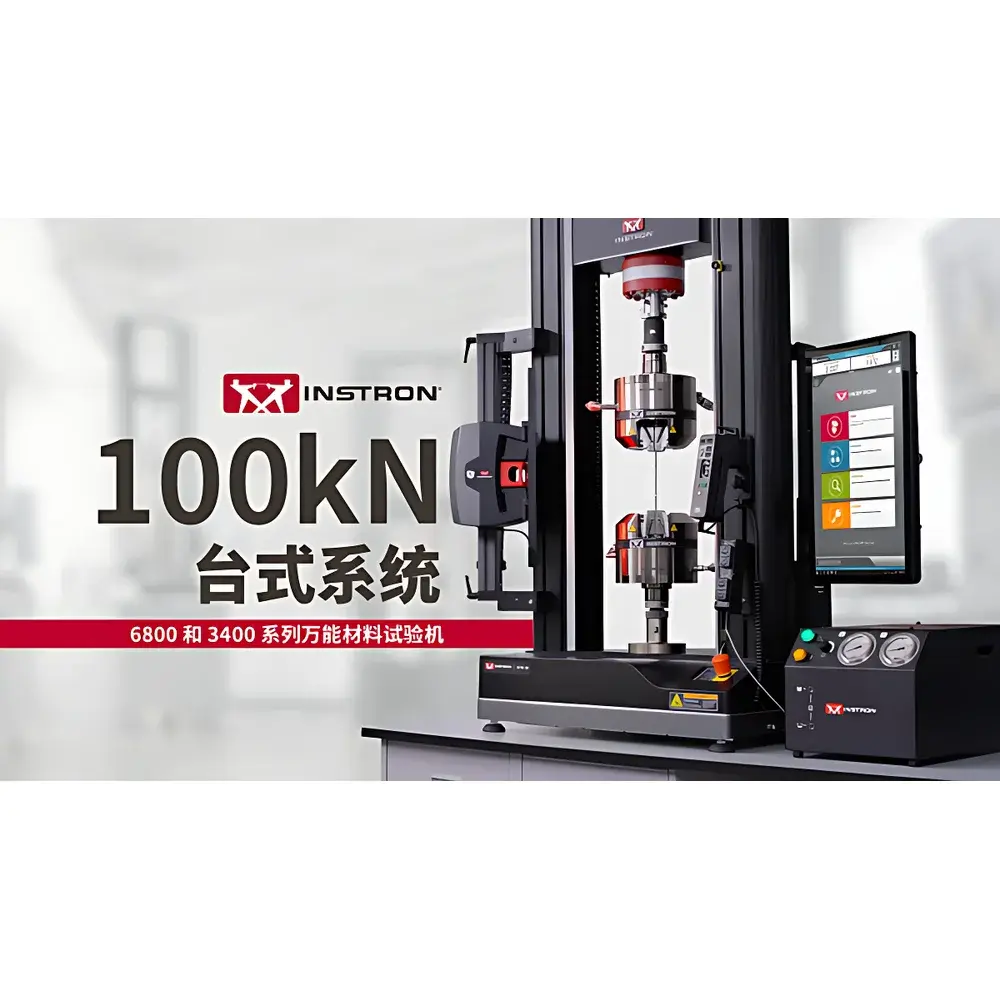
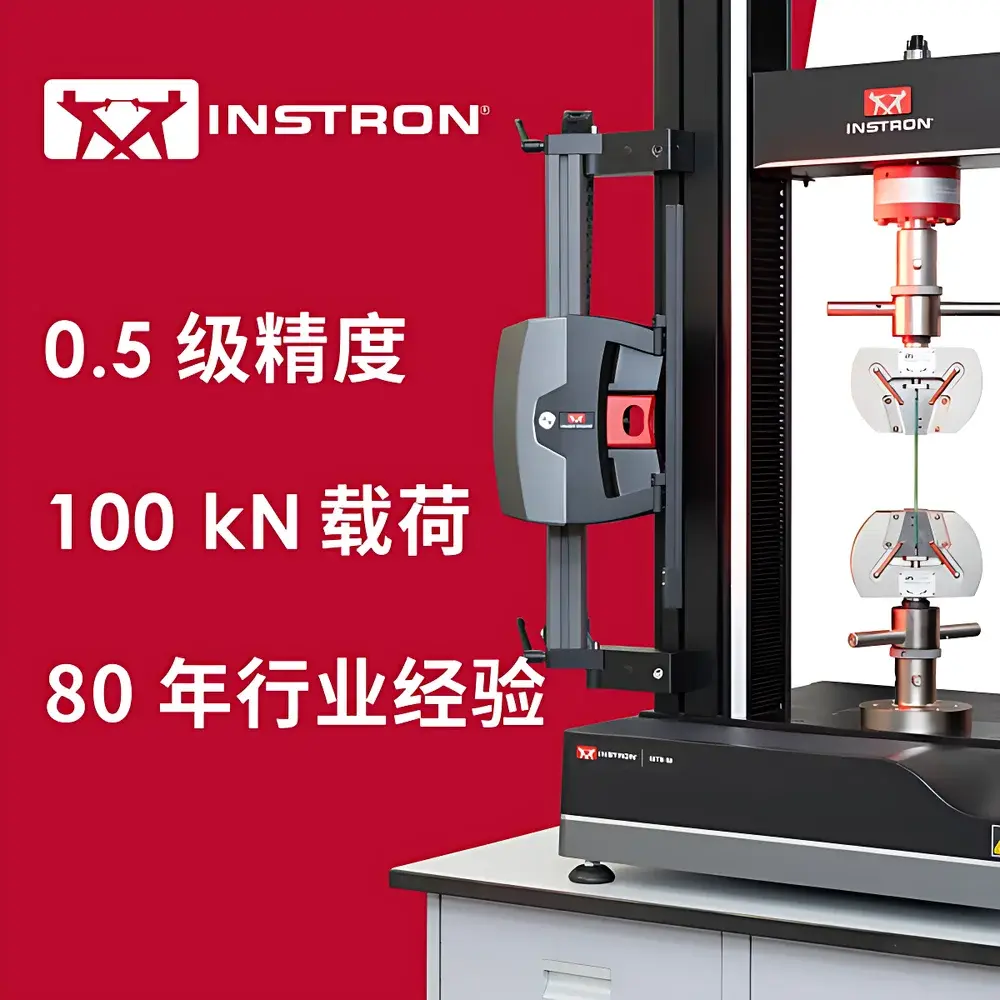
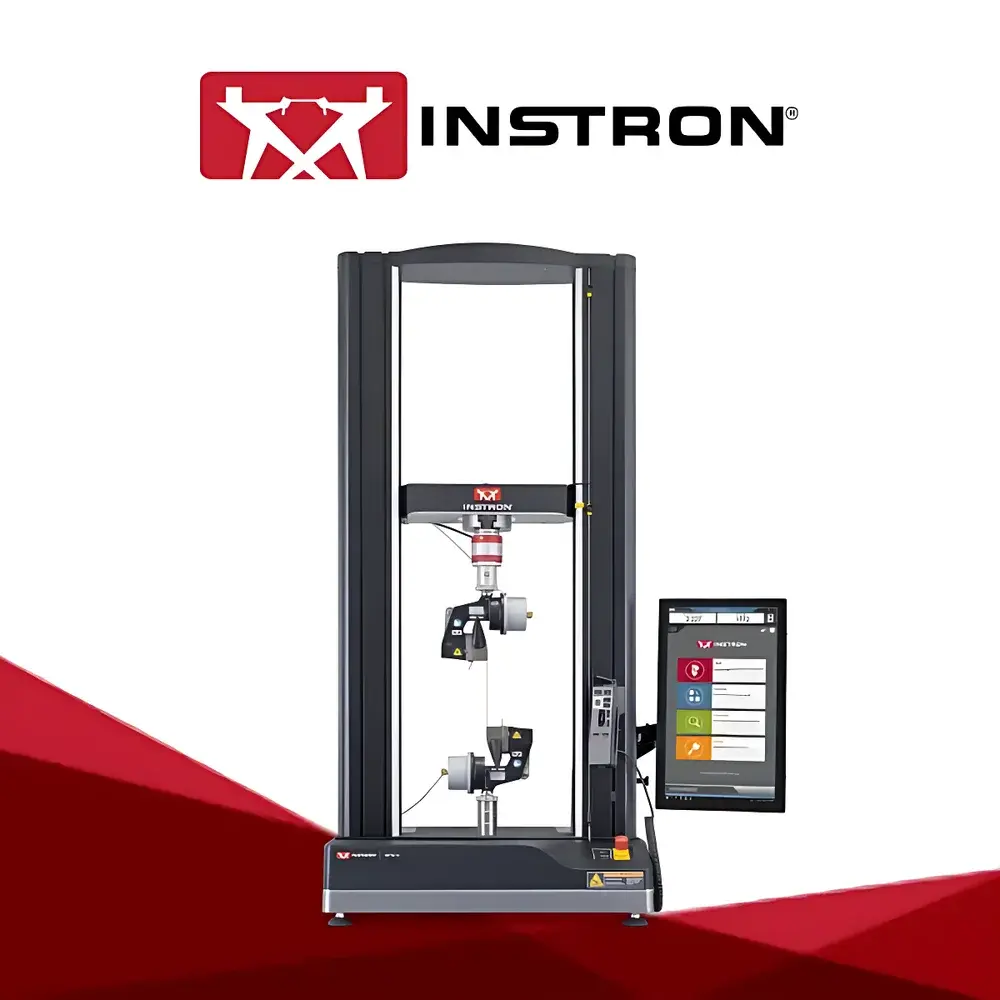
Instron 6800 Series Dual-Column Tabletop Electromechanical Universal Testing System
| Brand | Instron |
|---|---|
| Origin | USA |
| Manufacturer | Instron Corporation |
| Product Type | Electromechanical Universal Testing Machine |
| Model Numbers | 68TM-5, 68TM-10, 68TM-30, 68TM-50, 68TM-100 |
| Maximum Load Capacity | 5 kN, 10 kN, 30 kN, 50 kN, or 100 kN |
| Load Accuracy Class | 0.5 or 1 (per ISO 7500-1 / ASTM E4) |
| Data Acquisition Rate | Up to 5 kHz (simultaneous force, displacement, strain) |
| Force Measurement Accuracy | ±0.5% of reading from 0.1% to 100% FS (with 2580 series load cells + Advanced Performance option) |
| Displacement Accuracy | ±0.01 mm or ±0.05% of reading (whichever is greater) |
| Strain Measurement Compliance | ASTM E83, ISO 9513, EN 10002-4, BS 3846 |
| Speed Accuracy | ±0.1% of set speed (under zero or constant load) |
| Operating Temperature | 5–40 °C |
| IP Rating | IP2X |
| Power Supply | 100–240 VAC ±10%, 47–63 Hz |
Overview
The Instron 6800 Series Dual-Column Tabletop Electromechanical Universal Testing System is engineered for high-precision mechanical property characterization of materials and components across research, quality control, and production environments. Based on closed-loop servo-controlled electromechanical actuation, the system delivers repeatable force and displacement control through a robust dual-column frame architecture, precision-ground ball screws, preloaded angular contact bearings, and low-stretch drive belts. Its design conforms to fundamental metrological principles defined in ISO 7500-1 and ASTM E4 for static uniaxial testing systems, ensuring traceable performance across its full load range—from 5 kN to 100 kN. The 6800 Series supports standardized tensile, compression, flexure, peel, puncture, shear, and friction testing protocols, making it suitable for evaluating polymers, composites, elastomers, thin films, textiles, adhesives, biomedical devices, automotive trim, and packaging substrates.
Key Features
- Modular dual-column frame with standard and extended-height configurations to accommodate diverse specimen geometries and fixture requirements.
- Instron Bluehill Universal software—integrated test method library, automated positioning, real-time data visualization, and audit-trail-enabled reporting compliant with FDA 21 CFR Part 11 and GLP/GMP workflows.
- Patented Operator Protection Architecture: intelligently manages system state transitions during setup, execution, and return phases to enforce safety-critical interlocks and prevent inadvertent access to hazardous zones.
- Collision detection and automatic motion halt upon unexpected force feedback during manual crosshead movement or post-test return sequences.
- Ergonomic front-mounted control handle with programmable function keys, specimen protection mode, and fine-positioning thumbwheel for sub-millimeter adjustments.
- Brushless AC servo motor rated for continuous operation up to 10 days at frequencies ≤1 Hz—ideal for long-duration creep and stress-relaxation studies under controlled ambient conditions (25 °C).
- Optional Smart Pneumatic Control: limits pneumatic clamp closing pressure and velocity during setup to reduce operator pinch risk without compromising grip integrity.
Sample Compatibility & Compliance
The 6800 Series interfaces seamlessly with over 300 standardized fixtures and grips cataloged in the Instron Accessories Manual—including wedge-action, hydraulic, pneumatic, and custom-designed solutions for brittle, ductile, anisotropic, or low-stiffness specimens. It executes tests aligned with major international standards including ASTM D638, D790, D1876, D3330, ISO 527, ISO 178, ISO 1133, EN ISO 10365, GB/T 1040, and GB/T 9341. All force transducers (2530 and 2580 series) are factory-calibrated per ISO 376 and certified to meet class 0.5 or class 1 accuracy per ISO 7500-1. System-level verification includes traceable calibration certificates and uncertainty budgets documented per ISO/IEC 17025 requirements.
Software & Data Management
Bluehill Universal provides a validated, role-based interface supporting method-driven testing, real-time curve overlay, multi-channel synchronization (force, displacement, extensometer strain), and automated pass/fail evaluation against user-defined acceptance criteria. Raw data is stored in encrypted .ibw format with embedded metadata (operator ID, timestamp, environmental logs, calibration history). Export options include CSV, PDF, XML, and direct integration with LIMS and MES platforms via RESTful API. Audit trails record all critical events—including parameter changes, calibration actions, and user logins—with immutable timestamps and digital signatures to satisfy regulatory documentation requirements.
Applications
This system serves as a primary mechanical testing platform in regulated and non-regulated sectors: polymer formulation labs assessing tensile modulus and elongation at break; medical device manufacturers validating suture strength and catheter kink resistance per ISO 10993-12; automotive suppliers verifying gasket compression set and sealant adhesion; electronics firms characterizing flex circuit bending fatigue; and packaging engineers evaluating peel strength of laminated pouches under variable humidity. Its repeatability (coefficient of variation <0.8% for standard tensile tests) and thermal stability support both routine QC and R&D-grade investigations.
FAQ
What load cell options are available for the 6800 Series, and how do they affect measurement resolution?
The system supports Instron’s 2530 and 2580 series load cells. The 2580 series enables ±0.5% accuracy down to 0.1% of full scale when equipped with the Advanced Performance option; the 2530 series maintains ±0.5% accuracy from 0.4% FS.
Is Bluehill Universal software validated for use in FDA-regulated environments?
Yes—version 4.0 and later include IQ/OQ documentation packages, electronic signature support, and audit trail functionality compliant with 21 CFR Part 11.
Can the 6800 Series perform cyclic loading tests?
Yes—via Bluehill Universal’s built-in waveform generator, users can define sinusoidal, triangular, trapezoidal, or custom waveforms with programmable frequency, amplitude, and dwell periods.
What environmental conditions must be maintained for optimal system performance?
Ambient temperature must be stabilized between 5–40 °C, relative humidity 10–90% (non-condensing), and installation site must be free of excessive dust, corrosive vapors, or electromagnetic interference.
Does the system support third-party extensometers?
Yes—through analog voltage input channels and digital encoder interfaces, compatible with LVDTs, clip-on, video, and laser extensometers meeting ASTM E83 or ISO 9513 Class 1 specifications.



