
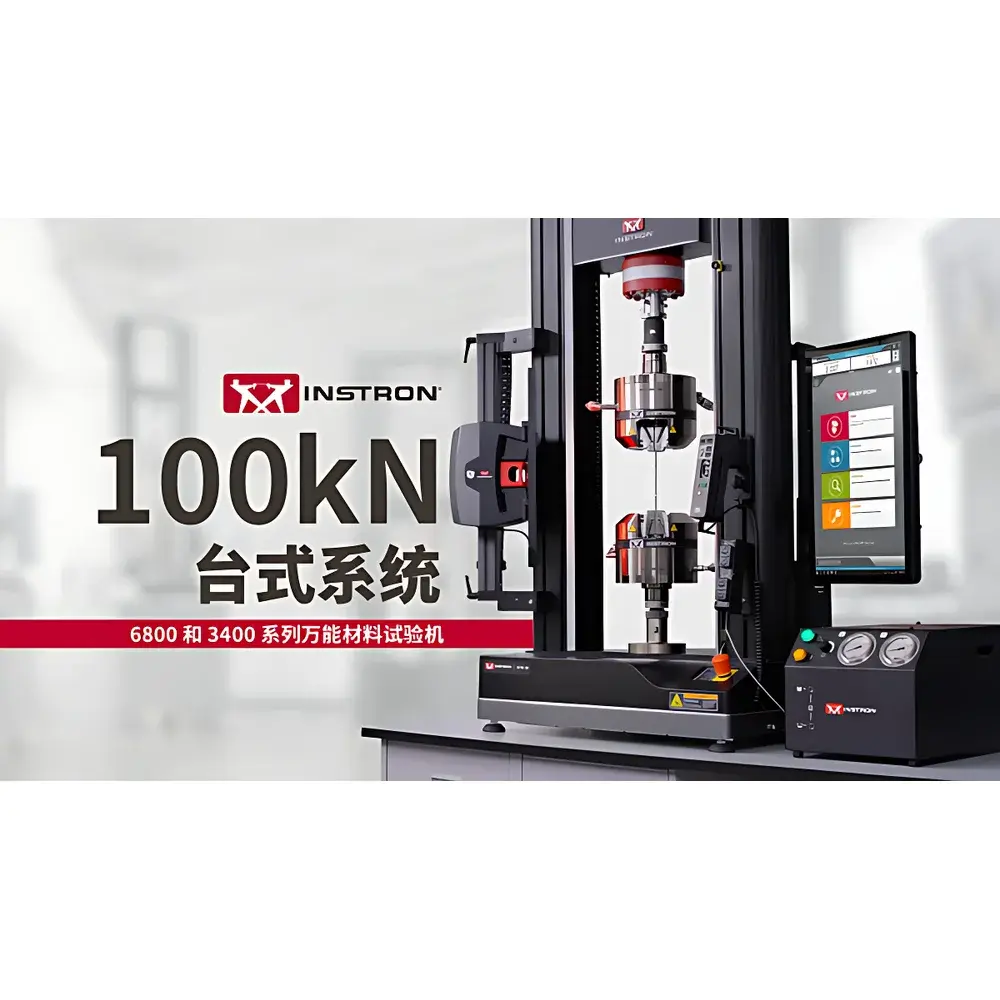
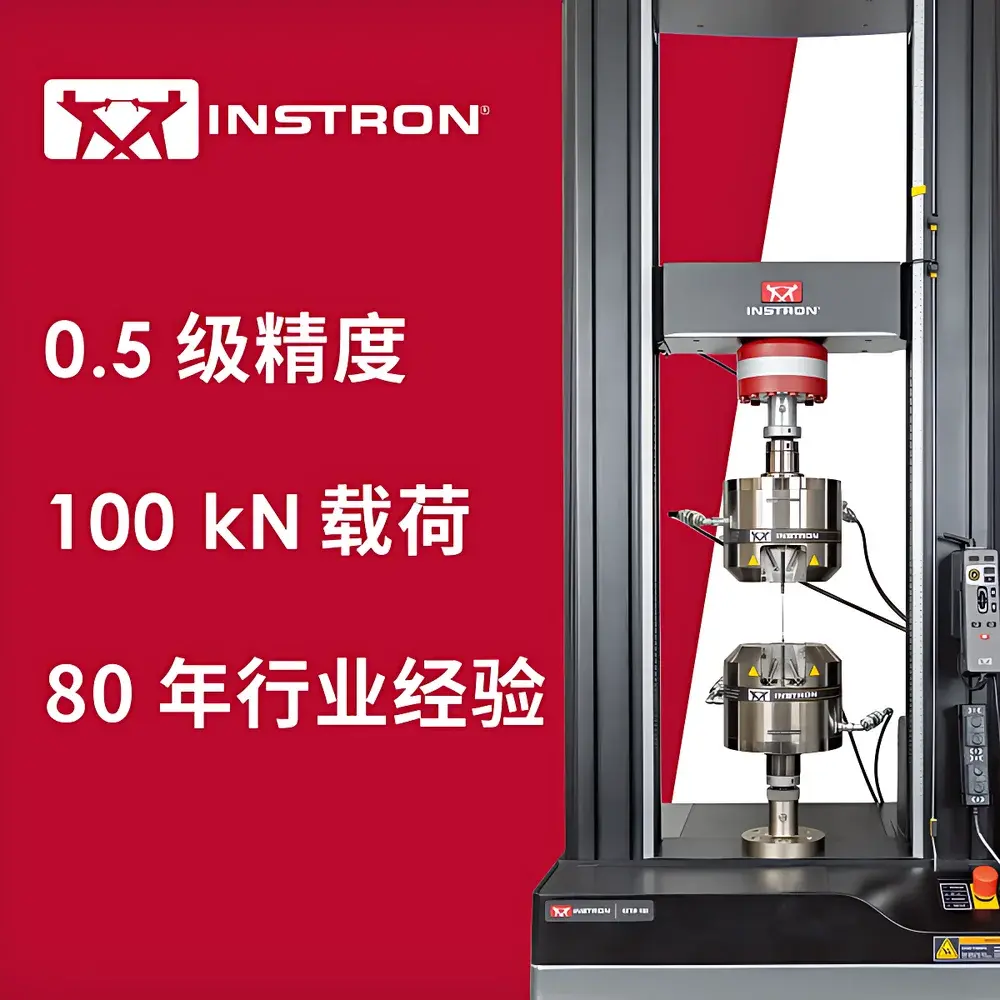
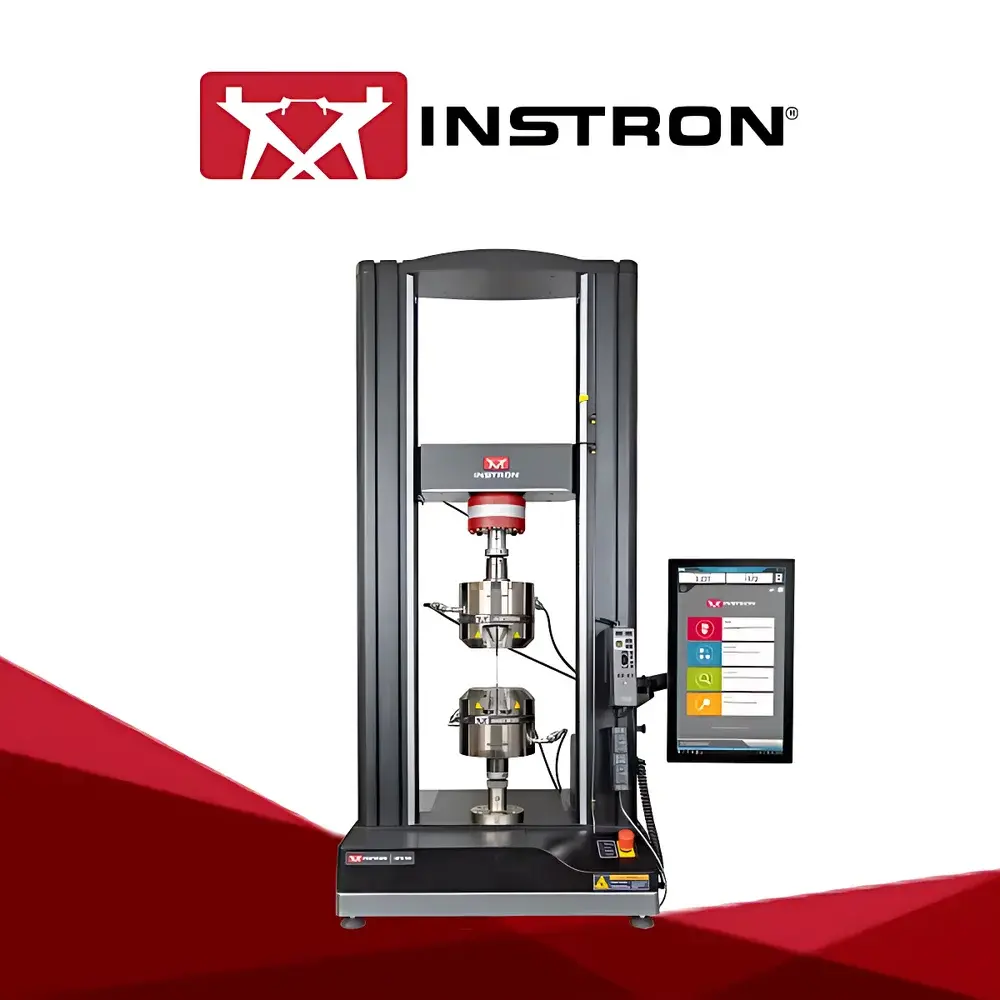
Instron 68TM-100 100 kN Dual-Column Tabletop Universal Testing System
| Brand | Instron |
|---|---|
| Origin | USA |
| Manufacturer | Instron Corporation |
| Model | 68TM-100 |
| Load Capacity | 100 kN |
| Load Accuracy | ±0.5% of reading (down to 0.1% FS with 2580 series transducers, Advanced Performance option) |
| Position Resolution | 2.69 nm |
| Crosshead Travel | 1097 mm (E1) / 1582 mm (E2) |
| Vertical Test Space | 1168 mm (E1) / 1672 mm (E2) |
| Horizontal Test Space | 420 mm |
| Speed Range | 0.001–508 mm/min |
| Data Acquisition Rate | Up to 5 kHz (synchronized force, displacement, strain) |
| Compliance | ASTM E4, E8, E9, E21, ISO 6892-1, ISO 7500-1, GB/T 228.1, EN 10002-4, ISO 9513 |
Overview
The Instron 68TM-100 is a dual-column, tabletop universal testing system engineered for high-precision mechanical property evaluation of metals, polymers, composites, elastomers, adhesives, and biomedical materials. Built on Instron’s proven 6800 Series architecture, it operates on the principle of servo-controlled electromechanical actuation, delivering repeatable, traceable, and standards-compliant force-displacement data under controlled loading conditions. With a maximum load capacity of 100 kN, the system supports static tensile, compression, flexure, peel, puncture, shear, and friction testing—fully aligned with routine QC/QA workflows and advanced R&D protocols. Its rigid frame construction—featuring preloaded bearings, precision-ground ball screws, reinforced crosshead and base plates, and low-stretch drive belts—ensures minimal compliance and exceptional axial stiffness (180 kN/mm), critical for accurate modulus determination and low-force/high-resolution measurements.
Key Features
- Patented Operator Protection Architecture: Integrates intelligent workflow logic to enforce safe system states during setup, execution, and return phases—reducing human error and mitigating risk during manual operation.
- Auto-Positioning Functionality: Stores and recalls optimal grip separation and crosshead start positions per test method, ensuring inter-operator consistency and eliminating manual setup variability.
- Collision Detection & Protection: Automatically decelerates or halts crosshead motion upon detection of unexpected force during manual positioning or return sequences—preserving both specimen integrity and load cell calibration.
- Ergonomic Integrated Handwheel & Customizable Control Panel: Features tactile position micro-adjustment, programmable function keys, and real-time status indicators for immediate recognition of safety mode activation or deactivation.
- Smart Pneumatic Clamp Control (Optional): Limits clamp closing pressure and velocity during setup to minimize operator pinch hazards—particularly valuable in high-throughput lab environments.
- Brushless AC Servo Motor: Enables uninterrupted cyclic, creep, and relaxation testing for up to 10 consecutive days at 25 °C and 1 Hz frequency—validated for long-duration material stability studies.
Sample Compatibility & Compliance
The 68TM-100 accommodates specimens ranging from thin films and foils to structural metallic coupons and composite laminates, leveraging over 300 standardized fixtures documented in the Instron Fixtures Handbook. It is fully compliant with international mechanical testing standards including ASTM E4 (load verification), E8/E8M (tensile testing of metallic materials), E9 (compression testing), E21 (tensile testing of metallic materials at elevated temperatures), ISO 6892-1 (metallic materials — tensile testing), ISO 7500-1 (static calibration of force-proving instruments), GB/T 228.1 (Chinese national standard for metallic tensile testing), and EN 10002-4 (strain measurement accuracy). Force measurement uncertainty meets ISO 7500-1 Class 0.5 requirements when equipped with 2580-series load cells and the Advanced Performance option; strain measurement conforms to ASTM E83 Class B-2 and ISO 9513 Class 1 specifications.
Software & Data Management
Controlled exclusively by Bluehill Universal software, the 68TM-100 delivers auditable, secure, and interoperable test execution. Bluehill Universal supports 21 CFR Part 11 compliance through electronic signatures, role-based access control, audit trail logging, and immutable data archiving—making it suitable for regulated environments governed by FDA, ISO 17025, or GLP/GMP frameworks. The software enables method-driven test sequencing, real-time curve overlay, automated pass/fail evaluation against user-defined limits, and export to CSV, PDF, XML, or directly to LIMS via API integration. Synchronized acquisition across force, displacement, and strain channels at up to 5 kHz ensures fidelity in dynamic event capture—essential for evaluating rate-dependent behavior such as yield point elongation or viscoelastic transitions.
Applications
This system serves as a primary platform for mechanical characterization across aerospace (e.g., titanium alloy tensile strength validation), automotive (composite bumper energy absorption), medical device development (suture tensile strength, stent radial force), packaging (peel adhesion of laminated films), and academic research (polymer crystallinity–modulus correlation). Its versatility extends to specialized applications including ASTM D638/D695/D790-compliant polymer testing, ISO 1133 melt flow index correlation studies, and ISO 148-1 Charpy impact pre-screening via quasi-static simulation. The E2 height configuration further enables large-format composite panel compression testing per ASTM D3410.
FAQ
What load cell options are compatible with the 68TM-100?
The system supports Instron’s 2530 and 2580 series load cells, with full-range accuracies of ±0.5% (to 0.4% FS with 2530) or ±0.5% (to 0.1% FS with 2580 + Advanced Performance option).
Is the 68TM-100 suitable for fatigue testing?
It is optimized for static and quasi-static tests; for high-cycle fatigue, Instron recommends the ElectroPuls or 8800 series servo-hydraulic systems.
Can Bluehill Universal be validated for GxP environments?
Yes—pre-qualified IQ/OQ documentation packages and 21 CFR Part 11 configuration guides are available directly from Instron for laboratory validation support.
What environmental conditions are required for operation?
Ambient temperature: +5 °C to +40 °C; relative humidity: 10–90% non-condensing at 20 °C; IP2X-rated enclosure—additional enclosures recommended for corrosive or particulate-laden environments.
How is system calibration maintained over time?
Load frame stiffness and displacement calibration are factory-verified per ISO 7500-1 and ASTM E4; periodic verification using NIST-traceable reference standards and third-party accredited laboratories is recommended annually or per internal quality protocol.



