
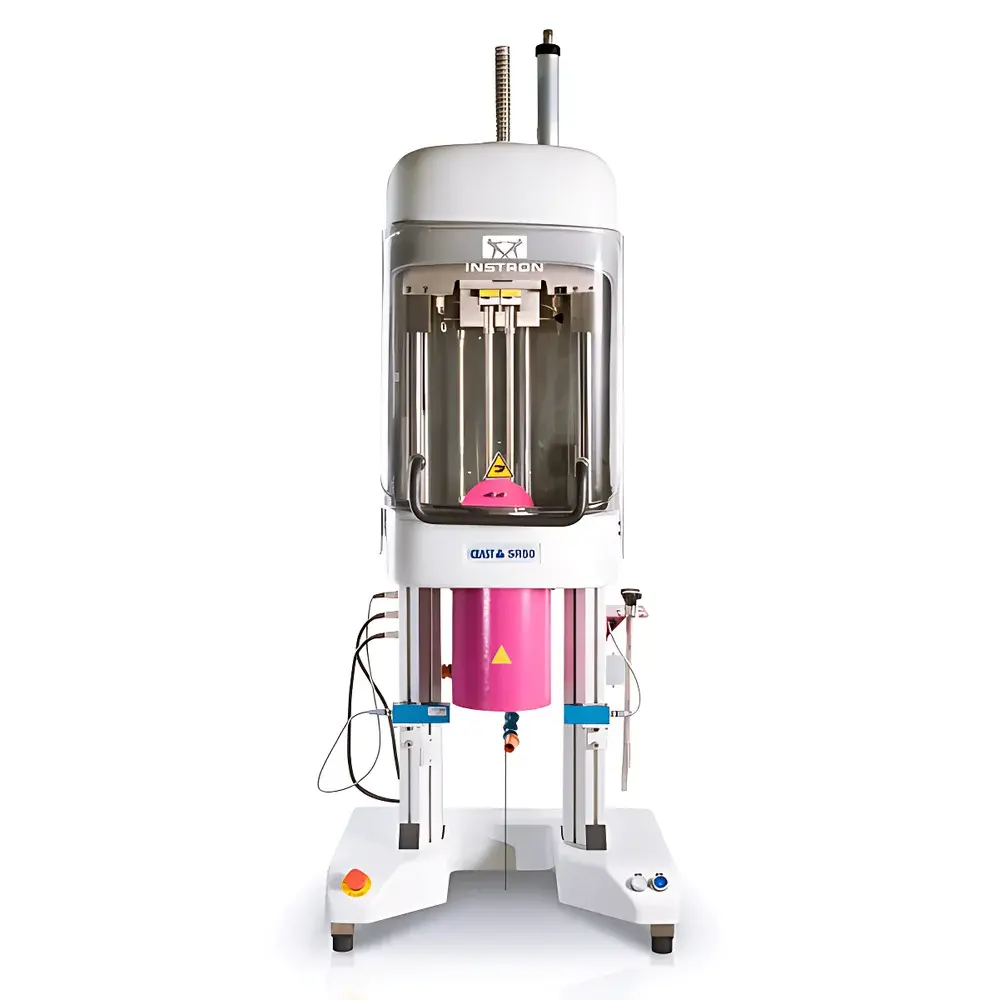
INSTRON CEAST SmartRHEO Series Capillary Rheometer
| Brand | INSTRON |
|---|---|
| Origin | Italy |
| Manufacturer | CEAST (INSTRON Group) |
| Type | Capillary Rheometer |
| Models | CEAST SR20 / CEAST SR50 |
| Force Range | 20 kN (SR20), 50 kN (SR50) |
| Barrel Diameter | 15 mm standard |
| Sample State | Solid (melted in situ) |
| Dual-Barrel Configuration | Yes |
| Independent Load Cells | Two (one per barrel) |
| Barrel Pressure Sensors | Integrated |
| Compliance | ASTM D3835, ISO 11443, ISO 6721-6, USP <1043>, GLP/GMP-ready software architecture |
Overview
The INSTRON CEAST SmartRHEO Series Capillary Rheometer is a high-precision, dual-barrel capillary rheological testing system engineered for the quantitative characterization of polymer melts under controlled shear and extensional flow conditions. Operating on the principle of capillary extrusion rheology—where molten polymer is forced through a precision-ground die under calibrated piston displacement—the system measures pressure drop, volumetric flow rate, and piston displacement to derive fundamental rheological properties including apparent viscosity, shear stress, shear rate, and extensional viscosity. Designed specifically for thermoplastic and thermoset polymers in solid pellet or powder form, the SmartRHEO platform supports full melt-state rheological profiling across wide ranges of temperature (up to 450 °C), shear rate (0.01–10⁵ s⁻¹), and residence time. Its modular architecture enables seamless integration of advanced test protocols—including melt fracture detection, thermal degradation assessment, and wall-slip quantification—making it suitable for R&D laboratories, quality control environments, and regulatory-compliant material development workflows.
Key Features
- Dual-barrel configuration with independent load cells (20 kN or 50 kN capacity) and integrated barrel pressure transducers for simultaneous, interference-free comparative testing of two samples or processing conditions
- Thermally stabilized barrel assembly with axial temperature uniformity ±0.5 °C over 150 mm active zone, compliant with ISO 11443 requirements for melt temperature control
- Modular software-driven test modules: Melt Fracture (high-speed piston mode), Thermal Degradation (isothermal time-series profiling), Extensional Viscosity (Cogswell-based calculation), Wall-Slip Analysis (Mooney method), Temperature-Viscosity Modeling (Arrhenius, WLF, and modified Arrhenius fits), Advanced Curve Fitting (Power Law, Cross, Yasuda-Carreau, polynomial models), and Stress Relaxation (post-shear decay kinetics)
- Full compliance with FDA 21 CFR Part 11 for electronic records and signatures; audit trail logging, user role-based access control, and password-protected instrument operation
- Standard 15 mm internal diameter barrel with interchangeable dies (L/D = 10, 20, 30, 40); optional micro-barrel configurations available for low-volume or high-viscosity screening
Sample Compatibility & Compliance
The SmartRHEO accommodates solid-state polymeric feedstocks—including virgin resins, compounded blends, filled systems (e.g., glass-fiber or mineral-filled), and reactive thermosets—requiring no pre-melting or solvent handling. All sample preparation occurs in situ under inert atmosphere (N₂ purge compatible), minimizing oxidative degradation. The system meets ASTM D3835 (Standard Test Method for Determination of Melt Flow Rates of Thermoplastics Using Capillary Rheometers), ISO 11443 (Plastics — Determination of the Rheological Properties of Molten Polymers Using Capillary Rheometers), and ISO 6721-6 (Plastics — Determination of Dynamic Mechanical Properties — Part 6: Shear Vibrations). Data acquisition and reporting support GLP and GMP documentation standards, including full traceability of calibration certificates, environmental logs, and operator metadata.
Software & Data Management
CEAST’s proprietary SmartRHEO software provides a validated, Windows-based interface with real-time visualization of pressure, temperature, piston displacement, and calculated rheological parameters. It delivers automated generation of flow curves (η vs. γ̇), Bagley and Rabinowitsch corrections, and time-temperature superposition master curves. Export formats include CSV, XML, and HDF5 for downstream integration with CAE tools (e.g., Moldflow, Polyflow) and statistical process control platforms. All modules enforce data integrity via timestamped audit trails, electronic signature capture, and revision-controlled method templates. Software validation documentation (IQ/OQ/PQ protocols) is provided for regulated environments.
Applications
- Processing window definition for extrusion, injection molding, blow molding, and thermoforming
- Quality assurance of incoming resin batches against reference flow curves
- Formulation optimization of additives (lubricants, nucleating agents, flame retardants) via wall-slip and melt strength analysis
- Thermal stability evaluation of heat-sensitive biopolymers and engineering thermoplastics
- Extensional viscosity benchmarking for fiber spinning and film blowing simulations
- Regulatory submission support for medical-grade polymer devices (ISO 10993, USP )
FAQ
What sample forms are supported?
Solid pellets, granules, or powders—no pre-melting required. The system melts and homogenizes samples in situ under controlled nitrogen purge.
Can the SR20 and SR50 be upgraded post-purchase?
Yes—hardware modules (e.g., extended temperature furnace, micro-barrel kit) and software licenses (e.g., extensional viscosity, stress relaxation) are field-installable with minimal downtime.
Is the system compatible with third-party LIMS or MES platforms?
Yes—via OPC UA and RESTful API interfaces supporting structured data exchange with laboratory information management systems and manufacturing execution systems.
How is die swell correction handled?
SmartRHEO applies automatic Bagley correction using multiple L/D dies and integrates Rabinowitsch correction for non-Newtonian effects during viscosity calculation.
Does the software support multi-user environments with role-based permissions?
Yes—administrator, analyst, and reviewer roles are enforced with configurable access rights to methods, reports, and calibration functions per 21 CFR Part 11 requirements.



