
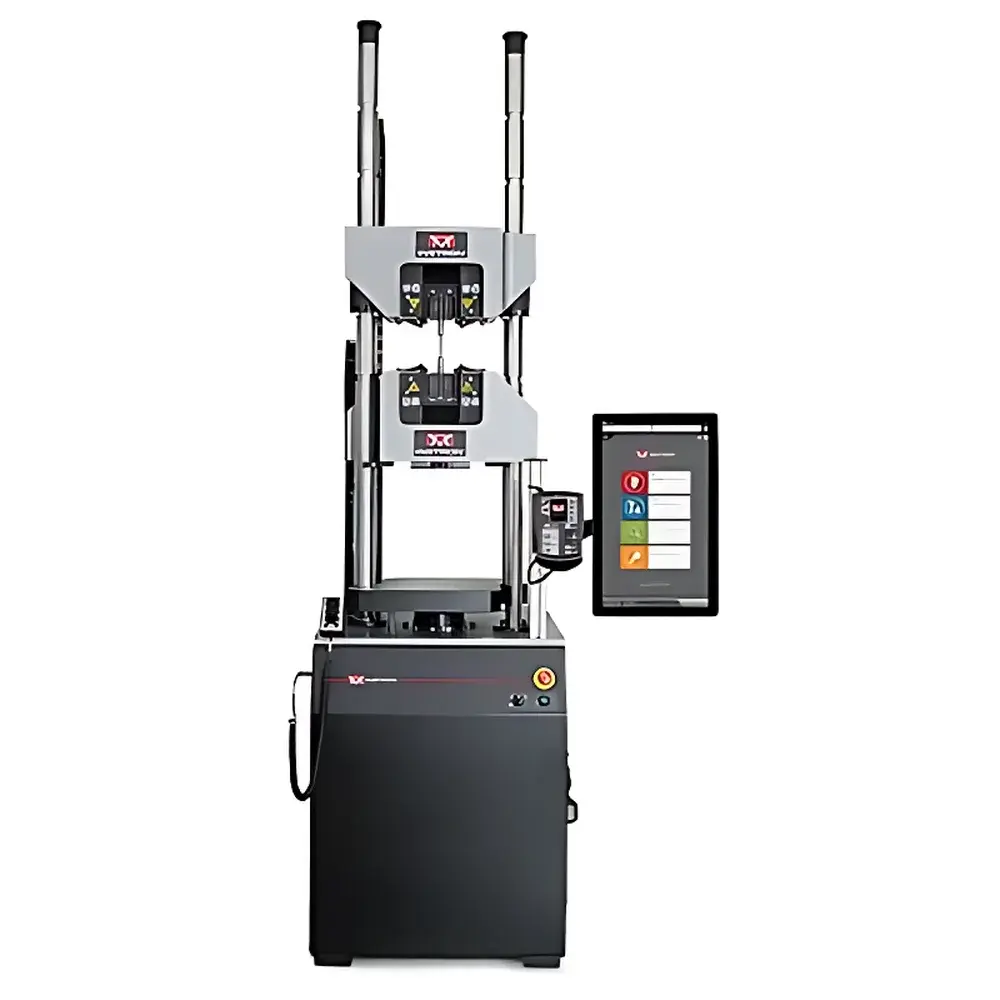
Instron DX Series Hydraulic Universal Testing Machine
| Brand | Instron |
|---|---|
| Origin | USA |
| Manufacturer Type | Manufacturer |
| Origin Category | Imported |
| Model | DX |
| Instrument Type | Hydraulic Universal Testing Machine |
| Load Capacities | 150 kN, 300 kN, 600 kN |
| Crosshead Speed Accuracy | ±0.5% of set speed |
| Load Measurement Accuracy | ±0.5% of reading (down to 1/250 of load cell full scale) |
| Strain Measurement Accuracy | ±0.5% of extensometer reading (down to 1/50 of extensometer full scale) |
| Data Acquisition Rate | Up to 500 Hz synchronized across all channels |
| Power Supply | Single-phase 220 V ±10%, 50 Hz, 2750 VA |
| Dimensions (H×W×D) | 2353–2458 mm × 675–915 mm × 675–877 mm |
| Weight | 1000–2041 kg |
Overview
The Instron DX Series Hydraulic Universal Testing Machine is an engineered solution for high-force mechanical testing of metals, composites, concrete, and other structural materials requiring loads up to 600 kN. Built on a monolithic hydraulic architecture, the DX platform integrates the load frame, high-response servo-hydraulic power unit, digital motion and load controller, and intuitive touchscreen operator interface into a single compact footprint—reducing laboratory space requirements by over 60% compared to conventional dual-unit configurations. Unlike traditional systems relying on analog signal conditioning or indirect force estimation, the DX employs direct force measurement via precision-calibrated load cells with real-time digital compensation. Its closed-loop control system utilizes advanced PID algorithms with adaptive tuning, enabling stable, high-fidelity execution of complex test profiles—including ramp-hold, cyclic loading, creep, and stress-relaxation protocols—under ISO 16840, ASTM E4, ASTM E8/E8M, and ASTM E9 compliance frameworks.
Key Features
- Integrated hydraulic architecture: Co-located frame, hydraulic power unit, electronics, and HMI eliminate inter-unit cabling, reduce installation time, and improve long-term system stability.
- Direct digital force measurement: High-stability load cells with factory-matched calibration coefficients ensure traceable accuracy per ISO 7500-1 Class 0.5.
- Auto-ranging sensor recognition: Load cells are automatically identified and scaled upon connection; single-point calibration suffices for full-range linearity—no manual range switching or transient settling delays.
- 500 Hz synchronized data acquisition: All channels—including load, displacement, strain (via connected extensometers), and auxiliary analog inputs—are sampled and timestamped at up to 500 Hz with sub-millisecond jitter, supporting dynamic event capture and high-resolution post-test analysis.
- Touchscreen operator interface: 12.1-inch capacitive display with glove-compatible operation, preloaded with standardized test methods (e.g., tensile, compression, bend), customizable workflows, and real-time curve overlay.
- Robust mechanical design: Rigid cast-iron frame with precision-ground columns, self-aligning crosshead guidance, and integrated safety interlocks compliant with ISO 13857 and EN 60204-1.
Sample Compatibility & Compliance
The DX Series accommodates specimens ranging from small metallic coupons (per ASTM E8) to large-scale reinforced concrete cylinders (per ASTM C39) and composite laminates (per ASTM D3039). Dual-test-space configuration supports simultaneous top- and bottom-loading setups—ideal for comparative testing or multi-specimen efficiency. All models meet CE marking requirements and conform to essential health and safety directives including Machinery Directive 2006/42/EC. Force and displacement measurement systems are validated per ISO 7500-1 and ISO 9513, respectively. Optional extensometers comply with ISO 9513 Class 1 or Class 0.5 specifications. System validation documentation supports GLP and GMP environments, with audit-ready calibration records traceable to NIST standards.
Software & Data Management
Control and analysis are executed via Bluehill Universal software (v5.x), a 64-bit Windows application qualified under FDA 21 CFR Part 11 for electronic records and signatures. The software provides role-based user access control, full audit trail logging (including parameter changes, test start/stop events, and data export actions), and automated report generation in PDF/A-1b or Excel formats. Raw data is stored in HDF5 format—ensuring lossless fidelity, metadata embedding (test method, operator ID, calibration dates), and compatibility with third-party analysis tools (MATLAB, Python pandas, Minitab). Optional cloud synchronization enables secure remote monitoring and centralized fleet management across multi-site laboratories.
Applications
The DX Series serves as a primary verification tool in quality assurance labs for aerospace fasteners (per NASM 1312), automotive chassis components (per SAE J211), civil infrastructure materials (per AASHTO T100), and energy sector piping (per API RP 5L3). It is routinely deployed for mechanical property certification—including ultimate tensile strength, yield offset (0.2%), modulus of elasticity, fracture toughness (KIc via SE(B) specimens), and compressive strength of grouts and mortars. Its high-force stability and thermal drift compensation make it suitable for elevated-temperature testing when paired with environmental chambers (−70 °C to +1000 °C).
FAQ
What load capacities are available in the DX Series?
The DX Series offers three standard configurations: 150DX (150 kN), 300DX (300 kN), and 600DX (600 kN), each rated for static and quasi-static testing per ISO 6892-1 and ASTM E4.
Does the DX support third-party extensometers?
Yes—the system accepts analog and digital extensometers with LVDT, strain-gauge, or optical outputs via configurable input modules; automatic identification and scaling occur upon connection.
Is Bluehill Universal software included with the system?
Yes—every DX system ships with a perpetual license for Bluehill Universal, including all standard test methods, reporting templates, and firmware update entitlements for the first 12 months.
Can the DX be integrated into an existing LIMS or MES environment?
Yes—through native RESTful API support and OPC UA server capability, the DX enables bidirectional data exchange with laboratory information management systems and manufacturing execution systems.
What maintenance intervals are recommended?
Hydraulic fluid analysis and filter replacement every 2,000 operating hours; annual verification of load cell linearity and crosshead displacement accuracy per ISO 7500-1; biennial full system validation recommended for regulated environments.



