
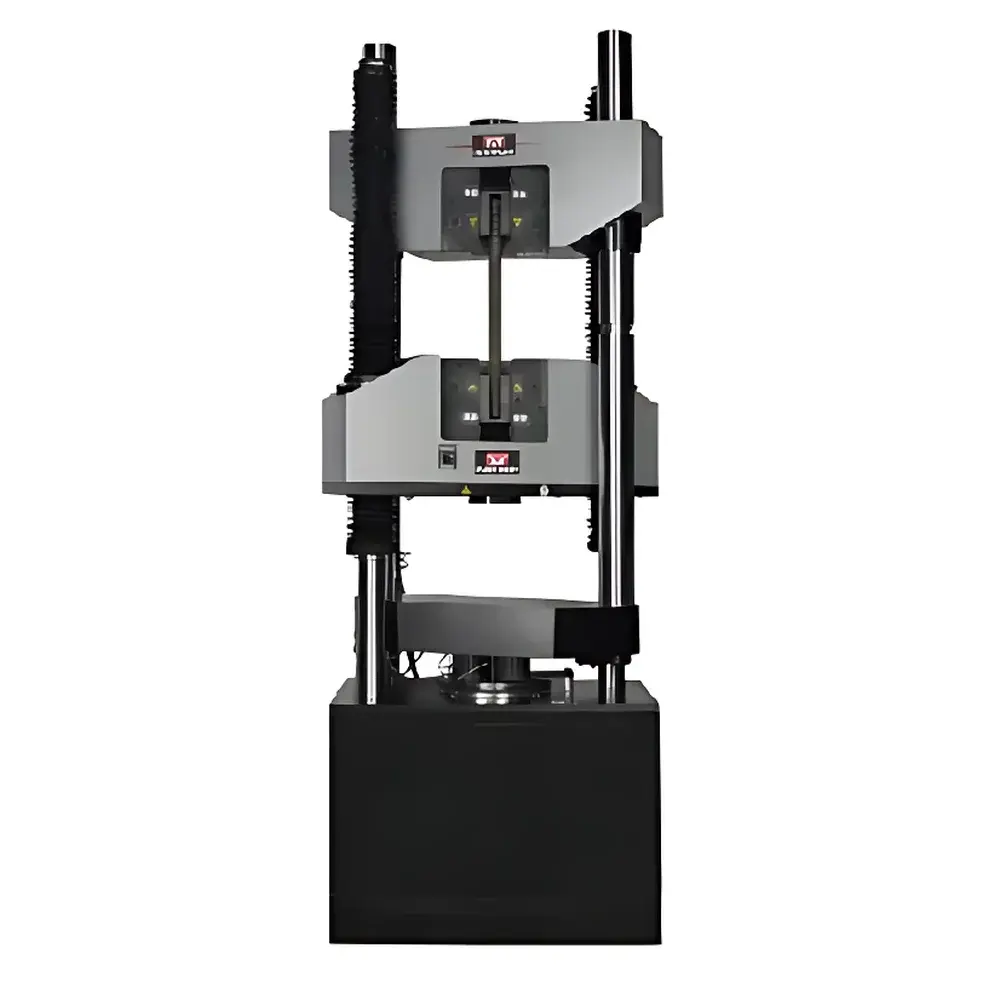
Instron HDX Series High-Load Hydraulic Universal Testing Machine
| Brand | Instron |
|---|---|
| Origin | USA |
| Manufacturer Type | Direct Manufacturer |
| Origin Category | Imported |
| Model | HDX |
| Instrument Type | Hydraulic Universal Testing Machine |
| Frame Load Capacity | 1000 kN |
| Test Speed (Full Load) | 100 mm/min (39 in/min) |
| Position Resolution (Standard) | 6.35 µm (0.00025 in) |
| Position Accuracy (Standard) | ±1% or 0.254 mm (0.01 in), whichever is greater |
| Position Resolution (High-Resolution Option) | 1.27 µm (0.00004 in) |
| Position Accuracy (High-Resolution Option) | ±0.5% or 0.13 mm (0.005 in), whichever is greater |
| Actuator Stroke | 254 mm (10 in) |
| Crosshead Adjustment Speed | 300 mm/min (12 in/min) |
| Tensile Test Space (Open Crosshead) | 0–760 mm (0–30 in) |
| Tensile Test Space (Closed Crosshead) | 0–1270 mm (0–50 in) |
| Specimen Gauge Length Range (Open Crosshead) | 400–1050 mm (16–41.5 in) |
| Specimen Gauge Length Range (Closed Crosshead) | 400–1665 mm (16–65.5 in) |
| Compression Test Space | 0–1000 mm (0–39.5 in) |
| Horizontal Clearance | 741 mm (29.2 in) |
| Floor Footprint | 1228 mm W × 832 mm D (48.4 in × 32.8 in) |
| Maximum Operating Height | 3366 mm (132.5 in) |
Overview
The Instron HDX Series High-Load Hydraulic Universal Testing Machine is an engineered solution for high-force mechanical characterization of structural and industrial materials under demanding laboratory and production QA/QC environments. Built upon a rigid, dual-space frame architecture, the HDX platform employs servo-controlled hydraulic actuation to deliver precise, repeatable force application up to 1000 kN — enabling standardized tensile, compression, flexure, shear, and bend testing per ASTM E8/E9, ISO 6892-1, ISO 7500-1, and EN 10002-2. Its dual-test-space configuration—featuring both open and closed crosshead variants—supports versatile specimen handling across wide dimensional ranges while maintaining metrological traceability and mechanical stability throughout the full stroke range. The system integrates Instron’s proprietary load cell technology with real-time zero-point compensation, ensuring long-term calibration integrity and minimizing thermal drift during extended test cycles.
Key Features
- Dual-test-space frame design: accommodates both open-hydraulic-brake and manually locked closed crossheads, optimizing flexibility for large-scale specimens and high-rigidity setups.
- Hydraulically actuated, digitally controlled loading system with variable pressure supply—dynamically modulates oil pressure to match instantaneous load demand, reducing heat generation and extending hydraulic fluid service life.
- High-resolution positioning capability: standard resolution of 6.35 µm (0.00025 in) with optional high-resolution mode at 1.27 µm (0.00004 in), supporting fine-strain measurements and low-displacement compliance testing.
- Rigid, reinforced frame construction minimizes deflection under peak load, enhancing measurement fidelity and reducing routine maintenance requirements.
- Integrated digital control electronics featuring high-bandwidth signal conditioning and sub-millisecond response time for accurate closed-loop control of force, displacement, and strain.
- Modular accessory interface supporting interchangeable grips, fixtures, extensometers, environmental chambers, and custom load train configurations.
Sample Compatibility & Compliance
The HDX series is validated for testing metallic and quasi-brittle materials including structural steel bars, reinforcing rebar, wire mesh, seamless tubes, forged rods, fasteners, and pre-stressed concrete specimens. Its wide gauge length range (400–1665 mm) and vertical travel capacity (up to 1270 mm with closed crosshead) support full-scale component-level validation in accordance with ASTM A370, ISO 6892-2, and EN 15630-1. All force measurement channels are traceable to NIST standards and certified to ISO/IEC 17025-accredited calibration protocols. System compliance includes adherence to ISO 16750-2 (mechanical shock/vibration), CE Machinery Directive 2006/42/EC, and UL 61010-1 safety requirements.
Software & Data Management
Control and analysis are performed via Bluehill Universal software—a modular, audit-ready platform compliant with FDA 21 CFR Part 11 and GLP/GMP data integrity requirements. Features include electronic signatures, role-based access control, automatic metadata capture (test parameters, operator ID, calibration status), and tamper-evident audit trails. Raw data export supports CSV, XML, and ASTM E1432-compliant formats. Custom test methods can be programmed using intuitive drag-and-drop logic, with embedded pass/fail criteria and automated report generation aligned with internal SOPs or external regulatory submissions.
Applications
- Tensile testing of high-strength alloy steels, titanium alloys, and advanced composites per ASTM E21, ISO 6892-1, and MIL-STD-810.
- Compression testing of concrete cylinders, grout samples, and masonry units per ASTM C39, C109, and EN 12390-3.
- Three- and four-point bending of structural beams, rails, and extrusions per ASTM D7264 and ISO 14125.
- Shear and torsional characterization of weldments, bolted joints, and laminated assemblies.
- Creep and stress-relaxation evaluation under sustained loads using programmable dwell sequences and temperature-controlled environmental enclosures (optional).
- Qualification testing of civil infrastructure components—including anchor systems, cable assemblies, and seismic dampers—under cyclic and monotonic loading profiles.
FAQ
What is the maximum allowable test speed at full 1000 kN load?
The HDX achieves 100 mm/min (39 in/min) at rated capacity, maintained through closed-loop hydraulic pressure regulation and optimized pump displacement.
Can the HDX accommodate non-standard specimen geometries such as irregular castings or welded assemblies?
Yes—custom fixtures, universal wedge grips, and modular load train adapters enable secure clamping and alignment of complex geometries without compromising force transmission fidelity.
Is the system compatible with third-party extensometers or strain measurement systems?
All HDX models feature analog and digital I/O interfaces conforming to ASTM E83 Class B and ISO 9513 Class 0.5 specifications, supporting integration with contact and non-contact extensometers from major vendors.
How frequently does the hydraulic system require scheduled maintenance?
With variable-pressure operation and integrated filtration, typical oil change intervals exceed 5,000 operating hours; frame lubrication and seal inspection are recommended annually per preventive maintenance schedule.
Does Bluehill Universal support multi-user environments with version-controlled test methods?
Yes—centralized method libraries, revision history tracking, and role-based editing permissions ensure consistent execution across global laboratories and contract testing facilities.



