
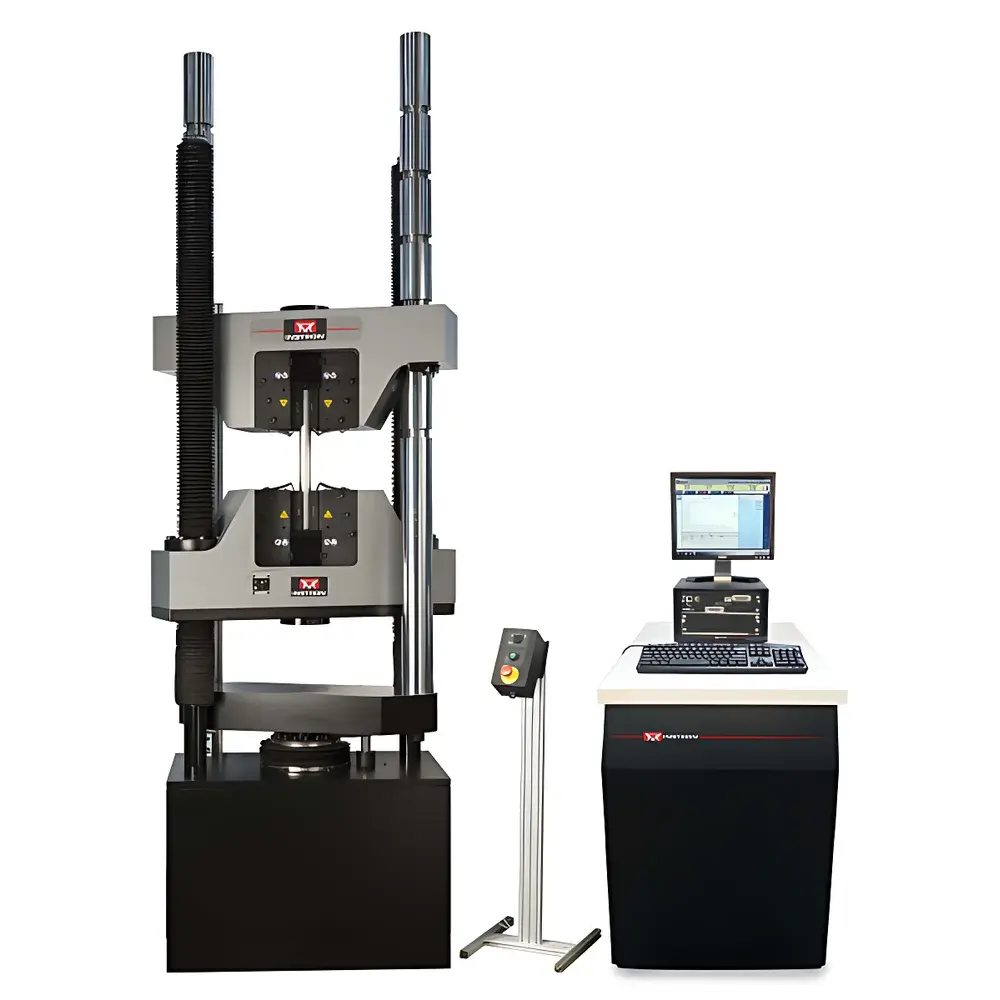
Instron MDX Series High-Load Hydraulic Universal Testing Machine
| Brand | Instron |
|---|---|
| Origin | USA |
| Manufacturer Type | Original Equipment Manufacturer (OEM) |
| Origin Category | Imported |
| Model | MDX |
| Instrument Type | Hydraulic Universal Testing Machine |
| Control System | Instron 59-Series Controller (1000 Hz Closed-Loop Rate) |
| Drive System | High-Response Servo Valve (200 Hz Bandwidth) |
| Hydraulic Power Unit | Instron V11b Variable-Pressure Pump |
| Clamp Integration | Integrated Hydraulic Wedge Grips in Crosshead |
| Software | Instron Partner Software |
| Load Capacity Options | 600 kN, 1000 kN, 1500 kN |
Overview
The Instron MDX Series High-Load Hydraulic Universal Testing Machine is an engineered solution for static and quasi-static mechanical characterization of high-strength structural materials—including advanced composites, high-tensile steels, concrete, aerospace alloys, and heavy-section polymers. Built upon Instron’s legacy of precision force measurement and robust electromechanical architecture, the MDX platform employs a closed-loop hydraulic actuation system governed by the Instron 59-Series digital controller operating at a 1000 Hz sampling and control rate. This enables precise load, displacement, and strain regulation across demanding test protocols defined by ASTM E4, ASTM E8/E8M, ISO 6892-1, ISO 15630, and EN 10002-1. The system’s core design philosophy centers on thermal stability, long-term repeatability, and operational efficiency—critical requirements for accredited testing laboratories conducting GLP-compliant or ISO/IEC 17025-certified material verification.
Key Features
- High-fidelity closed-loop control: 1000 Hz real-time feedback loop ensures minimal phase lag and optimal tracking accuracy during ramp-and-hold, creep, and relaxation tests.
- Integrated hydraulic wedge grips: Mounted directly within the crosshead structure; eliminate external levers or manual tightening mechanisms and maintain constant clamping force throughout the test cycle.
- V11b variable-pressure hydraulic power unit: Dynamically modulates system pressure to match instantaneous load demand—reducing oil temperature rise by up to 40%, extending fluid service life, and eliminating the need for external cooling circuits.
- 200 Hz servo valve bandwidth: Enables accurate dynamic response to high-frequency internal vibrations (up to 30 Hz) generated during composite fracture or brittle material failure—supported by intelligent signal filtering algorithms embedded in the 59-Series controller firmware.
- Modular crosshead design: Open-frame architecture accommodates large specimens and facilitates rapid fixture reconfiguration for tension, compression, bending, shear, and flexure configurations.
- Instron load cell technology: Precision-calibrated, temperature-compensated transducers with <±0.5% of reading accuracy (per ASTM E4) and active zero-tracking capability ensure traceable, repeatable force measurement across full capacity range.
Sample Compatibility & Compliance
The MDX Series supports specimen geometries ranging from standard tensile coupons (e.g., ASTM E8 sub-sized bars) to full-scale structural components (e.g., reinforced concrete beams, wind turbine blade sections). Its dual-test-space configuration permits simultaneous setup of tension and compression fixtures—optimizing throughput in high-volume QA/QC environments. All mechanical components comply with CE Machinery Directive 2006/42/EC and meet essential safety requirements outlined in ISO 12100. Force calibration is NIST-traceable and supports audit readiness for FDA 21 CFR Part 11–governed pharmaceutical packaging validation, aerospace component certification per SAE AMS 2300, and civil infrastructure testing under AASHTO T22/T106.
Software & Data Management
Instron Partner Software provides a validated, configurable environment for test method development, execution, and post-processing. It supports automated compliance checking against preloaded standards (e.g., automatic yield point detection per ISO 6892-1 Annex B), real-time statistical monitoring (X-bar/R charts), and secure data archiving with full audit trail functionality—including user login logs, parameter change history, and electronic signature support aligned with 21 CFR Part 11 Subpart C requirements. Raw channel data (load, displacement, extensometer, pressure) is stored in vendor-neutral ASCII format for third-party analysis or LIMS integration.
Applications
- Tensile testing of high-strength steel rebar and prestressing tendons (ASTM A615/A722)
- Compression testing of ultra-high-performance concrete (UHPC) and fiber-reinforced cementitious composites
- Three- and four-point bending of composite laminates per ASTM D7264
- Shear testing of adhesive bonds and sandwich core materials (ASTM D5656)
- Creep and stress-relaxation evaluation of thermoset resins and polymer matrix composites
- Mechanical qualification of additively manufactured metal parts (ASTM F3049)
- Structural validation of offshore platform joints and pipeline girth welds
FAQ
What load capacities are available in the MDX Series?
The MDX platform is offered in three nominal force ratings: 600 kN, 1000 kN, and 1500 kN—each configured with appropriately rated load cells, hydraulic cylinders, and structural frames.
Is the system compatible with extensometers and other third-party sensors?
Yes. The 59-Series controller features eight analog input channels supporting LVDT, strain gauge, and digital encoder signals. Instron-branded axial and clip-on extensometers (e.g., AUTOX 750) are fully integrated with automatic calibration and thermal drift compensation.
Can the MDX be upgraded with additional test modules post-purchase?
Absolutely. The modular hydraulic manifold, standardized mounting interfaces, and open software architecture allow seamless integration of custom fixtures, environmental chambers (e.g., −70 °C to +300 °C), and high-speed video extensometry systems.
Does the V11b pump require scheduled oil changes?
Under typical laboratory usage (≤6 hours/day), Instron recommends oil analysis every 2,000 operating hours; replacement intervals typically exceed 8,000 hours due to reduced thermal degradation from variable-pressure operation.
How is system calibration maintained over time?
The MDX includes built-in verification routines for load cell linearity and crosshead displacement accuracy. Periodic verification per ASTM E4 can be performed using certified deadweight standards or reference load cells traceable to national metrology institutes.



