
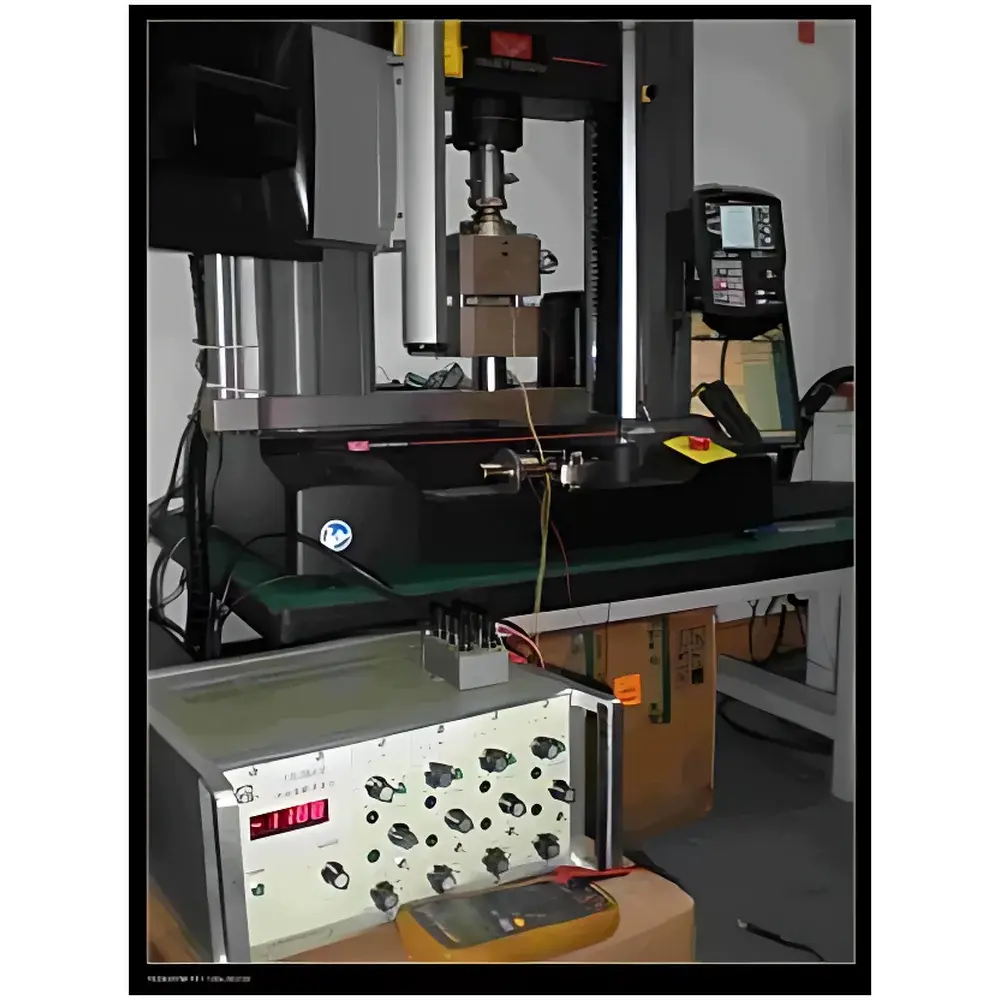
Instron Strain Gauge Measurement System for Composite Materials Testing
| Brand | Instron |
|---|---|
| Origin | Shanghai, China |
| Manufacturer Type | Manufacturer |
| Regional Category | Domestic (China) |
| Model | Instron Strain Gauge Measurement System |
| Instrument Type | Electromechanical Universal Testing Machine |
| System Composition | 4-Channel Dynamic Resistive Strain Amplifier |
| Required Hardware | Instron testing system equipped with 1–2 dedicated strain input channels |
Overview
The Instron Strain Gauge Measurement System is a precision-engineered solution designed specifically for high-fidelity mechanical property characterization of advanced composite materials where conventional extensometry is impractical or geometrically incompatible. Unlike clip-on or non-contact displacement transducers, this system relies on bonded resistive strain gauges—applied directly to the specimen surface—to capture localized, full-field-compatible axial and transverse strain data under controlled uniaxial loading. It operates on the Wheatstone bridge principle, converting minute resistance changes in the gauge grid (typically <0.1% ΔR/R) into calibrated voltage outputs proportional to microstrain (µε). The system integrates natively with Instron electromechanical universal testing machines (UTMs) via dedicated analog strain input channels and is fully synchronized with Bluehill software for real-time acquisition, closed-loop control, and post-test analysis. Its primary purpose is to support standardized mechanical testing protocols—including tensile modulus, Poisson’s ratio, tensile strength at break, elongation at break, compressive modulus, and compressive failure strain—under ASTM D3039, ISO 527-4, ISO 14126, and ASTM D6641 compliance frameworks.
Key Features
- Four-channel dynamic resistive strain amplifier with programmable gain (±10 V output range), low-noise design (<1 µV RMS noise floor), and 24-bit ADC resolution for high signal fidelity across wide dynamic ranges.
- Integrated bridge completion modules supporting quarter-, half-, and full-bridge configurations; compatible with standard 120 Ω, 350 Ω, and 1 kΩ foil strain gauges.
- Traceable calibration signal generator enabling in-situ verification of amplifier linearity, zero drift, and sensitivity per ISO/IEC 17025 requirements.
- Dual Instron Strain Interface Control Modules provide hardware-level synchronization between load cell, crosshead position, and strain channel sampling—ensuring sub-millisecond temporal alignment essential for modulus calculation accuracy.
- Designed for seamless integration with Instron 3400, 5900, and 6800 series UTMs; requires minimum one analog strain input port (up to two recommended for simultaneous axial/transverse measurement).
Sample Compatibility & Compliance
This system is optimized for flat, laminated, or tubular composite specimens—including carbon fiber-reinforced polymer (CFRP), glass fiber composites, and hybrid thermoset/thermoplastic laminates—where surface access permits gauge bonding and electrical isolation. It supports standardized test geometries defined in ISO 14126 (compressive properties of fiber-reinforced plastics), ASTM D3039/D3410 (tensile/compressive properties of polymer matrix composites), and ASTM D5379 (shear properties via V-notch rail shear). When paired with Instron fixtures such as the 2736-005 Tension/Shear Fixture or ISO 14126-compliant compression jigs, the system delivers repeatable, standards-aligned results suitable for material qualification, process validation, and regulatory submissions. All hardware components comply with CE marking directives (EMC Directive 2014/30/EU, Low Voltage Directive 2014/35/EU) and meet Instron’s internal GLP/GMP design assurance criteria for audit-ready instrumentation.
Software & Data Management
Data acquisition, control, and analysis are executed through Instron Bluehill 3 or Bluehill Universal software platforms. Strain channels appear as native test variables alongside load and displacement, enabling real-time plotting, automatic yield point detection, tangent/secant modulus computation, and Poisson’s ratio derivation from dual-channel (axial + transverse) correlation. Raw strain time-series data are stored in .iqw format with embedded metadata—including gauge factor, bridge configuration, amplifier gain, and calibration timestamp—for full traceability. Export options include CSV, Excel, and XML formats compliant with FDA 21 CFR Part 11 requirements when configured with electronic signatures and audit trail modules. All strain-derived calculations adhere to ISO 527-2 Annex B and ASTM E111 guidelines for elastic modulus determination.
Applications
- Determination of tensile and compressive elastic moduli for anisotropic composite laminates.
- Poisson’s ratio measurement across fiber orientations (0°, 90°, ±45°) to validate micromechanical models.
- Strain-to-failure characterization for brittle matrix systems where extensometer slippage compromises elongation accuracy.
- Validation of finite element model boundary conditions using experimentally derived local strain fields.
- Quality control testing of prepreg batches and cured laminate panels in aerospace and automotive Tier-1 supplier environments.
FAQ
Does this system require a specific Instron controller firmware version?
Yes—firmware v12.1 or later is required for full strain channel synchronization and Bluehill 3.5+ compatibility.
Can I use third-party strain gauges with this system?
Yes, provided they conform to industry-standard resistance values (120 Ω, 350 Ω, or 1 kΩ), gauge factor tolerance (±1%), and temperature compensation specifications aligned with the bridge completion box.
Is thermal drift compensation included?
The dynamic strain amplifier includes auto-zeroing routines and temperature-stable thin-film resistor networks; however, active thermal compensation requires external temperature sensor input and custom Bluehill script implementation.
How is calibration traceability maintained?
Each strain amplifier ships with a NIST-traceable calibration certificate; the included strain signal generator allows periodic field verification against certified reference standards per ISO/IEC 17025 Clause 6.5.
Can this system be used for fatigue testing?
Yes—when configured with Instron’s WaveMatrix or Bluehill Fatigue software, it supports high-cycle strain-controlled fatigue tests up to 100 Hz with continuous strain monitoring and cycle-by-cycle data logging.



