
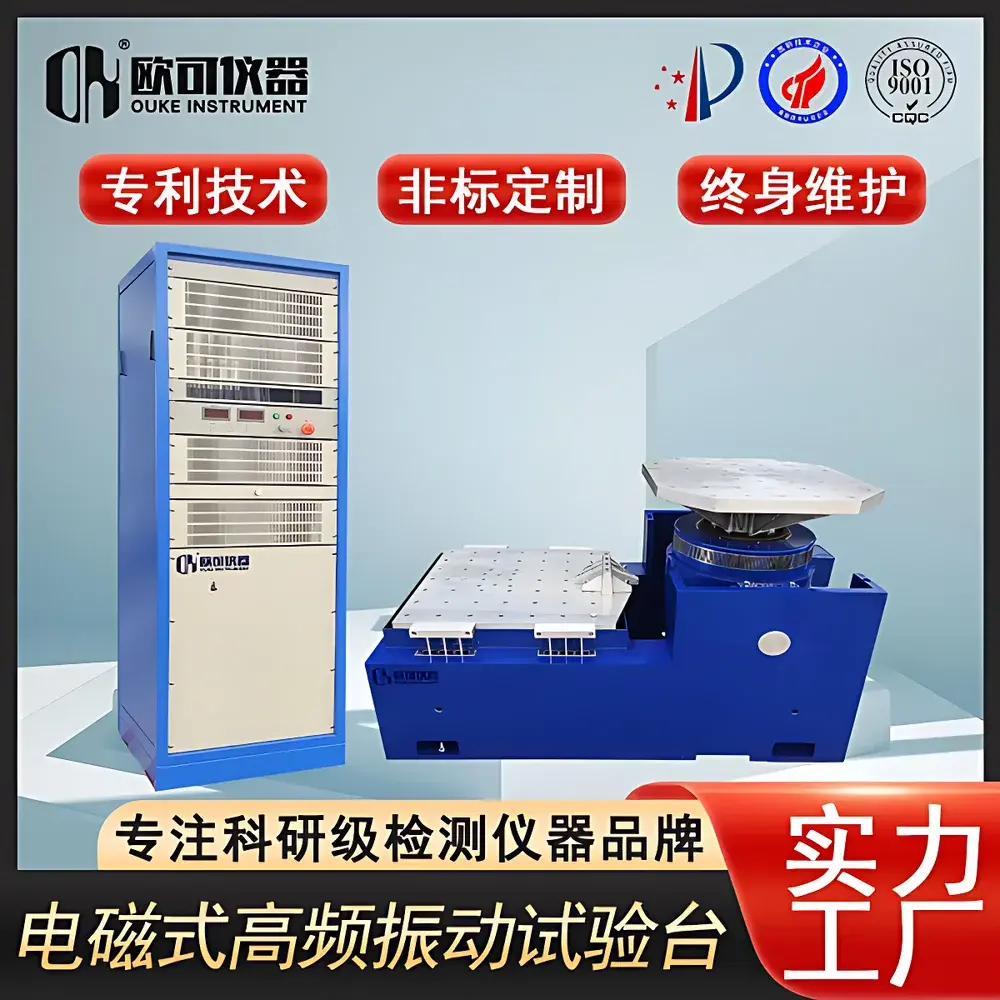
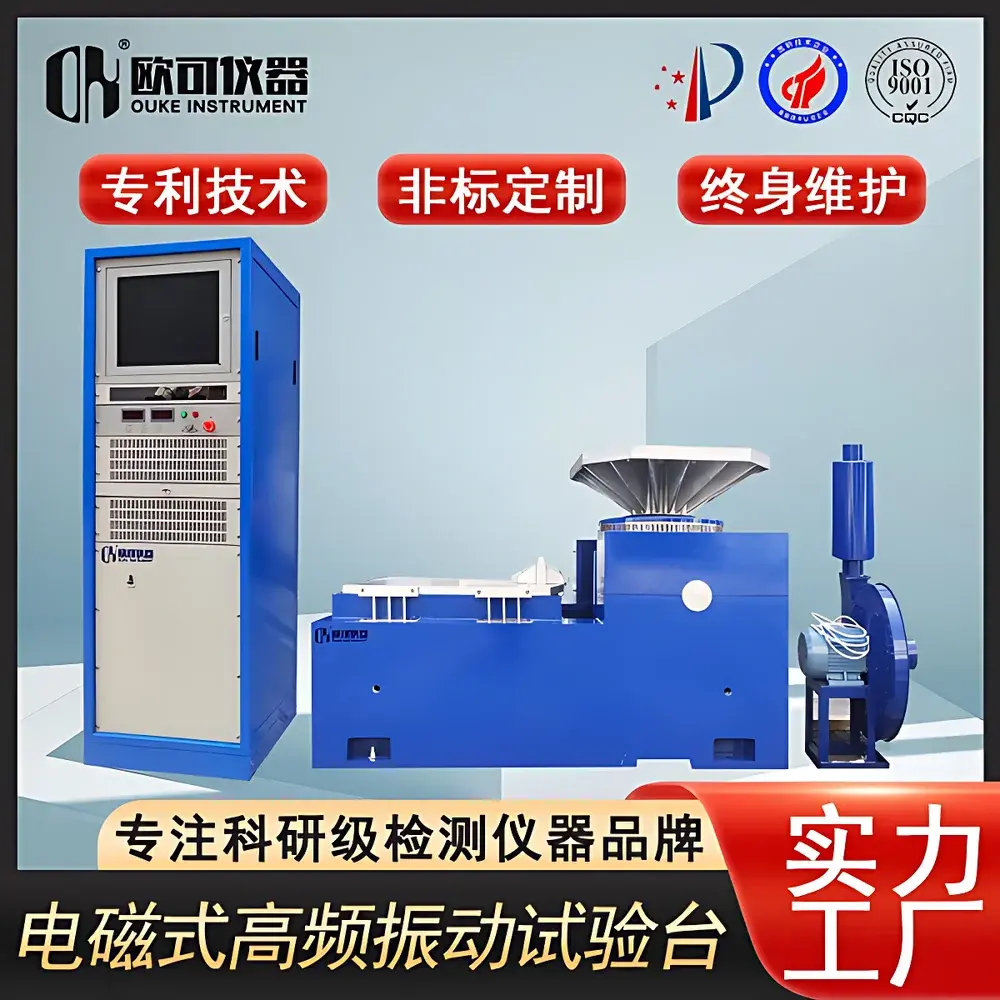
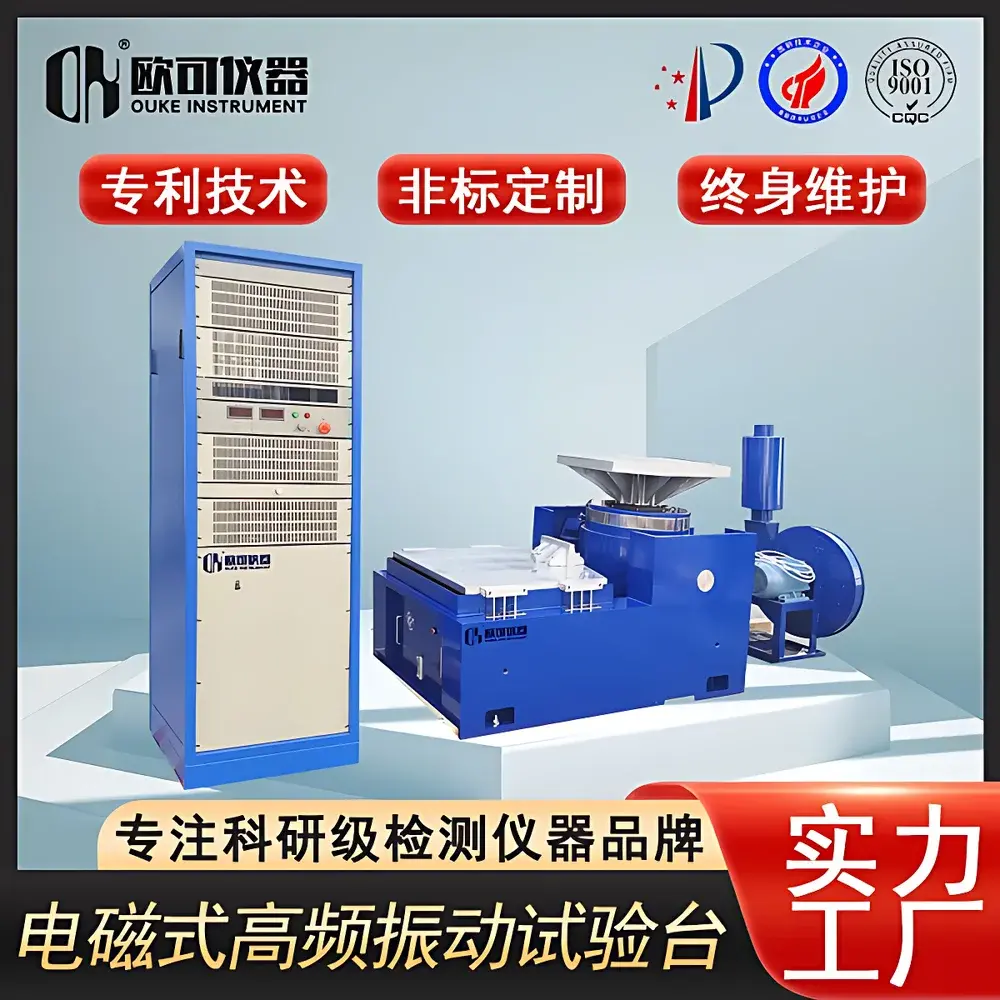
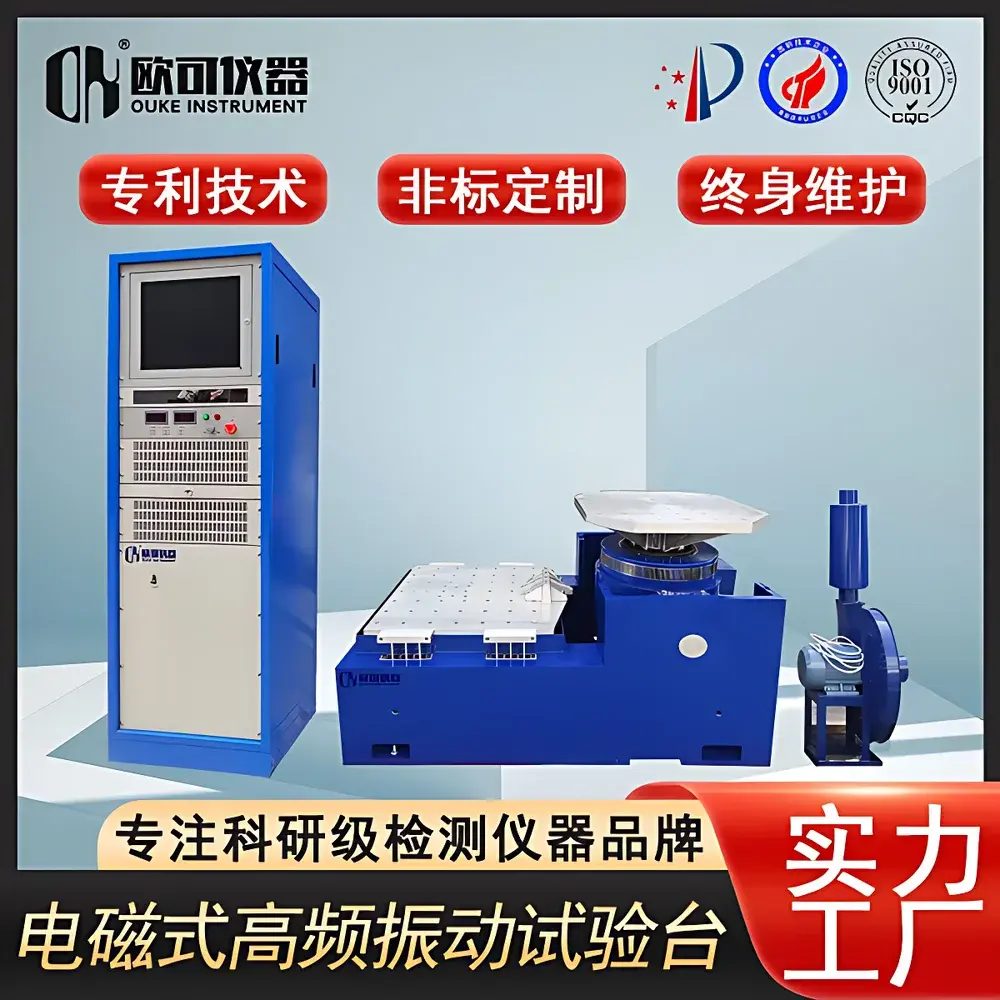
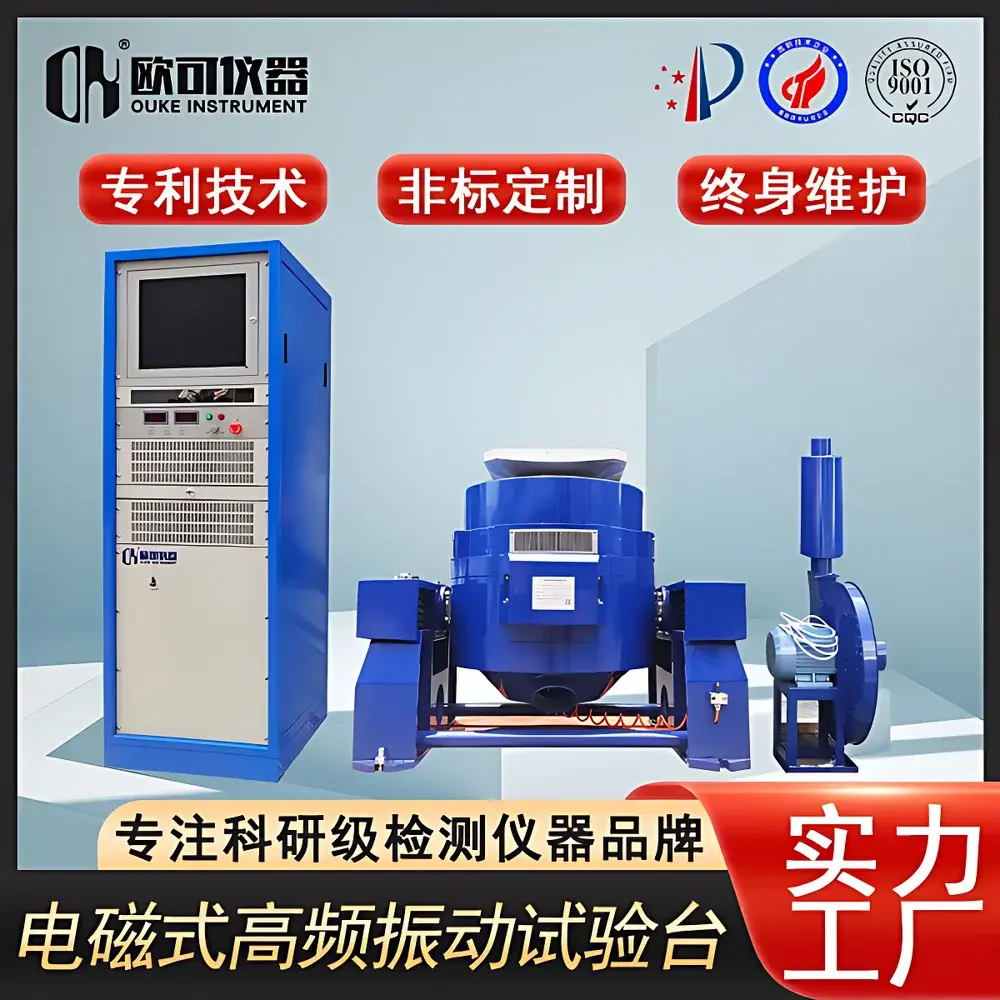
OK Instruments OK-ES-2 Electro-Hydraulic Vibration Shaker
| Brand | OK Instruments |
|---|---|
| Origin | Guangdong, China |
| Manufacturer Type | Direct Manufacturer |
| Product Category | Domestic |
| Model | OK-ES-2 |
| Instrument Type | Electro-Hydraulic Vibration Shaker |
| Rated Thrust | 1.98 kN |
| Rated Frequency Range | 5–5000 Hz |
| Maximum Test Load | 70 kg |
| Table Dimensions | 300 × 300 × 30 mm |
| Maximum Acceleration | 10 g |
Overview
The OK Instruments OK-ES-2 Electro-Hydraulic Vibration Shaker is a high-performance, closed-loop controlled dynamic testing system engineered for precision simulation of mechanical vibration environments across a broad frequency spectrum (5–5000 Hz) with high-force fidelity. Unlike electromagnetic shakers—optimized for high-frequency, low-to-mid amplitude excitation—the OK-ES-2 leverages electro-hydraulic servo technology to deliver superior low-frequency force density, large displacement capability, and robust load handling. Its core operational principle relies on the conversion of electrical control signals into proportional hydraulic flow via a high-bandwidth electro-hydraulic servo valve, driving a double-acting hydraulic actuator to generate controlled linear motion. Real-time feedback from integrated LVDT displacement transducers and piezoelectric accelerometers enables tight closed-loop regulation of acceleration, velocity, displacement, and force profiles in accordance with standardized test spectra (e.g., sine, random, shock, and road profile simulations). Designed for laboratory and industrial R&D environments, the OK-ES-2 meets fundamental requirements for structural dynamics validation, modal analysis, and durability qualification under realistic mechanical stress conditions.
Key Features
- Electro-hydraulic servo architecture delivering high thrust-to-weight ratio and extended stroke capacity beyond electromagnetic alternatives
- Rated thrust of 1.98 kN with peak capability supporting up to 70 kg test mass under full acceleration envelope
- Wide operational bandwidth: 5 Hz to 5000 Hz—engineered for both low-frequency structural resonance studies and mid-frequency component-level qualification
- Rigid 300 × 300 × 30 mm aluminum alloy table with precision-machined mounting surface (flatness ≤ ±5 µm) and optimized stiffness-to-mass ratio
- Integrated high-resolution position and acceleration feedback channels compliant with ISO 5347 and ASTM E1435 standards for shaker calibration traceability
- Modular control interface compatible with industry-standard vibration controllers (e.g., LDS SCADAS, Vibration Research VR9500, or m+p VibControl)
Sample Compatibility & Compliance
The OK-ES-2 accommodates rigidly mounted specimens ranging from small mechanical subassemblies to medium-scale structural components, including automotive chassis modules, electronic enclosures, aerospace panel sections, and industrial sensor housings. Its 70 kg payload capacity and 10 g peak acceleration rating enable compliance with common environmental stress screening (ESS) and reliability test protocols per MIL-STD-810H Method 514.7 (Vibration), IEC 60068-2-64 (Random Vibration), and ISO 16750-3 (Road Vehicle Vibration). The system supports GLP-compliant test execution when paired with validated controller firmware featuring audit-trail logging, user access levels, and electronic signature support per FDA 21 CFR Part 11 requirements.
Software & Data Management
The shaker operates seamlessly with third-party real-time vibration control platforms that provide spectral definition, test sequencing, live monitoring, and post-test analytics. Supported test modes include swept-sine, fixed- and variable-frequency sine, wideband random (PSD-controlled), classical shock (half-sine, trapezoidal), and time-history replay (e.g., road load data). All controller systems implement IEEE 1451.4-compliant TEDS sensor integration, automatic transducer scaling, and raw data export in universal formats (e.g., UFF 58, HDF5, CSV). Calibration certificates—including sensitivity, linearity, and phase response across the rated frequency band—are provided with NIST-traceable documentation.
Applications
- Automotive: Component-level durability testing of suspension arms, brake calipers, and powertrain mounts; subsystem validation of HVAC modules and infotainment assemblies
- Aerospace: Modal survey of wing ribs and fuselage frames; flutter margin assessment of control surfaces using broadband excitation
- Electronics: PCB-level shock and vibe screening per IPC-9701; connector retention and solder joint integrity evaluation
- Energy: Vibration qualification of transformer bushings, wind turbine pitch actuators, and nuclear instrumentation housings
- Academic Research: Experimental modal analysis (EMA), operational modal analysis (OMA), and forced-response characterization of composite laminates and additively manufactured structures
FAQ
What distinguishes electro-hydraulic shakers from electromagnetic shakers?
Electro-hydraulic systems excel in low-frequency, high-force applications due to hydraulic amplification—enabling larger displacements and higher thrust at frequencies below 500 Hz. Electromagnetic shakers offer superior waveform fidelity above 1 kHz but are limited in stroke and peak force.
Is the OK-ES-2 suitable for seismic simulation?
While not a full-scale shake table, the OK-ES-2 supports low-frequency sine sweeps and time-history replay down to 5 Hz—making it appropriate for component-level seismic qualification per IEEE 344 and ASCE 4-98 guidelines.
Does the system include calibration documentation?
Yes—each unit ships with factory calibration reports covering thrust linearity, table acceleration uniformity, and frequency response flatness, traceable to national metrology institutes.
Can the shaker be integrated into an existing test lab network?
It features Ethernet/IP and analog I/O interfaces for synchronization with data acquisition systems, environmental chambers, and safety interlock networks.
What maintenance is required for long-term reliability?
Scheduled replacement of hydraulic filters every 500 operating hours, annual servo valve inspection, and biannual verification of fluid cleanliness per ISO 4406 Class 17/14 is recommended.



