
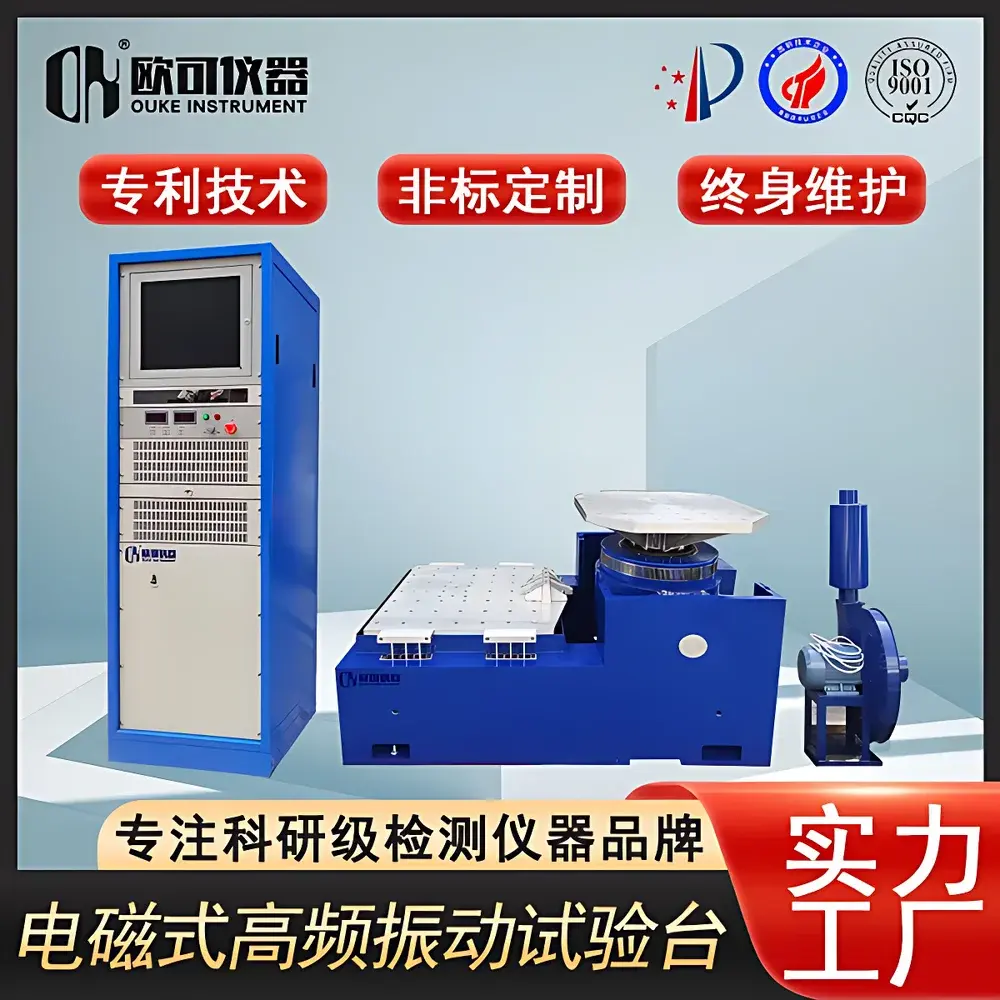
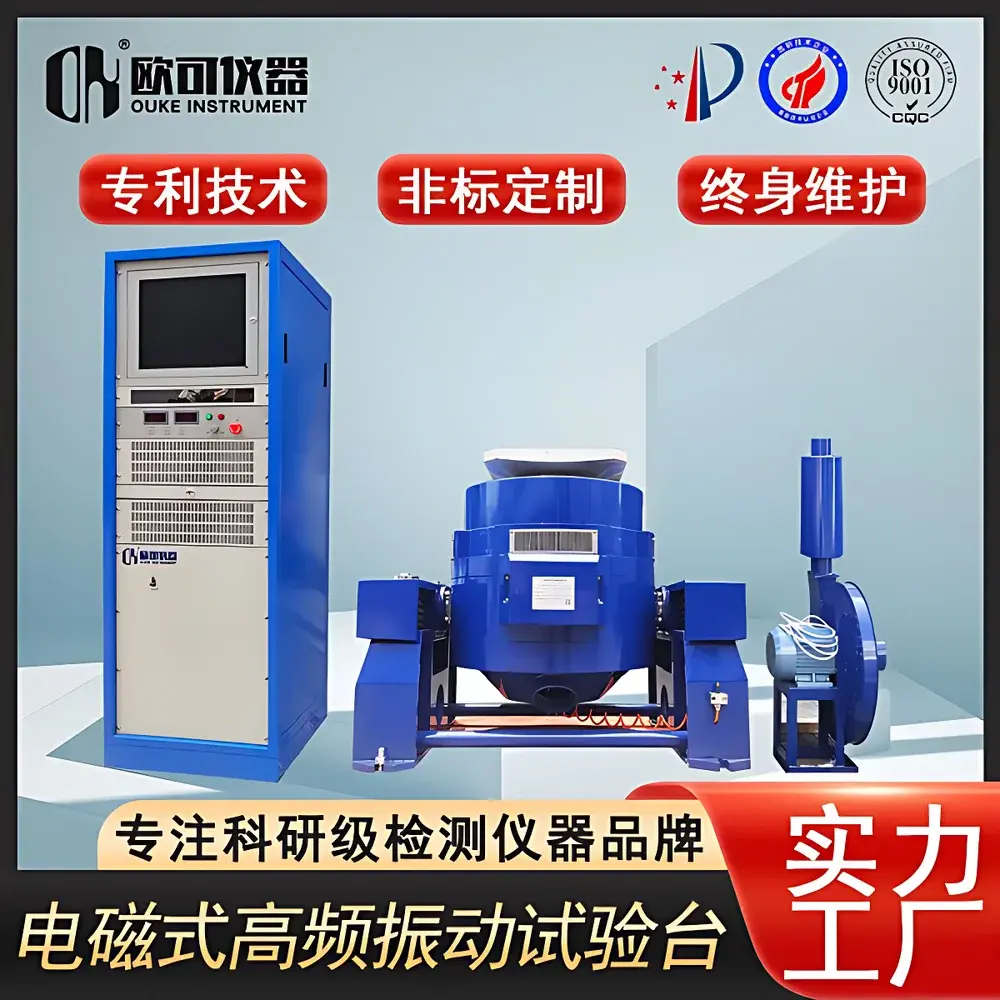
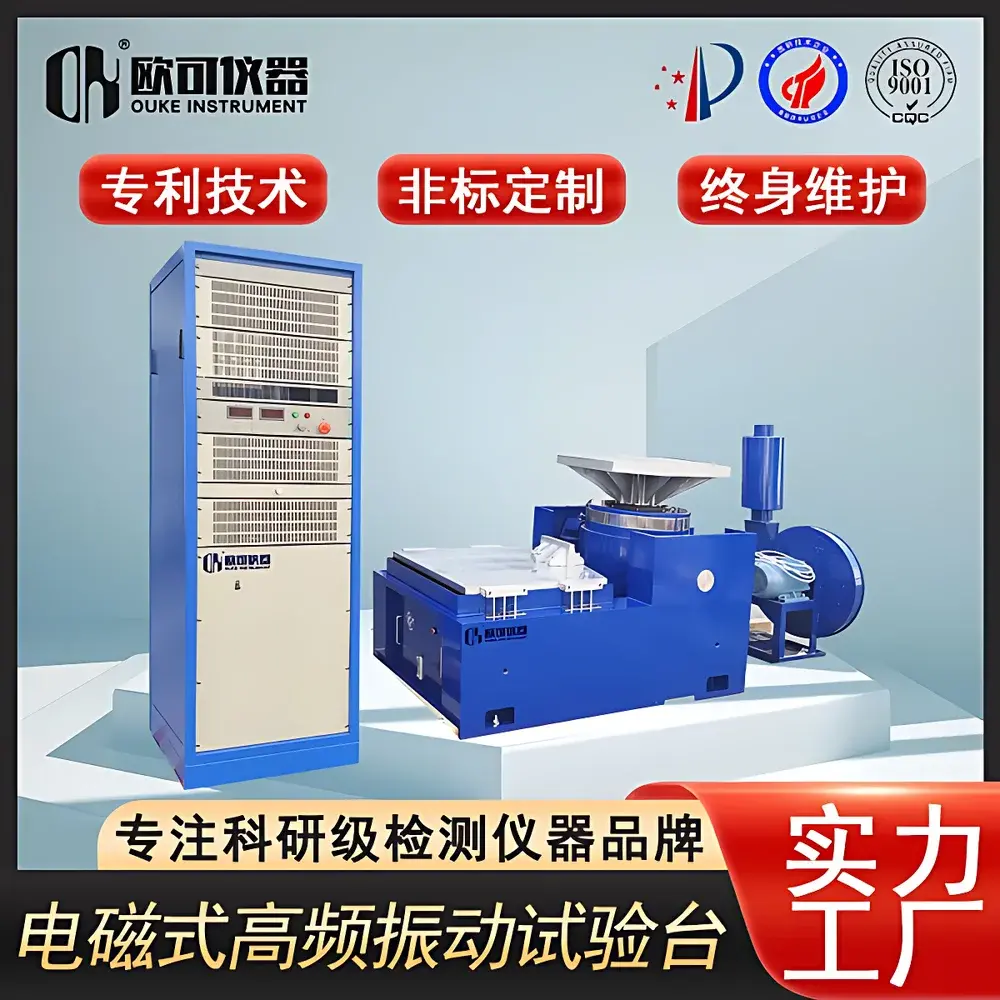
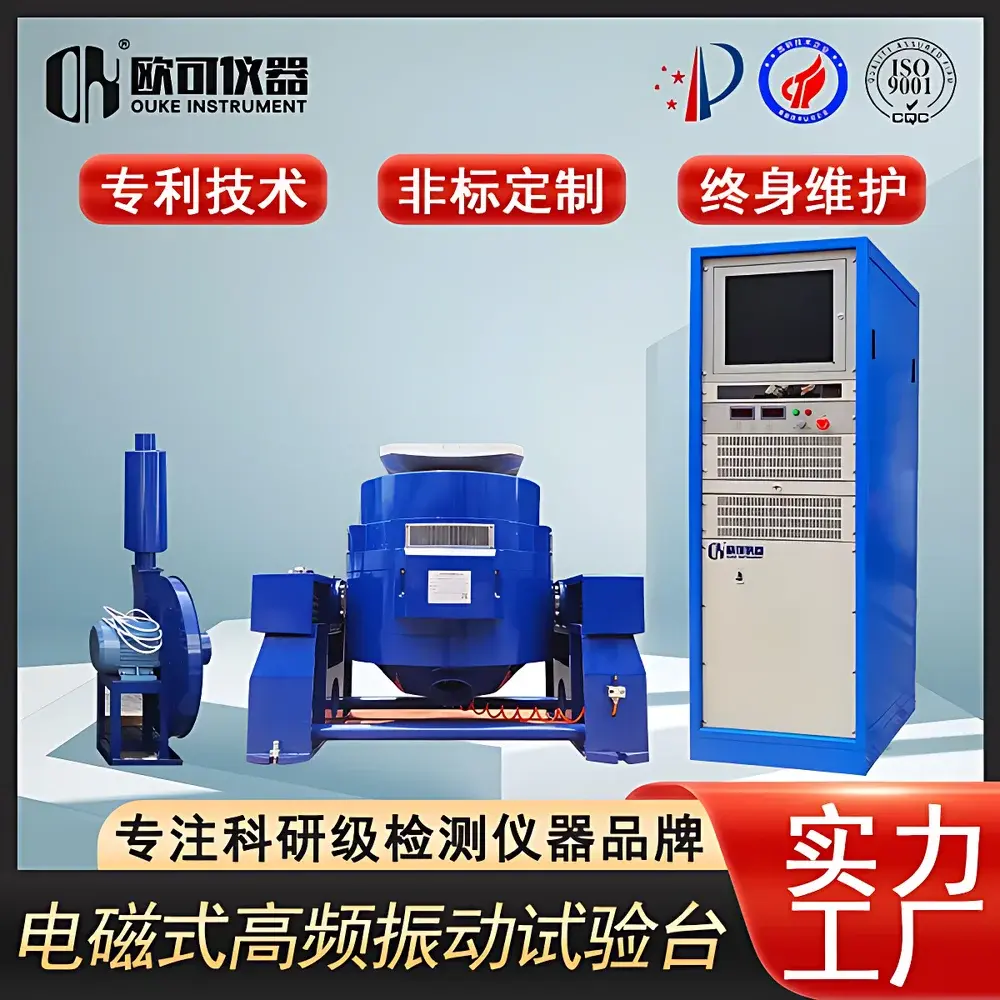
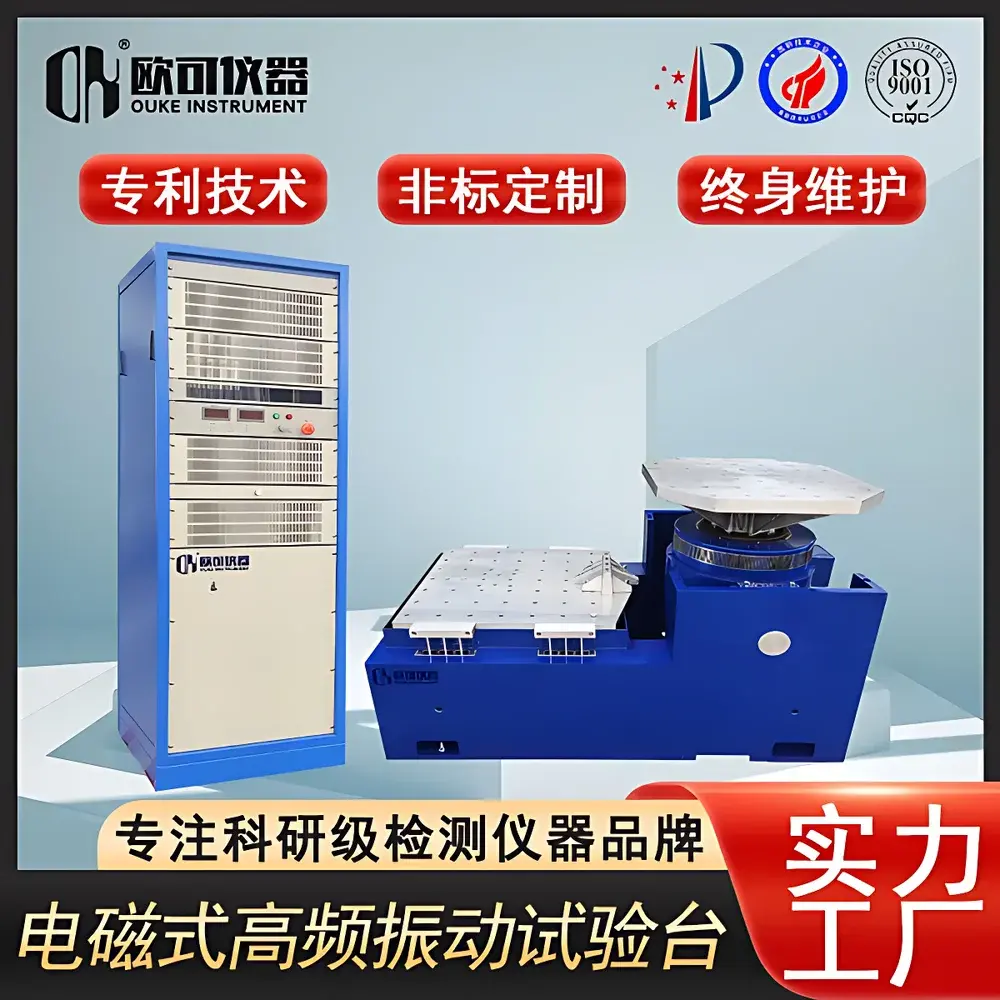
OK Instruments OK-ES-3.00 Electromagnetic Vibration Shaker System
| Brand | OK Instruments |
|---|---|
| Origin | Guangdong, China |
| Manufacturer Type | Direct Manufacturer |
| Instrument Type | Electromagnetic Vibration Shaker |
| Model | OK-ES-3.00 |
| Rated Thrust | 1.98 kN |
| Frequency Range | 5–5000 Hz |
| Max. Test Load | 70 kg |
| Table Dimensions | 300 × 300 × 30 mm (L × W × H) |
| Max. Acceleration | 10 g |
| Drive Power | 4.2 kW |
| Adjustable Peak-to-Peak Amplitude | 0–4 mm |
| Operating Modes | Sine, Sweep, Programmable, Amplitude Modulation, Time-Controlled |
| Vibration Axes | Vertical & Horizontal |
| Control Resolution | 0.01 Hz (display), ±0.1 Hz (accuracy) |
| Input Voltage | 380 V ±10% |
| Magnetic Shielding | Magnesium Alloy Table Surface |
| Control Interface | Real-time PID-regulated digital frequency controller with waveform display and synchronization monitoring |
Overview
The OK Instruments OK-ES-3.00 Electromagnetic Vibration Shaker System is a high-fidelity, dual-axis electromagnetic shaker engineered for precision mechanical stress testing across aerospace, automotive, electronics, and quality assurance laboratories. Based on Lorentz-force actuation principles, the system generates controlled sinusoidal motion through dynamic interaction between high-current coil assemblies and permanent magnetic fields—ensuring linearity, low harmonic distortion, and minimal thermal drift during extended operation. Designed to meet the mechanical excitation requirements of MIL-STD-810H, IEC 60068-2-6, and ISO 10816-1, the OK-ES-3.00 delivers calibrated acceleration profiles from 5 Hz to 5000 Hz, supporting both narrowband resonance detection and broadband fatigue assessment under defined load conditions up to 70 kg.
Key Features
- Electromagnetic actuation architecture with 1.98 kN rated thrust and 4.2 kW amplifier capacity, optimized for high-fidelity force transmission and thermal stability.
- Dual-axis operation: independently configurable vertical and horizontal vibration modes using modular table mounts; standard table dimensions 300 × 300 × 30 mm, with optional 450 × 450 × 46 mm extended platform for larger DUTs.
- Digital PID-controlled frequency generator with real-time feedback loop—enabling stable amplitude regulation across the full 5–5000 Hz range, resolution to 0.01 Hz, and accuracy within ±0.1 Hz.
- Programmable test sequencing: up to 30 user-defined segments per profile, each specifying frequency bounds, dwell time, sweep rate, and amplitude setpoint; supports infinite looping and conditional branching.
- Magnesium alloy table surface providing >60 dB magnetic field attenuation at frequencies above 1 kHz—critical for testing magnetically sensitive components (e.g., MEMS sensors, Hall-effect devices, MRI-compatible assemblies).
- Four-point synchronized excitation mechanism ensuring uniform modal energy distribution across the table surface; validated via laser Doppler vibrometry per ASTM E1876.
- Integrated anti-interference circuitry—including shielded cabling, galvanic isolation, and EMI-filtered power conditioning—to maintain signal integrity in electrically noisy environments (e.g., EMC labs, production floors).
- Real-time waveform visualization and parameter mirroring: acceleration, displacement, velocity, and drive current displayed simultaneously without host PC dependency.
Sample Compatibility & Compliance
The OK-ES-3.00 accommodates rigid and semi-rigid specimens weighing up to 70 kg, including printed circuit boards, structural brackets, avionics enclosures, and consumer electronics housings. Its 0–4 mmp-p amplitude range and 10 g peak acceleration capability enable compliance verification per US DoD standards (MIL-STD-810H Method 514.8), automotive OEM specifications (e.g., GMW 14872, Ford CETP 00.00-L-467), and industrial safety directives (IEC 60068-2-64). The magnesium-shielded table meets ISO/IEC 17025 traceability requirements for magnetic immunity validation when used with calibrated transducers (e.g., PCB Piezotronics 352C33). System-level calibration certificates are issued per ISO 17025-accredited procedures, covering sensitivity, linearity, and cross-axis rejection.
Software & Data Management
The embedded control firmware supports standalone operation with full test configuration, execution, and post-run data export (CSV, ASCII) via USB or Ethernet. Optional OK-VibraControl™ software (Windows-based) adds GLP-compliant audit trail logging, 21 CFR Part 11 electronic signature support, and automated report generation compliant with ISO/IEC 17025 documentation clauses. All test parameters—including frequency sweeps, dwell times, amplitude ramps, and pass/fail thresholds—are stored with timestamped metadata and operator ID. Raw acceleration waveforms are sampled at ≥51.2 kHz and archived with lossless compression for spectral reanalysis (FFT, PSD, Kurtosis).
Applications
- Resonance search and mode shape identification in mechanical assemblies.
- Environmental stress screening (ESS) of electronic subassemblies prior to burn-in.
- Vibration fatigue life prediction per Miner’s rule using programmable multi-segment spectra.
- Qualification testing of battery packs, connectors, and solder joints under variable g-level profiles.
- Verification of mounting interface integrity for satellite payloads and UAV subsystems.
- Development and validation of active damping algorithms using real-time response feedback.
FAQ
What standards does the OK-ES-3.00 comply with for vibration testing?
It conforms to IEC 60068-2-6 (sinusoidal vibration), ISO 10816-1 (vibration severity evaluation), and supports test method implementation per MIL-STD-810H Method 514.8.
Can the system perform random vibration testing?
No—the OK-ES-3.00 is optimized for deterministic excitations (sine, swept-sine, programmable sine sequences); random vibration requires a separate electrodynamic shaker with broadband power amplifier and dedicated controller.
Is third-party calibration available?
Yes—OK Instruments provides ISO/IEC 17025-accredited calibration services traceable to NIM (China) and NIST (USA) standards, including transducer sensitivity verification and table uniformity mapping.
How is magnetic shielding verified on the magnesium table?
Shielding effectiveness is measured using a calibrated triaxial magnetometer (e.g., Bartington Mag-03) per IEEE Std 299-2006, with attenuation ≥60 dB demonstrated at 1 kHz–10 kHz across the full table surface.
What maintenance is required for long-term reliability?
Annual inspection of voice coil alignment, suspension integrity, and amplifier cooling performance is recommended; no routine lubrication is required due to electromagnetic (non-contact) actuation design.



