
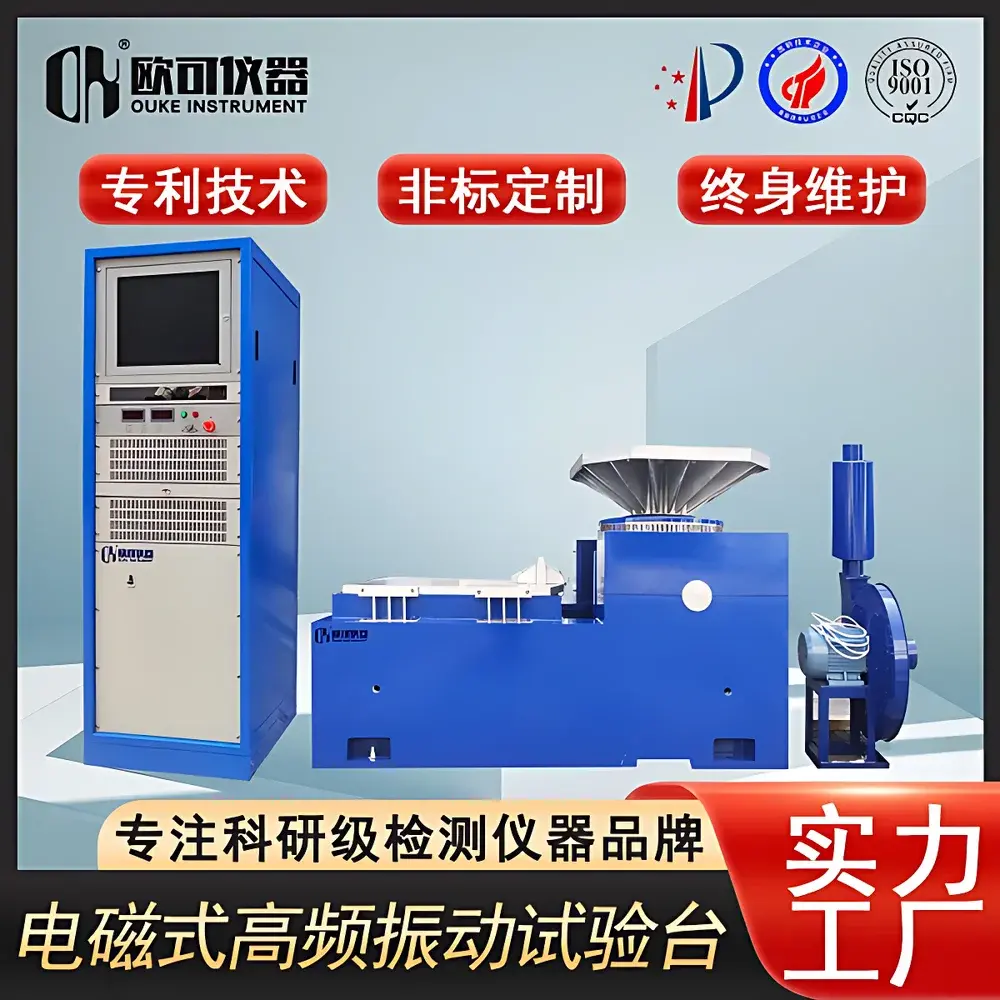
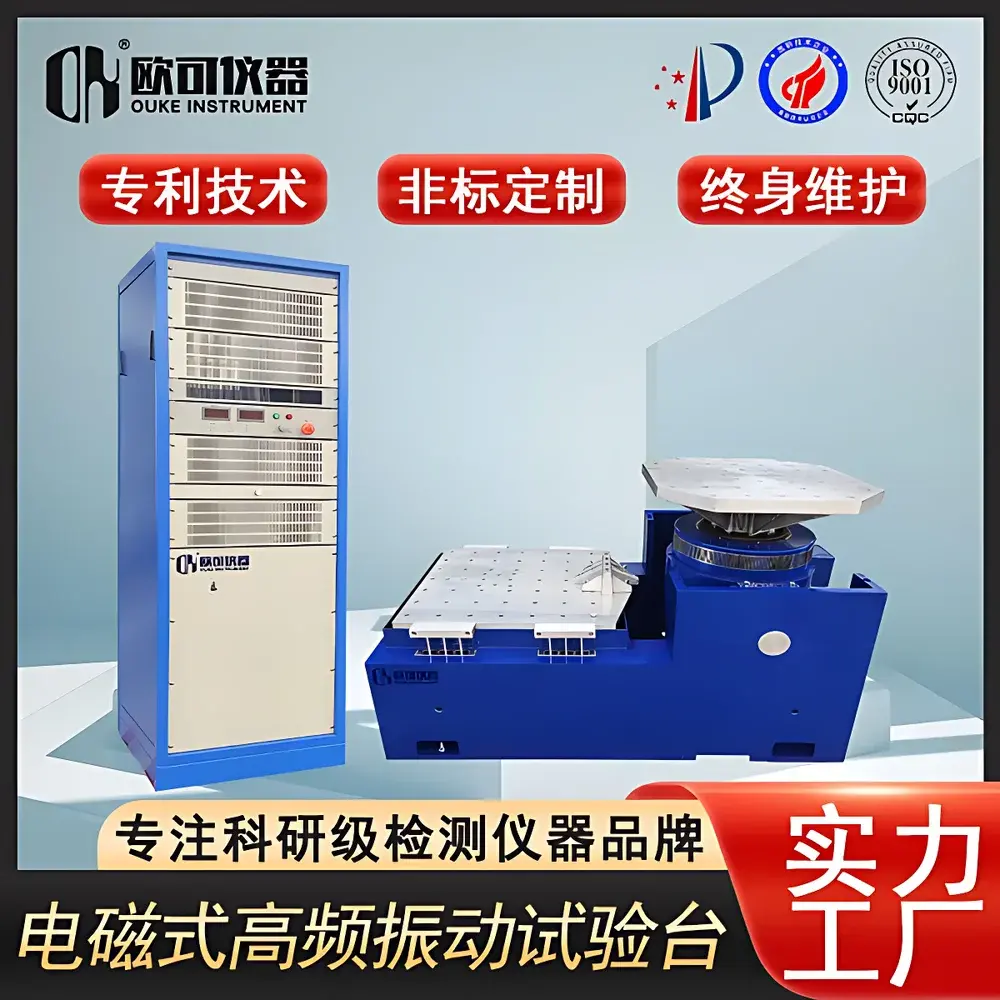
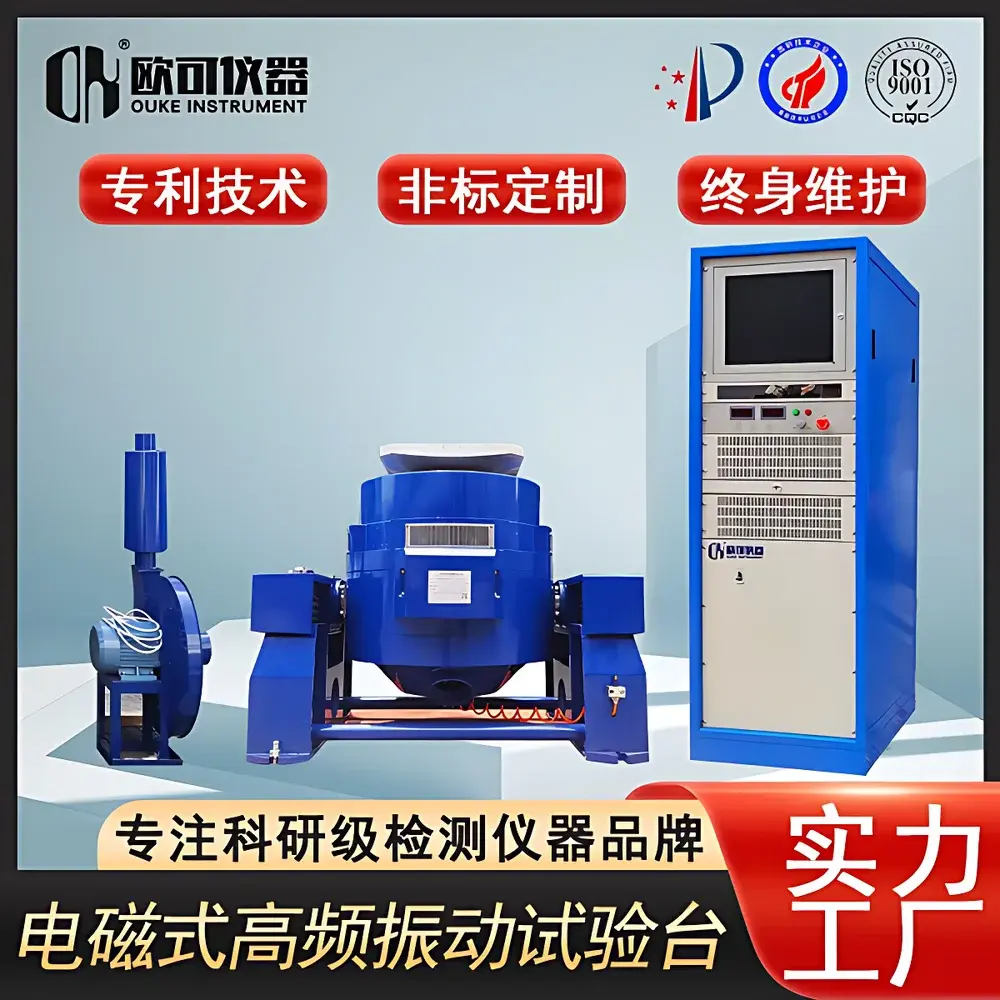
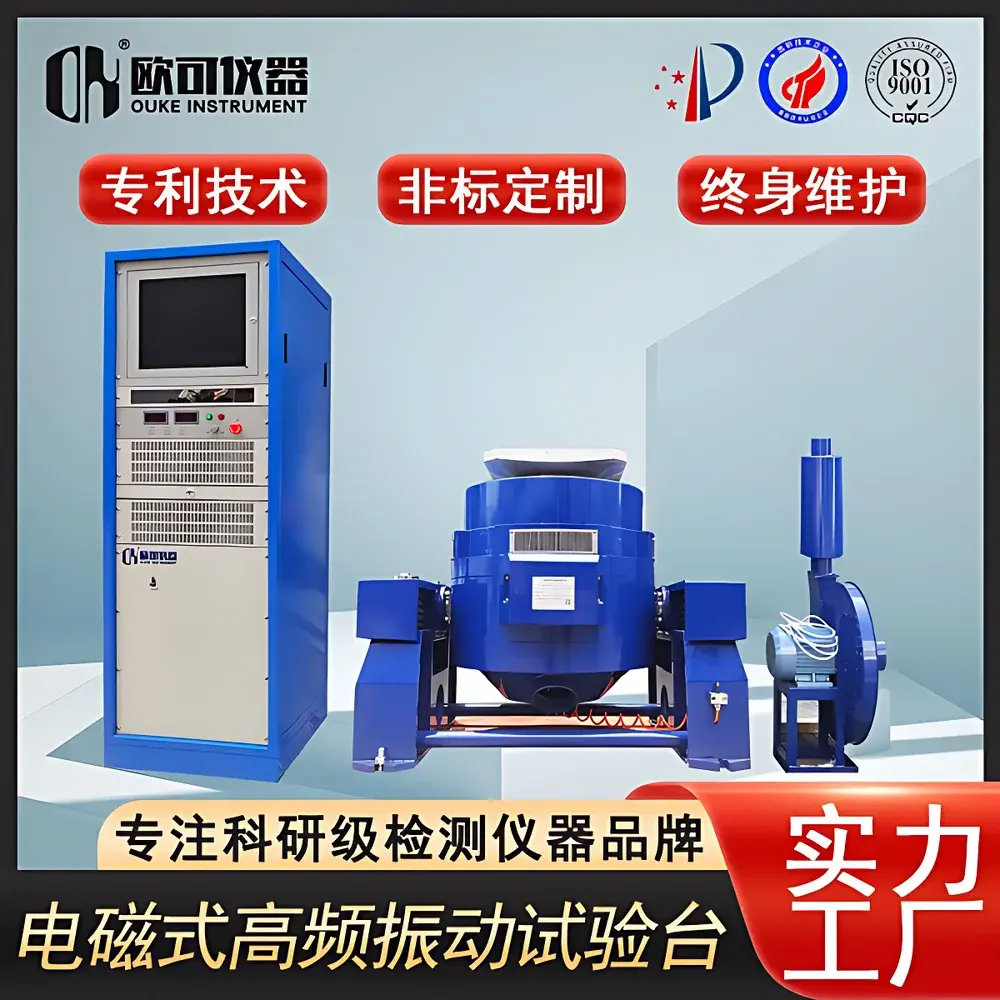
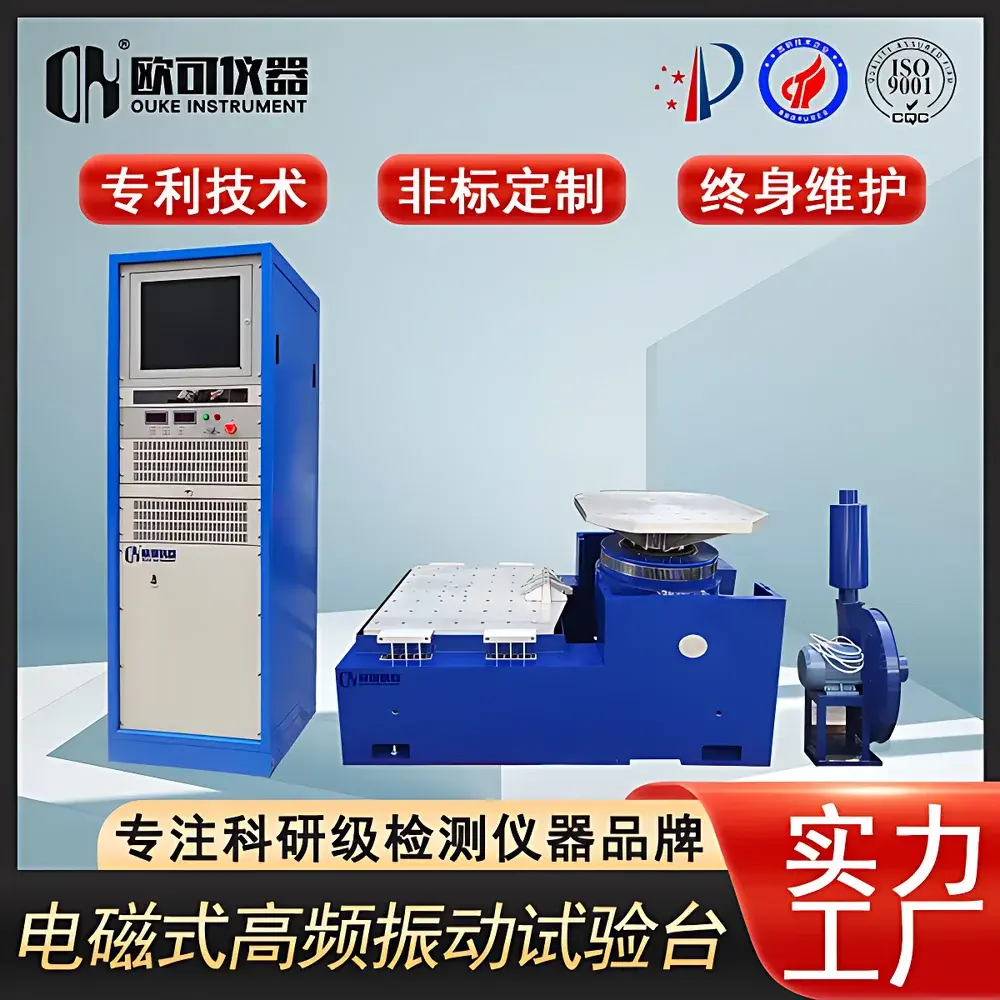
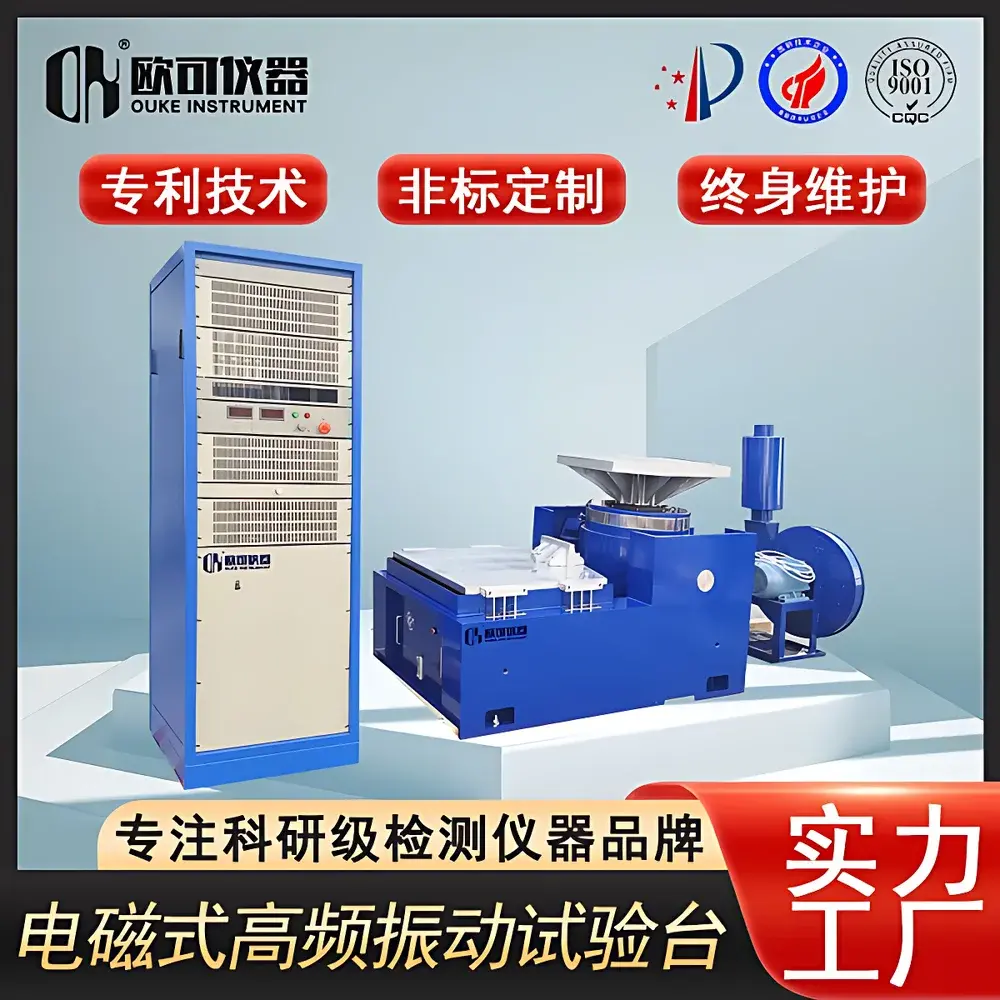
OK Instruments OK-ES-3.000 Triaxial Random Vibration Shaker System
| Brand | OK Instruments |
|---|---|
| Origin | Guangdong, China |
| Manufacturer Type | Direct Manufacturer |
| Instrument Type | Electromagnetic Vibration Shaker |
| Rated Force | 1.98 kN |
| Frequency Range | 5–5000 Hz |
| Max. Payload | 70 kg |
| Table Surface Dimensions | 300 × 300 × 30 mm |
| Peak Acceleration | 10 g |
Overview
The OK Instruments OK-ES-3.000 Triaxial Random Vibration Shaker System is an electromagnetically driven, multi-axis dynamic testing platform engineered for high-fidelity replication of real-world mechanical vibration environments in controlled laboratory settings. It operates on the principle of multi-input, multi-output (MIMO) closed-loop random vibration control, utilizing broadband Gaussian noise excitation synthesized from user-defined power spectral density (PSD) profiles. Unlike single-axis sinusoidal or shock-based exciters, this system simultaneously or independently applies stochastic acceleration fields across three orthogonal axes (X, Y, Z), enabling physically representative simulation of complex transport, operational, and installation-induced vibratory stresses—including road-induced chassis excitation, airborne turbulence, engine-borne broadband noise, and structural reverberation. Its core architecture supports both triaxial collocated shaker configurations and modular three-single-axis coupled platforms—optimized for modal decoupling, minimal cross-axis coupling (<5% typical), and repeatable PSD tracking within ±3 dB tolerance per IEC 60068-2-64 and ISO 10326-1 compliance frameworks.
Key Features
- Electromagnetic shaker design with integrated water-cooled voice coil and high-stiffness moving assembly, delivering 1.98 kN rated force and peak acceleration up to 10 g at full 70 kg payload
- Wide operational frequency bandwidth spanning 5 Hz to 5000 Hz—validated for low-frequency ride simulation and high-frequency component resonance screening
- 300 × 300 × 30 mm rigid aluminum alloy table surface with T-slot pattern for precision fixture mounting and center-of-gravity alignment verification
- Digital MIMO controller with real-time adaptive inverse transfer function synthesis, enabling automatic system equalization and closed-loop PSD convergence
- Integrated safety architecture including over-acceleration, over-displacement, thermal overload, and emergency stop interlocks compliant with EN 61000-6-2/6-4 electromagnetic compatibility standards
- Modular amplifier subsystem supporting scalable power delivery and harmonic distortion <1.5% THD across full dynamic range
Sample Compatibility & Compliance
The OK-ES-3.000 accommodates test specimens ranging from miniature electronic assemblies (e.g., MEMS sensors, PCB modules) to mid-sized automotive subsystems (ECUs, lighting clusters, brake calipers) and aerospace avionics enclosures. Fixture design follows ASTM D999 and ISTA 3A guidelines to minimize parasitic resonances and ensure load-path fidelity. The system meets essential requirements for environmental stress screening (ESS) and qualification testing under MIL-STD-810H Method 514.7, ISO 16750-3 (road vehicle vibration), GJB 150A-2009 (Chinese military standard), and IEC 60068-2-64 (random vibration testing). All control algorithms support audit-ready data logging aligned with FDA 21 CFR Part 11 electronic record integrity protocols when paired with validated software configurations.
Software & Data Management
Control and analysis are executed via OK-VibControl™ v4.x—a Windows-based application built on deterministic real-time kernel architecture. It supports import of industry-standard PSD definitions (e.g., GR-63-CORE, DO-160 Section 8), automated test profile sequencing, live spectral overlay, and MIMO coherence monitoring. Raw time-history data (acceleration, velocity, displacement) are acquired at 102.4 kHz per channel using synchronized 24-bit sigma-delta ADC front-ends. All datasets include embedded metadata (timestamp, calibration coefficients, sensor IDs, test configuration hash) and are exportable in HDF5, UFF58, or MATLAB .mat formats. Optional GLP/GMP-compliant audit trail module provides immutable records of operator actions, parameter changes, and system health status throughout test execution.
Applications
- Aerospace: Qualification of satellite payloads, launch vehicle fairings, and flight-critical electronics under launch vibration spectra
- Defense: Reliability validation of radar housings, missile guidance units, and ruggedized communication terminals subjected to off-road transport conditions
- Automotive: Durability assessment of ADAS cameras, battery management systems, and infotainment head units per ISO 16750-3 Class C/D profiles
- Electronics: Transport simulation for consumer devices (smartphones, laptops) and data center hardware (SSDs, server backplanes) per ISTA 3E and ASTM D4728
- Rail & Industrial: Fatigue life evaluation of signaling equipment, rail-mounted sensors, and precision metrology instrumentation under track-induced broadband excitation
FAQ
What standards does the OK-ES-3.000 support for random vibration testing?
It natively supports test profiles defined in ISO 10326-1, ISO 16750-3, MIL-STD-810H Method 514.7, IEC 60068-2-64, and GJB 150A-2009.
Can the system perform simultaneous triaxial vibration, or only sequential axis excitation?
The OK-ES-3.000 implements true simultaneous MIMO random vibration control—enabling concurrent excitation across X, Y, and Z axes with active cross-axis decoupling.
Is fixture design assistance available from OK Instruments?
Yes—OK provides fixture feasibility analysis, modal simulation review (ANSYS Workbench integration), and mechanical interface certification documentation upon request.
What is the maximum allowable unbalanced mass for stable operation?
With proper center-of-gravity alignment and fixture rigidity verification, the system maintains ≤±0.5 mm peak-to-peak displacement linearity up to 70 kg total mass including fixture.
Does the system include calibration traceability to national metrology institutes?
Each delivered unit ships with NIST-traceable accelerometer calibration certificates (per ISO 17025 accredited lab) and shaker force calibration report valid for 12 months.



