
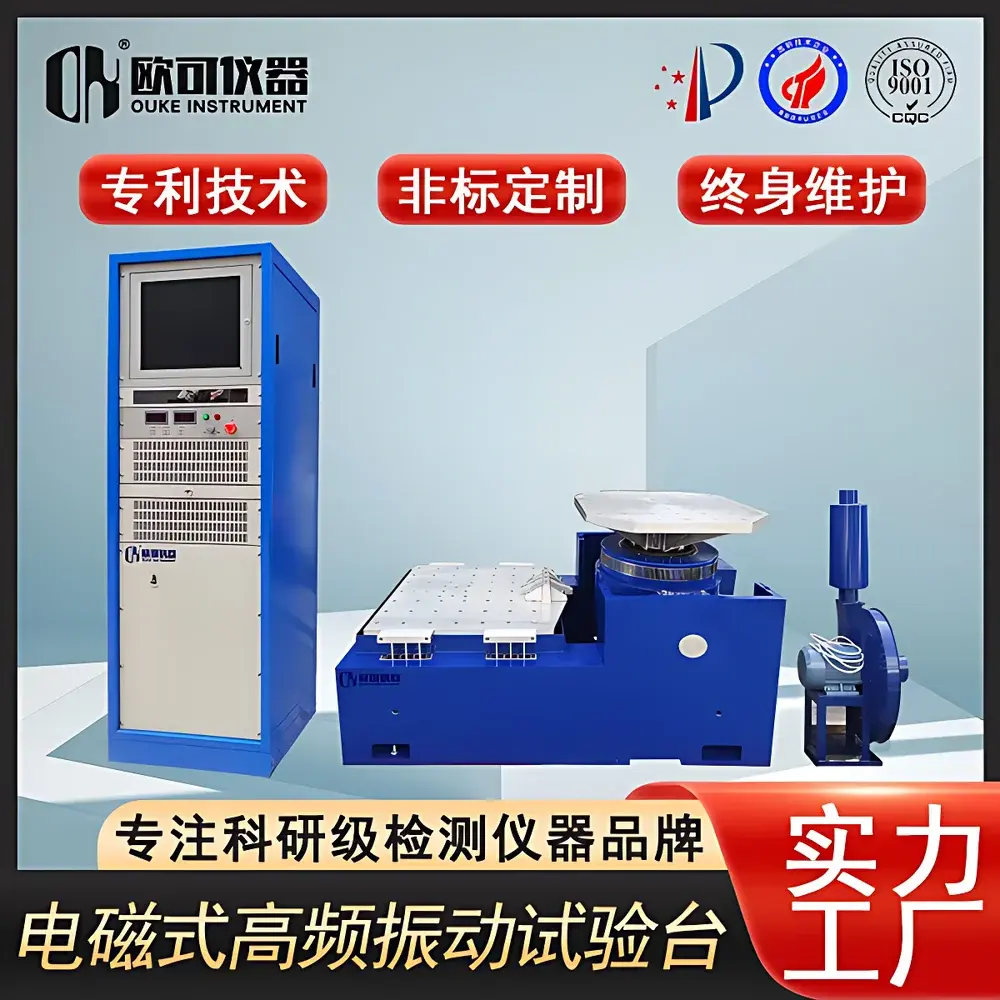
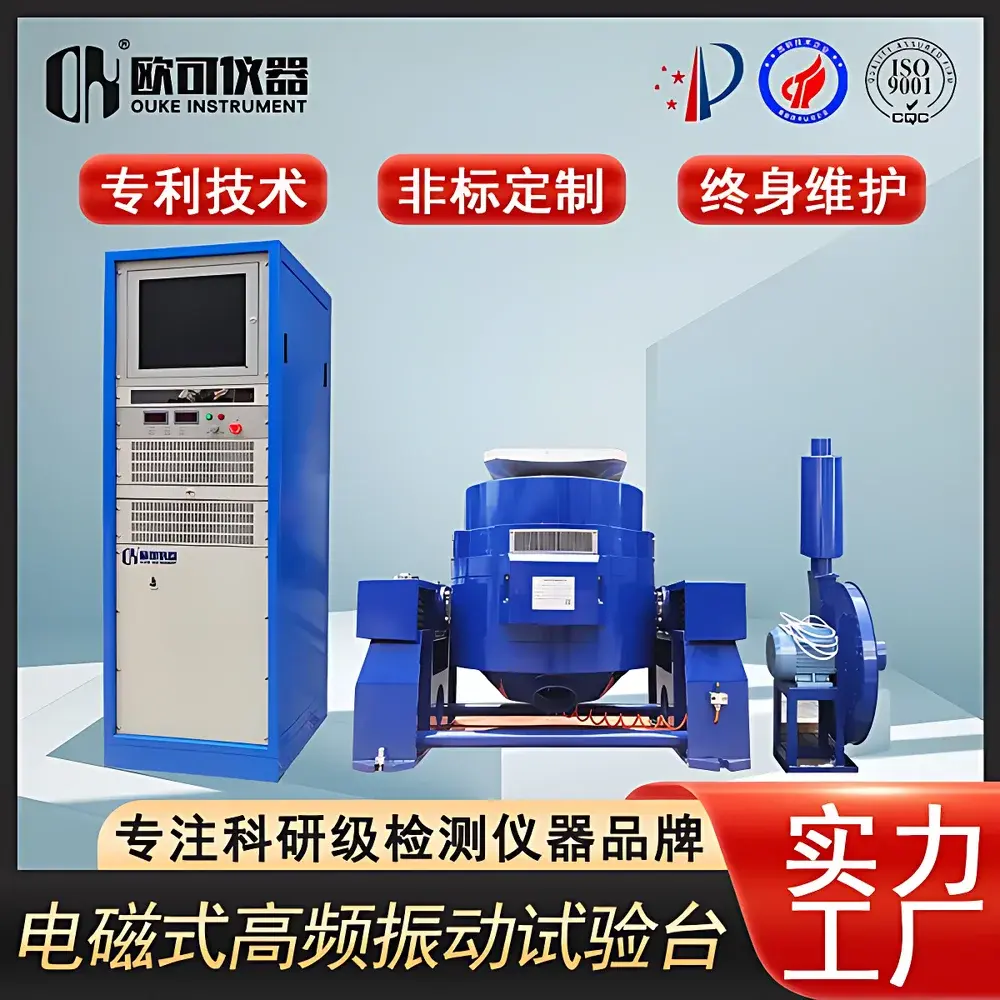
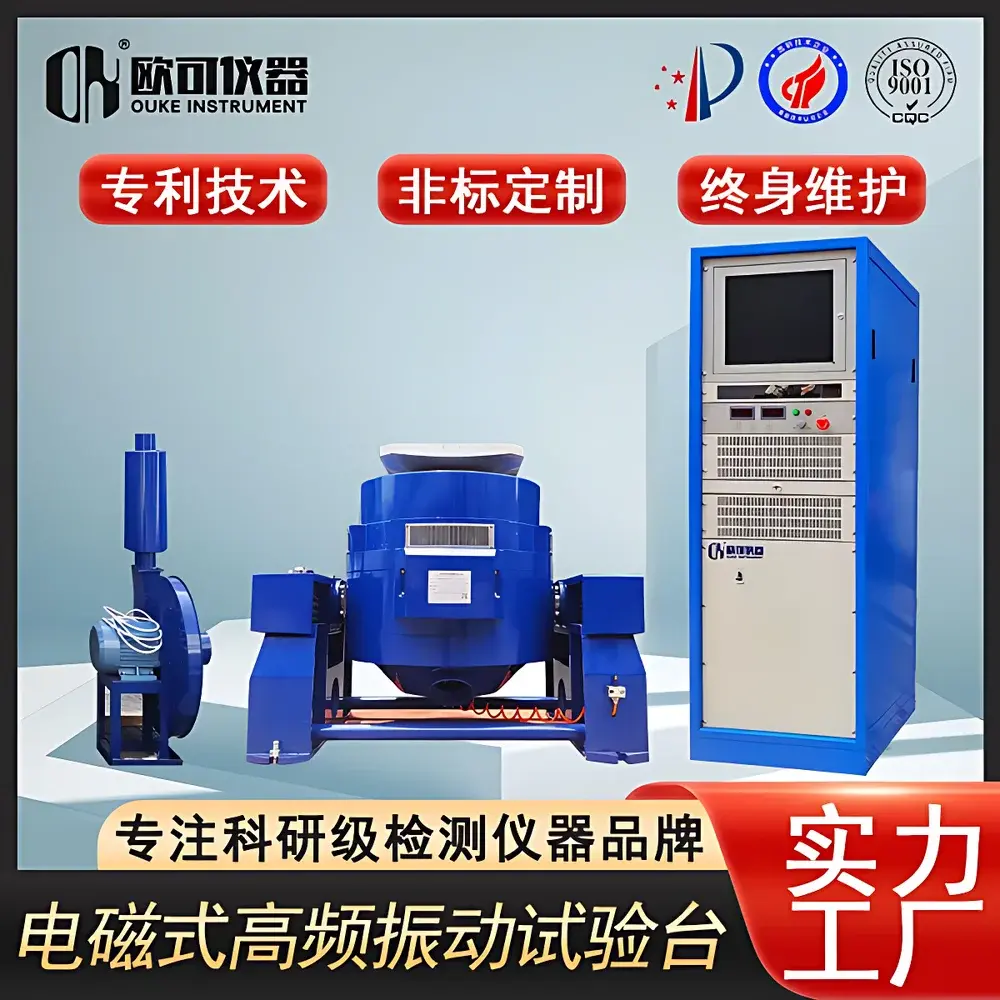
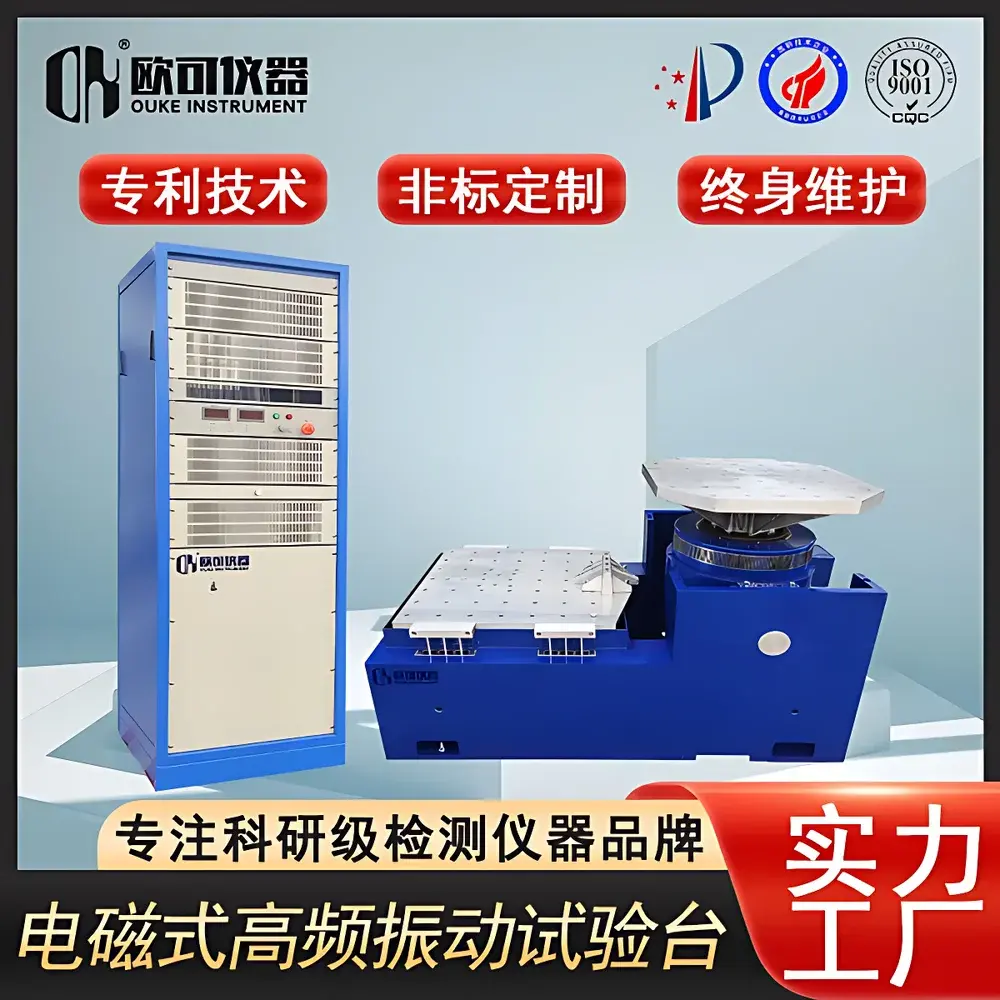
OK Instruments OK-ES-3.0100 Electromagnetic Vibration Shaker
| Brand | OK Instruments |
|---|---|
| Origin | Guangdong, China |
| Manufacturer Type | OEM/ODM Manufacturer |
| Country of Origin | China |
| Model | OK-ES-3.0100 |
| Instrument Type | Electromagnetic Vibration Shaker |
| Rated Thrust | 1.98 kN |
| Frequency Range | 5–5000 Hz |
| Maximum Test Load | 70 kg |
| Table Dimensions | 300 × 300 × 30 mm |
| Maximum Acceleration | 10 g |
Overview
The OK Instruments OK-ES-3.0100 is a high-fidelity electromagnetic vibration shaker engineered for precision laboratory-grade mechanical vibration simulation. It operates on the principle of Lorentz force generation: a voice-coil-type moving element (armature) is suspended within a high-intensity static magnetic field generated by permanent magnets and optimized pole structures. When an amplified AC drive signal—derived from a vibration controller—is applied to the armature coil, the resulting interaction between current and magnetic flux produces a controllable axial force, inducing linear acceleration of the test table. This electromechanical architecture enables deterministic, repeatable, and broadband excitation without hydraulic fluid, combustion byproducts, or mechanical backlash. The system supports closed-loop control via integrated accelerometers mounted directly beneath the table surface, enabling real-time feedback correction against ISO 5347, IEC 60068-2-6, and ASTM D999 reference spectra. Designed for structural durability assessment, fatigue life prediction, functional reliability screening, and environmental stress screening (ESS), the OK-ES-3.0100 delivers metrologically traceable motion profiles across its full operational bandwidth.
Key Features
- Electromagnetic actuation with zero oil contamination risk—ideal for cleanroom, electronics, and aerospace qualification environments
- Broadband frequency capability spanning 5 Hz to 5000 Hz, supporting sine, random, shock, and transient waveform synthesis
- Rated sinusoidal thrust of 1.98 kN ensures stable performance under dynamic loading up to 70 kg, including fixture mass
- Optimized magnetic circuit design incorporating shorting rings and demagnetizing coils to suppress stray flux below 2 mT at table surface—critical for magnetically sensitive devices (e.g., MEMS sensors, HDDs, optical assemblies)
- Integrated air suspension and low-resonance support structure minimizes base motion transmission; compliant with ISO 10816-1 vibration isolation requirements
- Modular cooling interface compatible with forced-air or recirculating water systems (optional), maintaining thermal stability during extended random testing sessions
- Standardized 300 × 300 × 30 mm aluminum test table with M8 threaded mounting pattern (ISO 13373-2 compliant) and optional inertial mass extension kits
Sample Compatibility & Compliance
The OK-ES-3.0100 accommodates rigid and semi-rigid specimens—including PCB assemblies, automotive ECUs, avionics enclosures, medical device housings, and packaging prototypes—within its 70 kg payload limit. Fixture design must maintain center-of-gravity alignment within ±15 mm of table geometric center to prevent torque-induced rocking. All mechanical interfaces conform to DIN 45672-2 mounting tolerances. The shaker meets CE marking requirements per Machinery Directive 2006/42/EC and EMC Directive 2014/30/EU. Its control fidelity supports compliance with MIL-STD-810H Method 514.8 (vibration), DO-160G Section 8 (avionics), IEC 60068-2-64 (random vibration), and GB/T 2423.10–2019 (Chinese national standard equivalent to IEC 60068-2-6). Optional calibration certificates are available traceable to NIM (National Institute of Metrology, China) or NIST-accredited labs.
Software & Data Management
The shaker integrates seamlessly with industry-standard vibration control platforms—including Vibration Research VR9500, Crystal Instruments Myrin, and m+p VibControl—via IEEE 1451.4 TEDS-compliant analog/digital I/O. Real-time data acquisition supports 24-bit resolution at sampling rates up to 102.4 kHz per channel. All test execution logs—including setpoint spectra, actual response PSDs, coherence functions, and overtest event timestamps—are stored in HDF5 format with embedded metadata (test ID, operator, date/time, firmware version). Audit trails comply with FDA 21 CFR Part 11 requirements when paired with validated software configurations. Export options include MATLAB (.mat), Universal File Format (.uff), and CSV for post-processing in fatigue analysis tools (nCode DesignLife, FE-SAFE).
Applications
- Aerospace component qualification per RTCA/DO-160G Section 8 (vibration, shock, swept sine)
- Automotive ECU and sensor robustness validation against ISO 16750-3 and SAE J1211
- Consumer electronics drop-and-vibration correlation studies (e.g., smartphone chassis fatigue, connector retention)
- Medical device sterilization packaging integrity testing (ASTM D4169, ISTA 3A)
- Structural modal analysis using impact hammer + shaker excitation (OMA/EOMA workflows)
- Materials science research on viscoelastic damping behavior under harmonic loading
- Quality assurance screening for solder joint reliability in high-reliability electronics (IPC-9701)
FAQ
What is the maximum allowable off-center load for this shaker?
For optimal linearity and reduced bearing wear, the center of gravity of the test article plus fixture must remain within ±15 mm of the table’s geometric center.
Does the OK-ES-3.0100 support multi-axis vibration testing?
No—it is a single-axis (vertical) shaker. For triaxial testing, it may be integrated into a 3-DOF stack configuration using orthogonal slip tables (requires custom engineering and additional controller channels).
Is water cooling mandatory for continuous operation?
Water cooling is recommended for random tests exceeding 4 hours or sine dwell tests above 8 g at frequencies below 20 Hz; air cooling suffices for most qualification-level sweeps and transient events.
Can third-party accelerometers be used with the built-in feedback loop?
Yes—the system provides configurable analog input channels for external transducers; however, factory-calibrated internal sensors are required for closed-loop control certification.
What documentation is provided for regulatory submissions?
Standard delivery includes Factory Calibration Report (traceable to NIM), Mechanical Drawings (GD&T annotated), CE Declaration of Conformity, and RoHS/REACH compliance statements. GMP/GLP-ready IQ/OQ protocols are available upon request.



