
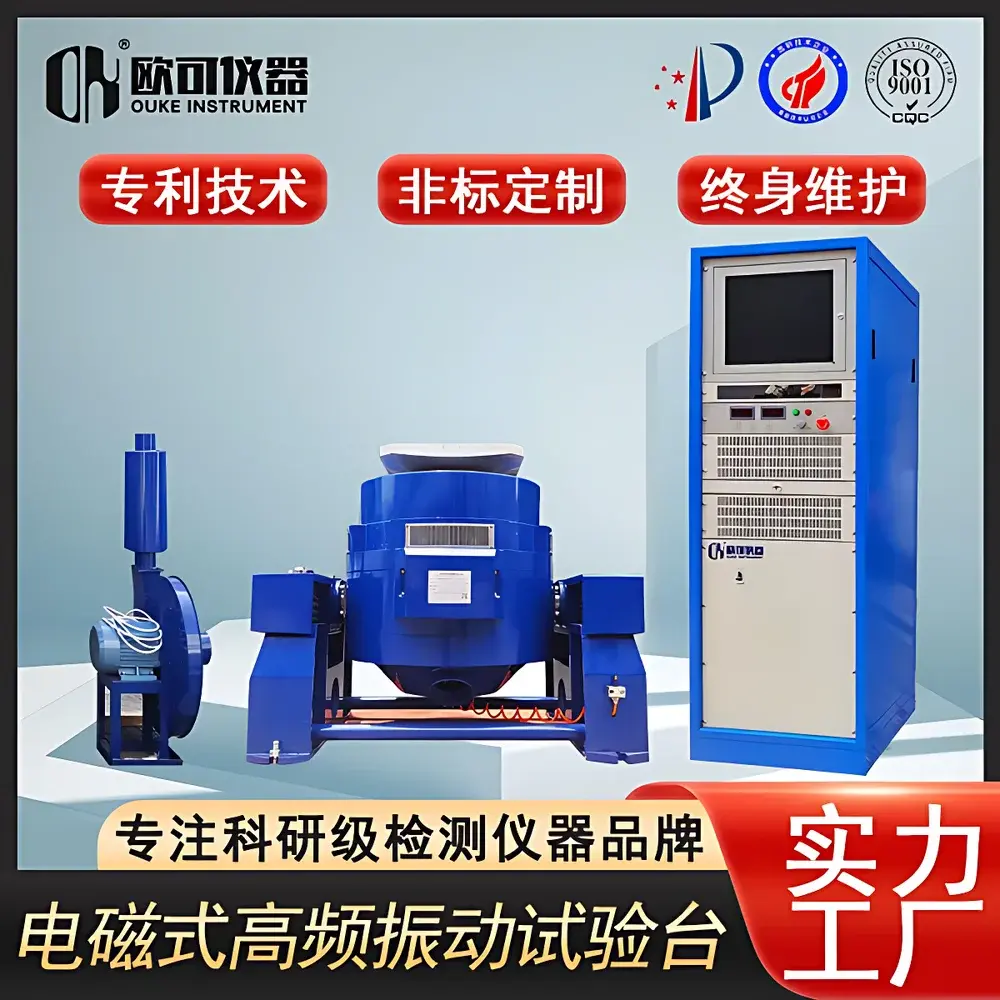
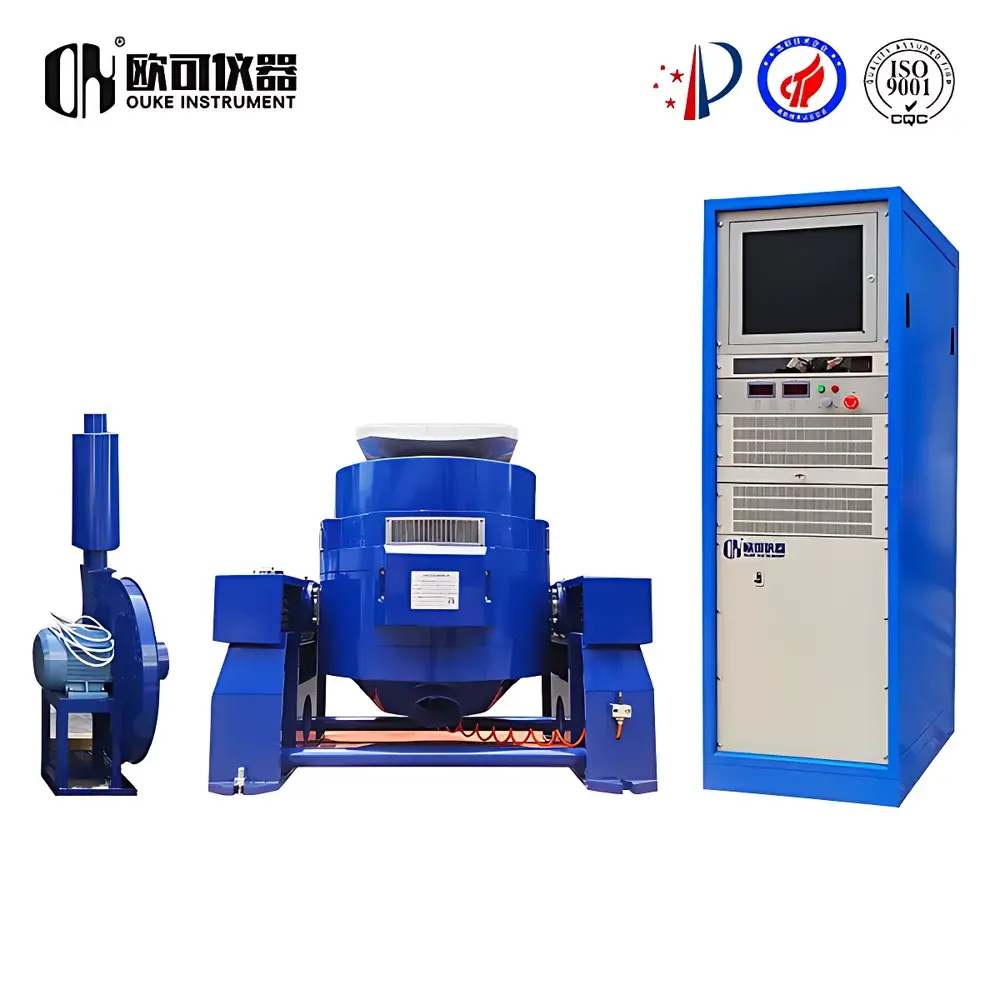
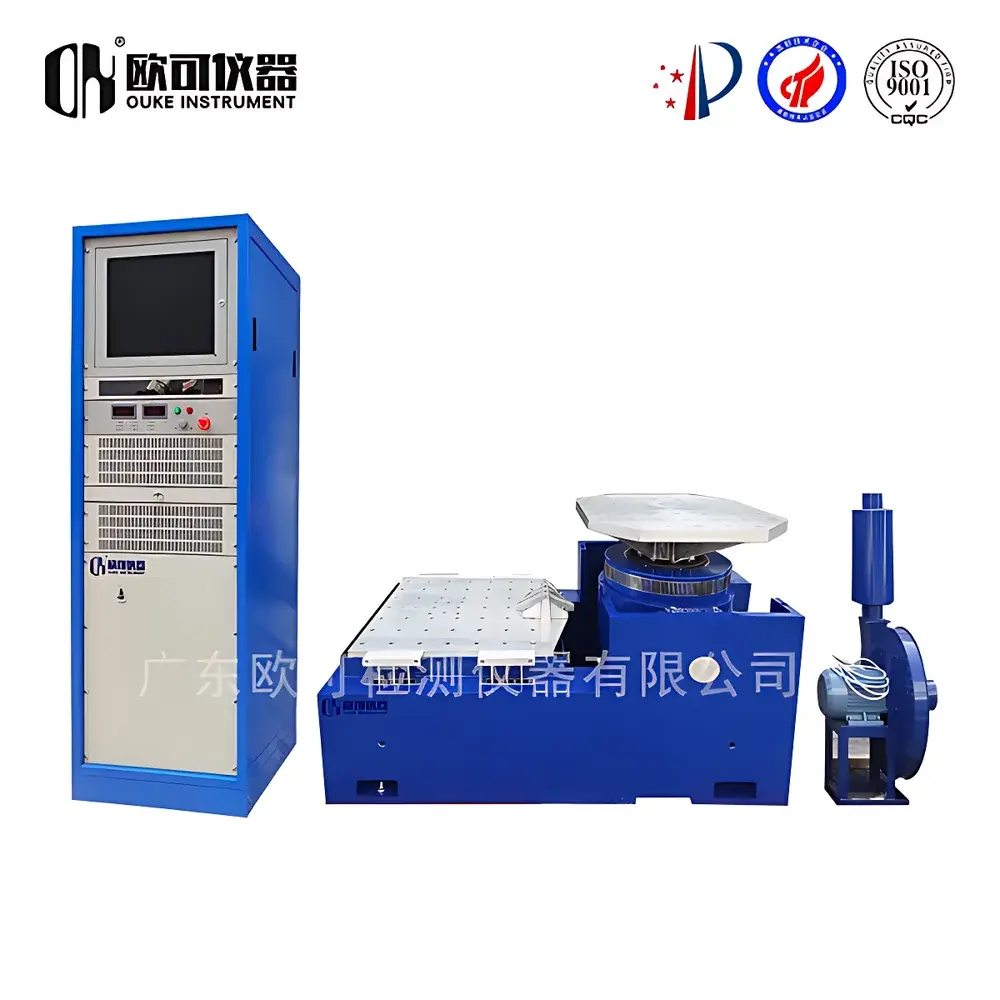
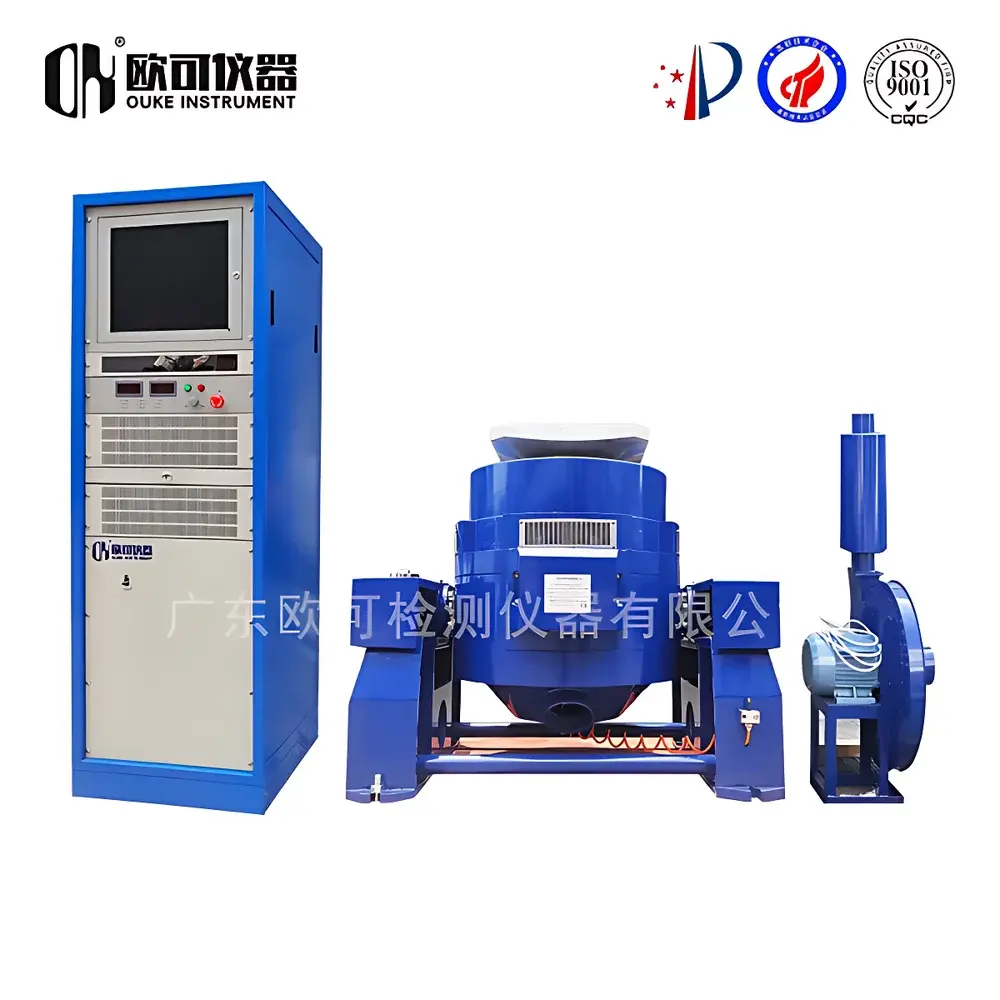
OK Instruments OK-ES-6 Mechanical Vibration Shaker
| Brand | OK Instruments |
|---|---|
| Origin | Guangdong, China |
| Manufacturer Type | Direct Manufacturer |
| Product Category | Domestic |
| Model | OK-ES-6 |
| Instrument Type | Mechanical Vibration Shaker |
| Rated Thrust | 1.98 kN |
| Rated Frequency Range | 5–5000 Hz |
| Maximum Test Load | 70 kg |
| Table Dimensions | 400 × 400 × 30 mm |
| Maximum Acceleration | 10 g |
Overview
The OK Instruments OK-ES-6 Mechanical Vibration Shaker is a robust, electromechanically actuated vibration testing system engineered for fixed-frequency sinusoidal excitation in industrial and educational environments. Unlike servo-controlled electromagnetic or electro-hydraulic shakers, the OK-ES-6 generates vibratory motion through purely mechanical means—specifically, dual counter-rotating eccentric mass assemblies driven by a three-phase induction motor and variable-frequency drive (VFD). This architecture leverages centrifugal force dynamics to produce repeatable, high-force, low-to-mid-frequency sinusoidal motion with minimal electronic dependency. Its operational principle conforms to classical Couette-type excitation: rotational imbalance induces periodic inertial forces orthogonal to the shaft axis, translating into controlled linear oscillation of the test table. While not suitable for random, transient, or multi-axis spectral testing, the OK-ES-6 delivers high reproducibility in standardized fixed-frequency applications—particularly where large displacement, high thrust, environmental resilience, and cost efficiency are prioritized over waveform flexibility or closed-loop control fidelity.
Key Features
- High-thrust mechanical excitation: 1.98 kN rated thrust enables stable vibration of heavy payloads up to 70 kg, optimized for low-frequency, high-displacement scenarios.
- Wide operational frequency range: Designed for 5–5000 Hz, with optimal linearity and mechanical stability between 5–100 Hz—ideal for transport simulation and structural fatigue screening.
- Dual eccentric mass system: Counter-rotating unbalanced masses allow directional control (vertical, horizontal, or angular) via adjustable phase offset—no software intervention required.
- Industrial-grade mechanical architecture: All-load-bearing components—including hardened steel crankshafts, precision-ground bearings, and reinforced cast-iron base frame—are engineered for long-term durability under continuous operation in non-climate-controlled facilities.
- Direct VFD speed regulation: Motor speed—and thus vibration frequency—is adjusted continuously via industrial-grade variable-frequency drive; amplitude is set mechanically via eccentric radius adjustment (performed during maintenance intervals).
- No embedded electronics in the shaker head: Eliminates susceptibility to EMI, thermal drift, or firmware-related failure modes—enhancing reliability in dusty, humid, or temperature-variable lab and factory settings.
Sample Compatibility & Compliance
The OK-ES-6 accommodates rigid and semi-rigid test specimens with mounting footprints up to 400 × 400 mm and total mass ≤ 70 kg. Its rigid aluminum alloy table (30 mm thickness) features standardized M6 and M8 threaded holes for universal fixture integration. The system complies with mechanical vibration test requirements defined in ASTM D999 (Standard Test Methods for Vibration Testing of Shipping Containers), ISTA 3A/3E (International Safe Transit Association protocols for parcel and unitized load simulation), and GB/T 4857.7–2005 (Chinese national standard for sinusoidal vibration testing of packaged products). It supports GLP-aligned documentation when paired with external data acquisition systems (e.g., USB-based accelerometers with timestamped logging), though it does not natively support FDA 21 CFR Part 11 audit trails due to its open-loop mechanical design.
Software & Data Management
The OK-ES-6 operates as a stand-alone hardware platform without integrated control software. Frequency is set exclusively via front-panel VFD interface or analog 0–10 V input; amplitude remains fixed per mechanical configuration. For traceable testing, users integrate third-party DAQ systems—such as National Instruments CompactDAQ or Dewesoft X—with triaxial accelerometers mounted on the table surface and/or test article. Raw time-series acceleration data can be exported in CSV or TDMS format for post-processing in MATLAB, Python (SciPy), or commercial analysis tools. Calibration certificates (traceable to NIM, China) are provided for the built-in reference accelerometer (optional add-on), covering sensitivity (pC/g), frequency response (±5% from 5–200 Hz), and linearity (≤ ±2% FS).
Applications
- Packaging validation: Simulating road, rail, and maritime transport vibrations per ASTM D999 and ISTA 3-series standards—especially effective for palletized goods, corrugated containers, and fragile consumer electronics packaging.
- Structural endurance screening: Subjecting welded frames, chassis components, and HVAC ductwork to sustained 10–60 Hz sinusoidal stress to identify resonant weaknesses prior to prototype validation.
- Vibratory material handling: Serving as excitation source for laboratory-scale vibrating screens, feeders, and fluidized bed demonstrators in metallurgical and chemical engineering curricula.
- Educational vibration mechanics: Demonstrating fundamental concepts—including resonance, transmissibility, modal coupling, and centrifugal excitation—in undergraduate mechanical engineering labs.
- Production-line environmental stress screening (ESS): Conducting fixed-frequency “burn-in” tests on assembled PCBs, power supplies, and automotive ECUs where cost-per-test and uptime outweigh waveform complexity requirements.
FAQ
Can the OK-ES-6 generate random or shock waveforms?
No. It produces only sinusoidal motion derived from rotational imbalance. Random, transient, or multi-degree-of-freedom waveforms require electromagnetic or electro-hydraulic shakers with digital closed-loop controllers.
Is real-time amplitude modulation possible during operation?
No. Amplitude is determined by eccentric mass geometry and must be adjusted manually during scheduled maintenance—requiring full system shutdown and mechanical recalibration.
What is the typical total harmonic distortion (THD) at 50 Hz?
Measured THD is ≤ 8% at nominal load (50 kg) and 50 Hz, consistent with ISO 5344 Class 2 mechanical shaker specifications for transport simulation equipment.
Does the system include seismic isolation or active damping?
No. Passive vibration isolation is recommended via pneumatic or elastomeric mounts (sold separately) when installed on shared laboratory floors to prevent energy transmission to adjacent instrumentation.
Can the OK-ES-6 be integrated into an automated test sequence?
Yes—via 0–10 V analog frequency command and digital start/stop I/O signals—but full test sequencing (e.g., sweep profiles, pass/fail logic) requires external PLC or PC-based SCADA integration.



