
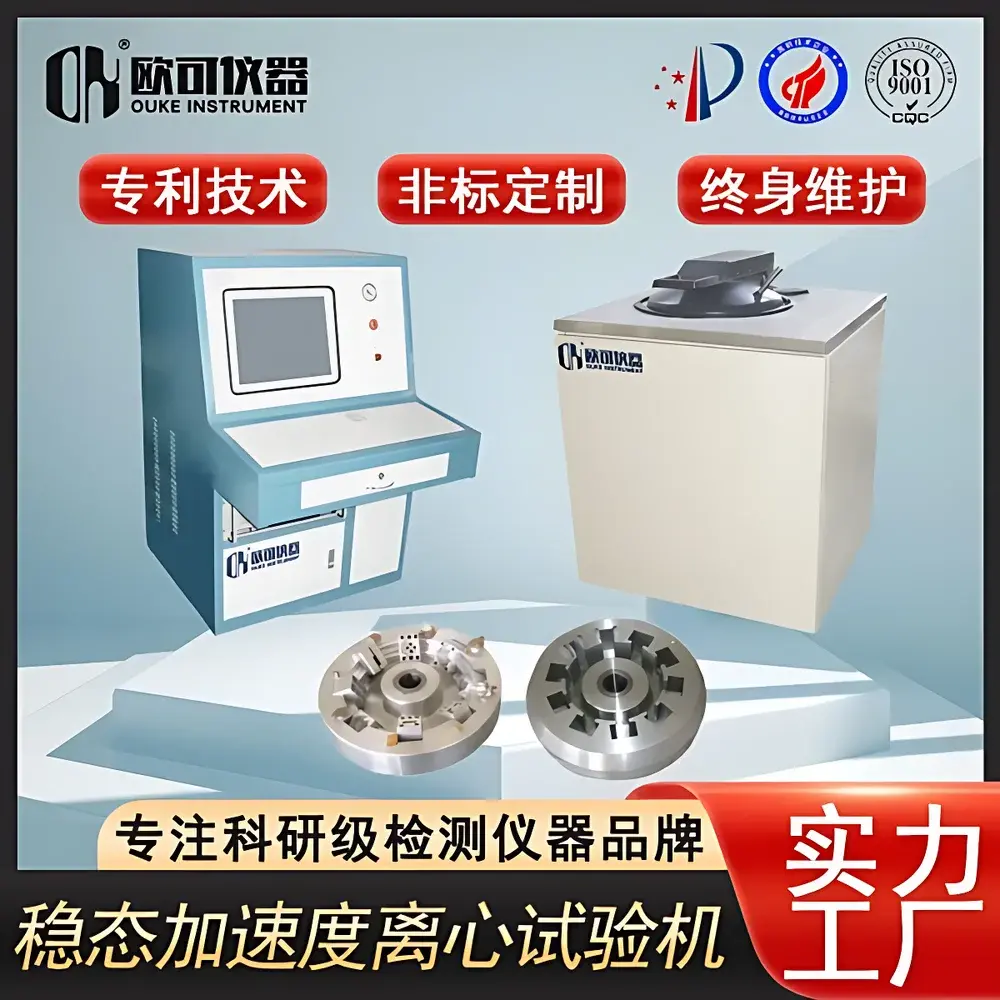
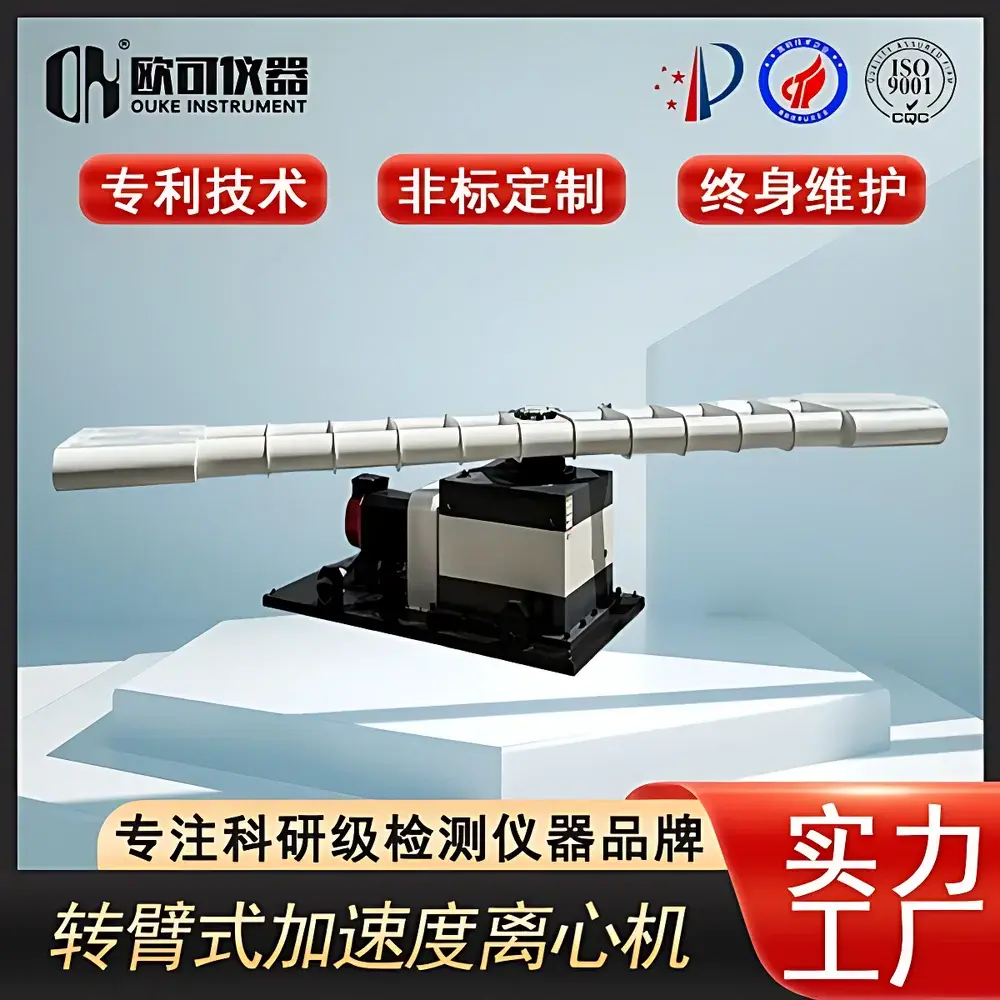
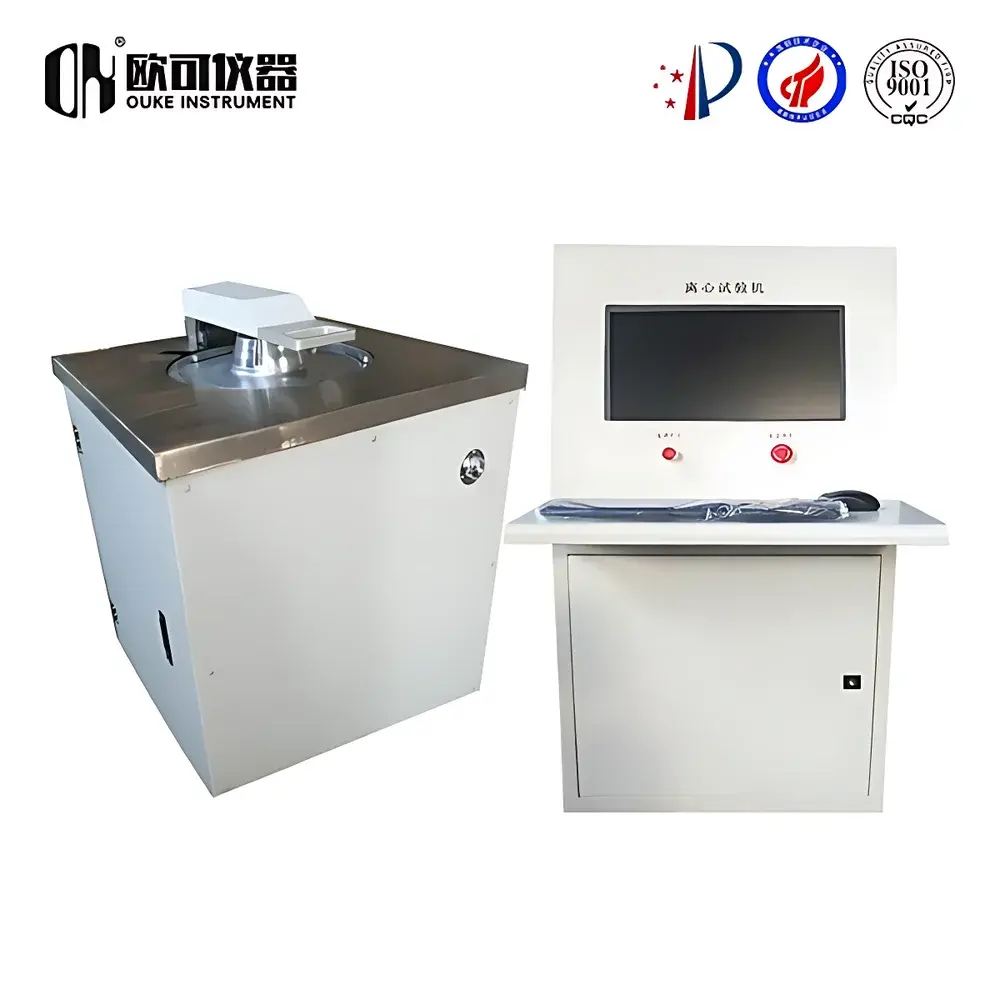
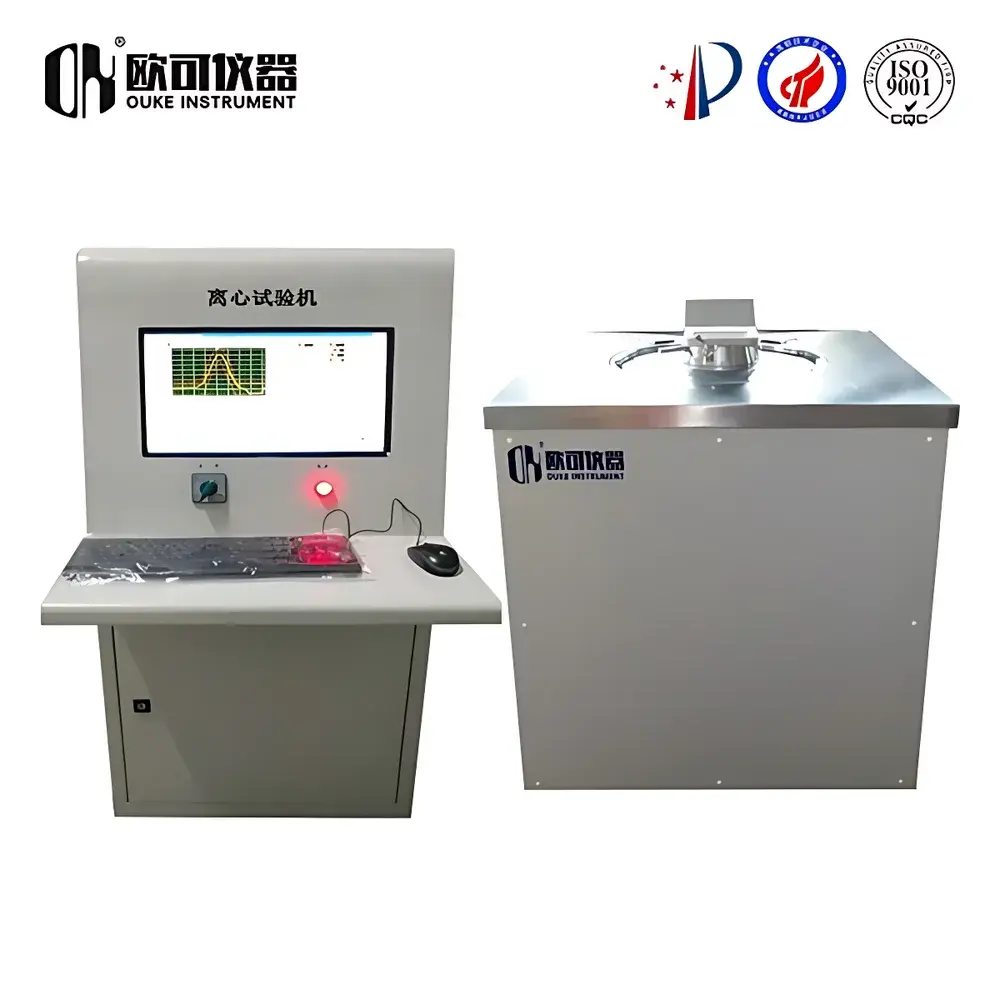
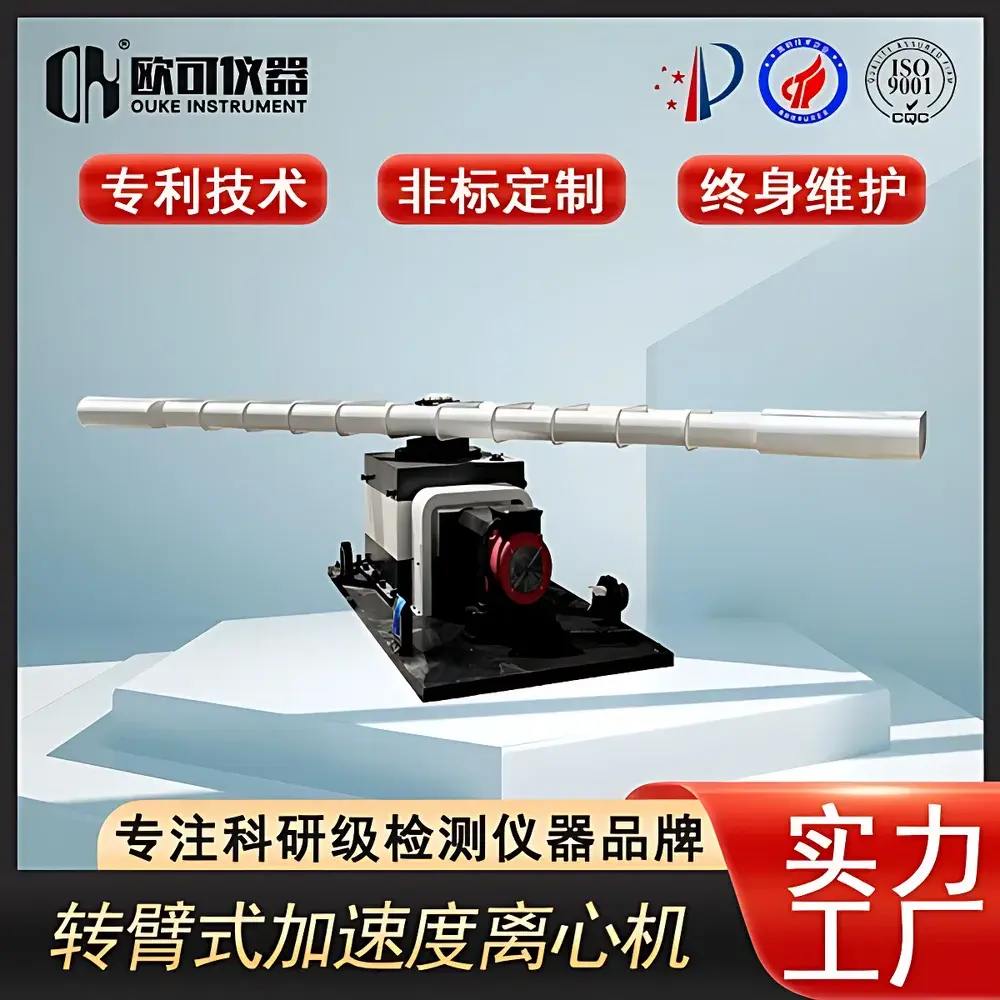
OK Instruments OK-LXJ50A Steady-State Acceleration Centrifuge
| Brand | OK Instruments |
|---|---|
| Origin | Guangdong, China |
| Manufacturer Type | Direct Manufacturer |
| Country of Origin | China |
| Model | OK-LXJ50A |
| Price | USD 28,000 (FOB Guangdong) |
Overview
The OK Instruments OK-LXJ50A Steady-State Acceleration Centrifuge is an electromechanical test system engineered to generate and maintain precisely controlled, unidirectional, constant-magnitude acceleration fields—expressed in multiples of Earth’s gravitational acceleration (g, where 1 g = 9.80665 m/s²). Unlike shock or vibration testers, this centrifuge operates on the principle of uniform circular motion, applying sustained radial acceleration via centripetal force according to the classical relation: a = ω²r = (2πN/60)² × r, where a is acceleration (g), N is rotational speed (RPM), and r is effective radius (m). By combining programmable motor control with calibrated arm geometry, the OK-LXJ50A delivers repeatable acceleration profiles ranging from 5 g to 50,000 g—enabling qualification-level environmental stress screening for mission-critical components under prolonged over-acceleration conditions typical of aerospace staging, hypersonic maneuvering, re-entry dynamics, and high-G automotive safety event simulation.
Key Features
- Robust dual-arm balanced rotor assembly with precision-machined aluminum alloy main shaft and dynamically balanced counterweight system, minimizing vibration at high rotational speeds
- High-torque AC servo drive with vector control and closed-loop RPM feedback, enabling acceleration ramp rates up to 500 g/min and steady-state stability within ±0.8% of setpoint
- Modular test platform (cradle) configurable for axial, lateral, or oblique mounting—supports 3-axis orientation per MIL-STD-883 Method 2001.7 and GJB 548B-2005 Method 2001
- Integrated safety-rated interlocked containment chamber constructed from 12-mm thick polycarbonate-reinforced steel, compliant with ISO 13857 and EN 60204-1 mechanical safety requirements
- Multi-channel slip-ring assembly supporting up to 16 independent analog signal paths (±10 V, 24-bit resolution) and DC power transfer (up to 5 A per channel) for real-time parametric monitoring during rotation
- Industrial-grade PLC-based control unit with Ethernet interface, supporting remote operation, recipe storage, and audit-trail logging per FDA 21 CFR Part 11 Annex 11 guidelines
Sample Compatibility & Compliance
The OK-LXJ50A accommodates specimens up to 5 kg mass and 200 mm maximum dimension, with customizable fixture interfaces for PCBs, MEMS inertial sensors, hybrid microcircuits, automotive airbag initiators, and miniature avionics modules. It fully supports standardized constant-acceleration test protocols including MIL-STD-883H Method 2001.7 (Constant Acceleration), GJB 548B-2005 Method 2001, and IEC 60068-2-7 (Test Ga: Constant Acceleration). Test execution adheres to GLP-compliant documentation workflows, with traceable calibration records maintained for both rotational speed (via laser tachometer) and radial position (micrometer-verified arm geometry). All mechanical and electrical subsystems are designed to meet CE marking requirements for machinery (2006/42/EC) and electromagnetic compatibility (2014/30/EU).
Software & Data Management
The embedded OK-CentriControl software suite provides a deterministic real-time operating environment for test sequence definition, parameter validation, and synchronized data acquisition. Users define acceleration profiles—including dwell time, ramp rate, hold duration, and axis-specific orientation—via intuitive graphical workflow templates. Acquired signals (e.g., output voltage drift, resistance shift, digital bus integrity) are timestamped with sub-millisecond resolution and stored in HDF5 format for post-test statistical analysis. The system supports automated report generation compliant with ISO/IEC 17025 clause 7.8.2, including uncertainty budgeting for acceleration magnitude based on combined standard uncertainties from RPM measurement (±0.15%), radius verification (±0.05 mm), and gravitational constant propagation. Audit trails record all operator actions, parameter changes, and emergency stops—retained for ≥36 months as required under GMP-aligned quality systems.
Applications
- Aerospace & Defense: Qualification testing of gyroscopes, accelerometers, and inertial measurement units (IMUs) under sustained 10–20,000 g loads; validation of satellite payload survivability during launch vehicle stage separation
- Automotive Electronics: Functional verification of crash sensors, ADAS radar housings, and battery management systems under cornering-induced lateral acceleration (up to 3 g continuous)
- Semiconductor Reliability: Structural integrity assessment of wire-bonded dies, flip-chip interconnects, and ceramic package hermeticity per JESD22-B105 and AEC-Q200
- Materials Science: Creep behavior evaluation of polymer composites and aluminum-lithium alloys under static mechanical stress analogous to long-duration flight loading
- Calibration & Metrology: Traceable reference acceleration source for laboratory-grade inertial sensor calibration, supporting NIST-traceable chain-of-custody documentation
FAQ
What acceleration range does the OK-LXJ50A support, and how is it verified?
The system achieves 5 g to 50,000 g using variable-speed rotation and selectable test radii (standard 150 mm, optional 300 mm extension arm). Acceleration magnitude is validated annually using NIST-traceable laser Doppler vibrometry and certified dimensional metrology.
Does the system comply with MIL-STD-883 and GJB 548 test requirements?
Yes—hardware configuration, cradle angular indexing (12-position manual indexer included), and software test templates are preconfigured to satisfy Method 2001.7 and GJB 548B-2005 procedural mandates, including dwell time tolerance (±1%), axis alignment repeatability (±0.5°), and pass/fail logic per device specification.
Can real-time electrical measurements be performed during rotation?
Yes—integrated 16-channel slip ring enables simultaneous analog signal acquisition (voltage, current, resistance) and DC power delivery without interruption, with noise floor < 5 µV RMS at 1 kHz bandwidth.
Is remote operation and data export supported?
The system features OPC UA server integration and supports CSV, MATLAB (.mat), and HDF5 exports. Remote access is enabled via TLS-secured web interface or dedicated API endpoints for integration into enterprise MES/QMS platforms.
What maintenance intervals and calibration documentation are provided?
Preventive maintenance is scheduled every 1,000 operational hours. Full calibration certificates—including torque sensor, encoder, and slip-ring channel linearity—are supplied with initial delivery and updated after each recalibration cycle, compliant with ISO/IEC 17025 documentation standards.



