
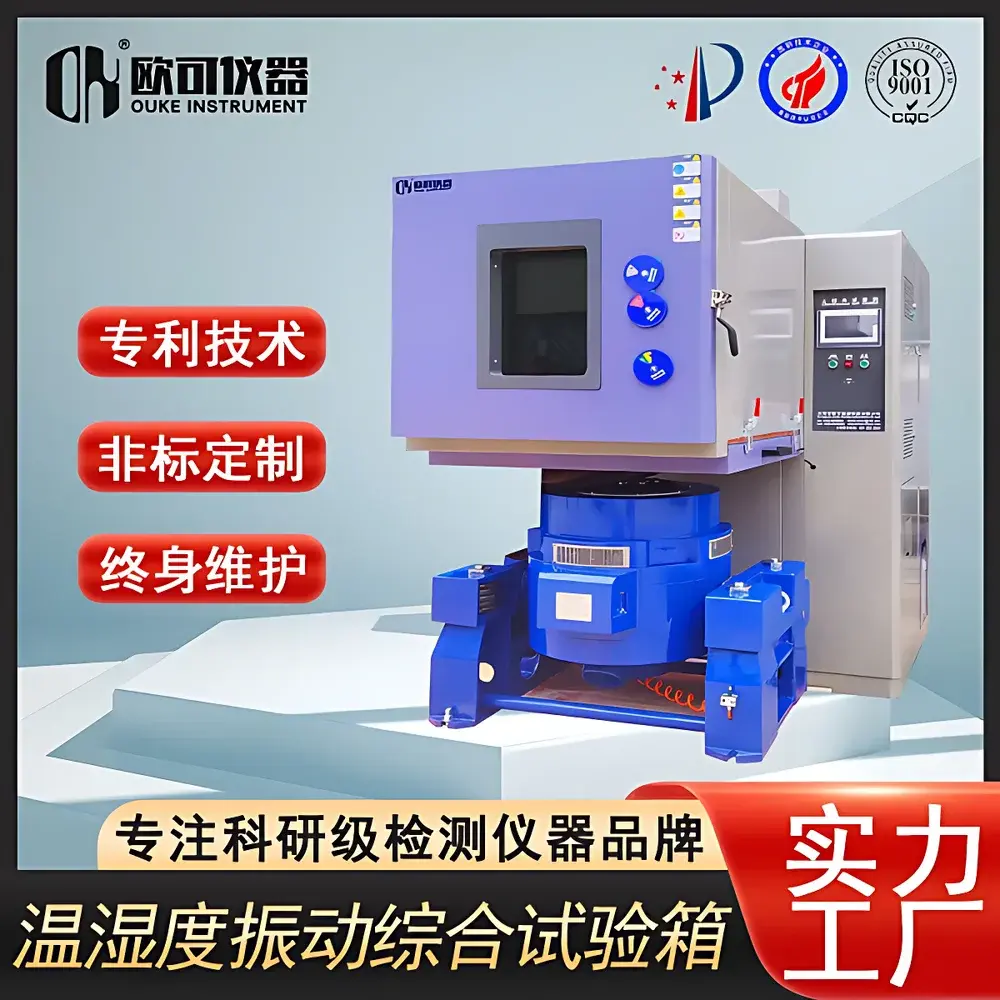
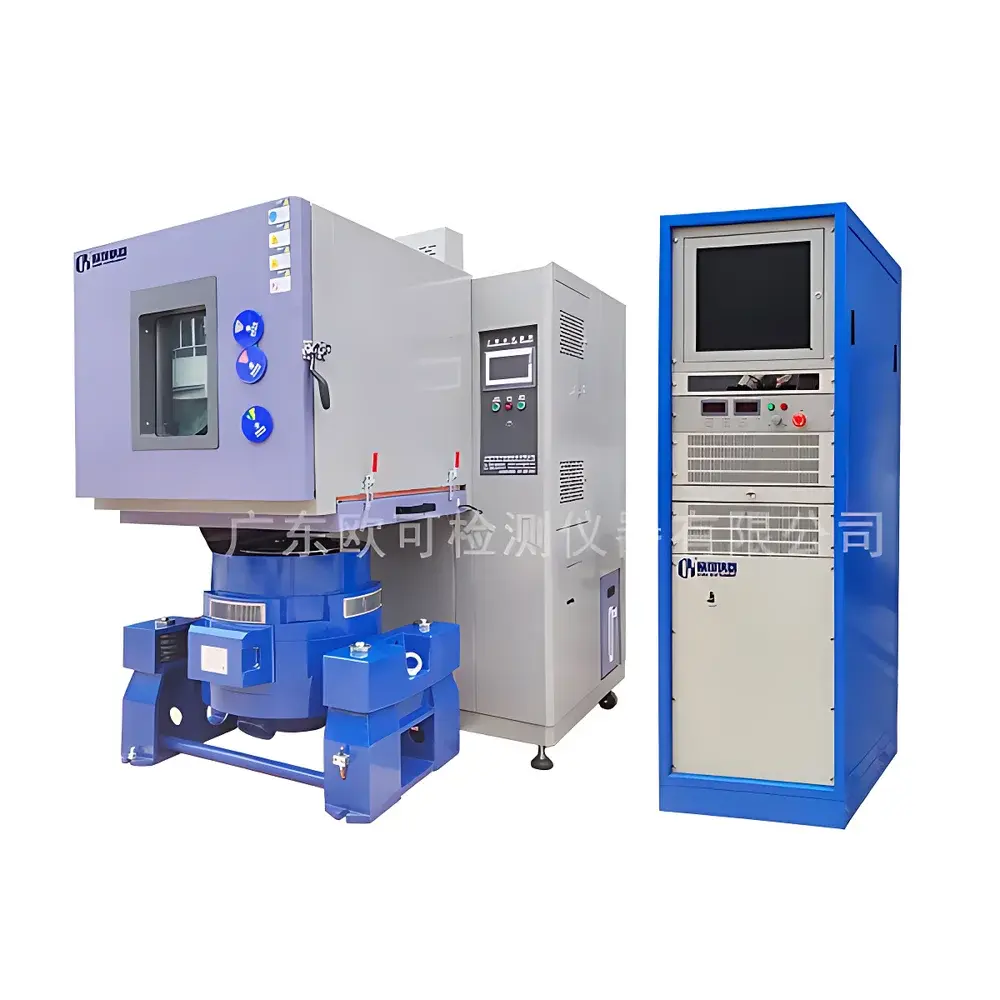
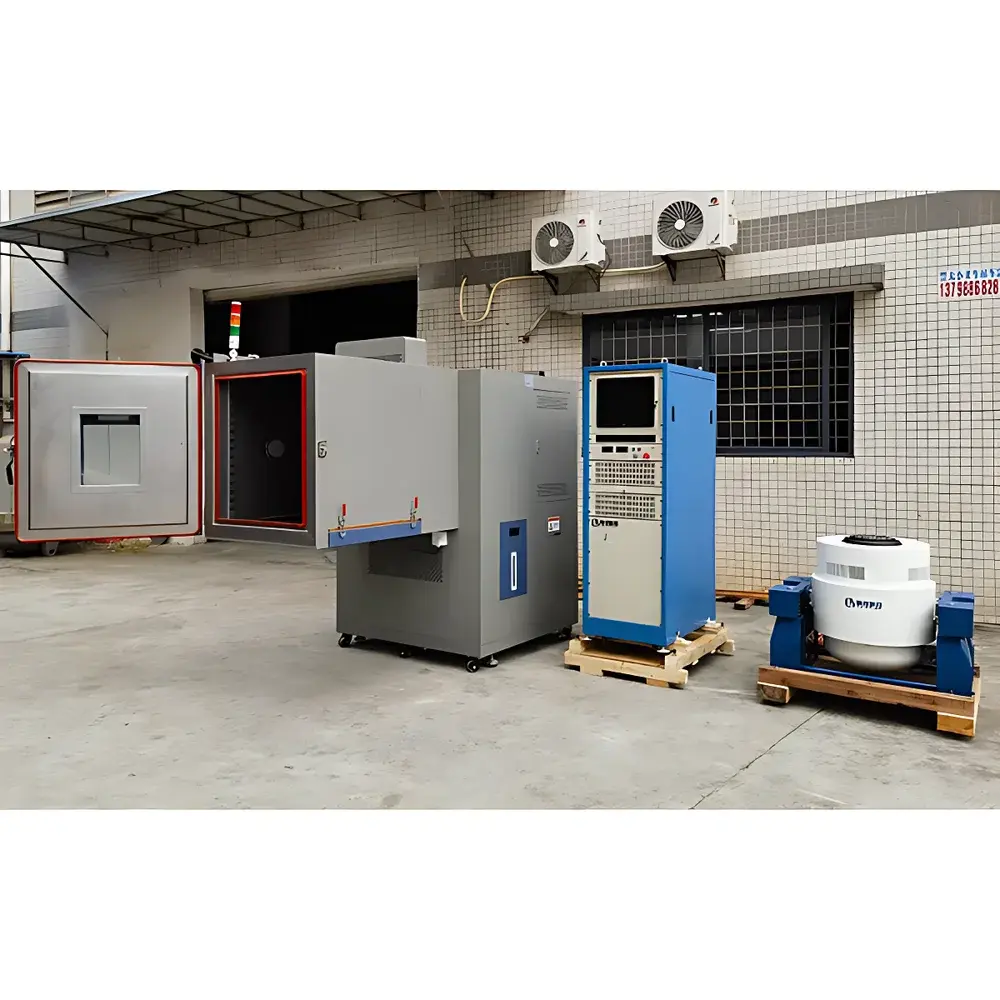
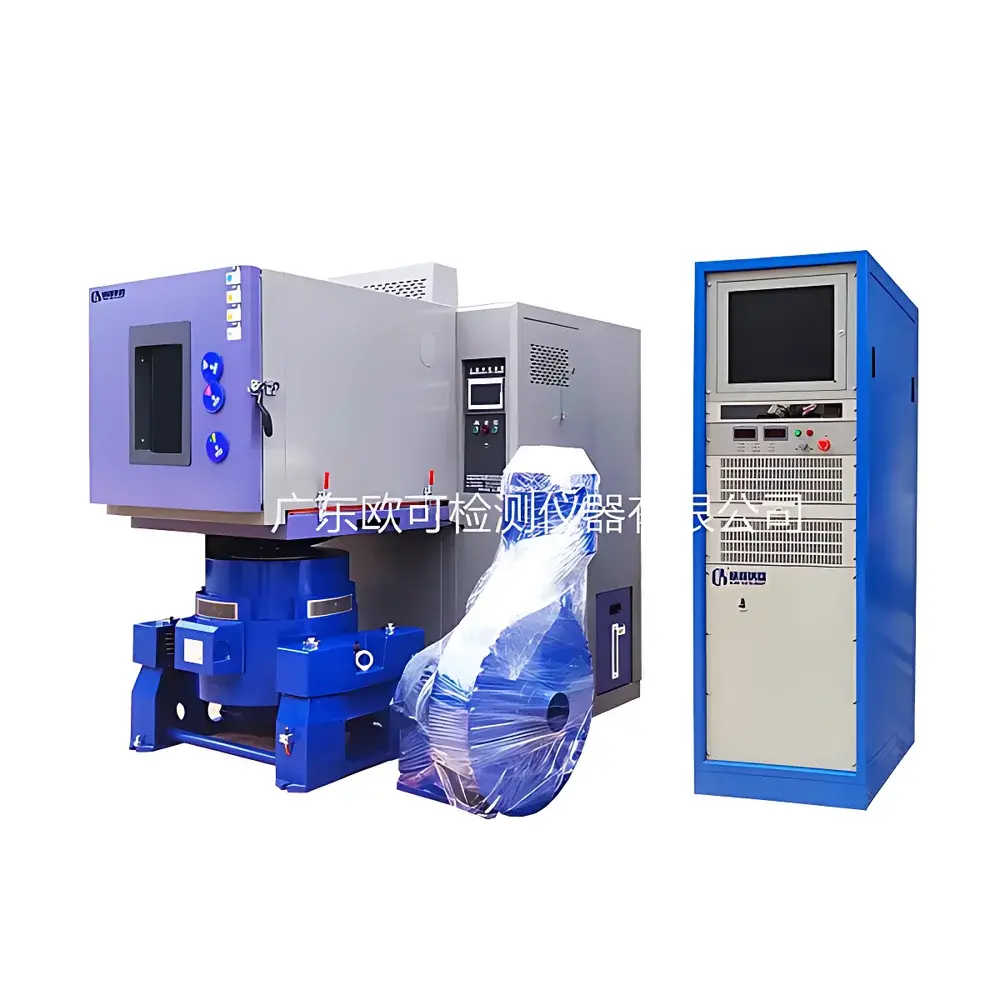
OK Instruments OK-ZTH-1000.357 Combined Temperature, Humidity and Vibration Test Chamber
| Brand | OK Instruments |
|---|---|
| Origin | Guangdong, China |
| Manufacturer Type | Direct Manufacturer |
| Product Origin | Domestic (China) |
| Model | OK-ZTH-1000.357 |
| Temperature Range | −70 °C to +150 °C |
| Humidity Range | 20–98 %RH at 20–85 °C |
| Temperature Ramp Rate | 5 / 10 / 15 °C/min |
| Temperature Uniformity | ≤ ±0.5 °C |
| Standard Load Capacity | 15 kg aluminum mass with 350 W internal heat dissipation |
Overview
The OK Instruments OK-ZTH-1000.357 Combined Temperature, Humidity and Vibration Test Chamber is an engineered solution for accelerated environmental reliability testing under concurrent multi-stress conditions. It integrates three critical physical stress domains—controlled thermal environments (including rapid temperature transitions), regulated humidity profiles, and programmable mechanical vibration—within a single, mechanically decoupled enclosure. Unlike sequential single-stress testing, this chamber operates on the principle of simultaneous stress application, grounded in the physics of coupled degradation mechanisms: thermal expansion mismatch under dynamic loading, moisture-assisted crack propagation during cyclic strain, and phase-dependent material damping shifts under combined thermo-mechanical excitation. Designed for laboratory-based qualification per MIL-STD-810H, IEC 60068-2, and automotive OEM-specific test specifications (e.g., GM W3177, Ford CETP 00.00-L-467), it enables replication of real-world operational envelopes encountered during transportation, storage, and field deployment—particularly where thermal gradients, hygroscopic swelling, and resonant structural response co-occur.
Key Features
- Triple-domain synchronization: Independent yet coordinated control of temperature (−70 °C to +150 °C), relative humidity (20–98 %RH within 20–85 °C operating band), and electrodynamic vibration (programmable sine/random waveforms).
- High-fidelity thermal ramping: Selectable ramp rates of 5, 10, or 15 °C/min across full temperature range, supported by dual-stage cascade refrigeration and PID-controlled resistive heating.
- Robust mechanical decoupling architecture: Patented isolation interface between the vibration table and climate chamber structure minimizes cross-coupling—preventing compressor vibration transmission and sensor drift while maintaining ≥95 % vibration energy transfer efficiency to the test specimen.
- Stable thermal-humidity uniformity: Air circulation system with turbulence-optimized duct geometry ensures ≤±0.5 °C temperature fluctuation and ±2 %RH humidity deviation at sensor locations per IEC 60068-3-5.
- Standardized load configuration: Validated performance with 15 kg aluminum reference mass dissipating up to 350 W—enabling thermal load compensation modeling for electronics-level testing.
- Integrated safety interlocks: Dual-channel overtemperature cutoff, vibration amplitude limiter, refrigerant pressure monitoring, and real-time cooling demand feedback for the shaker’s forced-air thermal management subsystem.
Sample Compatibility & Compliance
The OK-ZTH-1000.357 accommodates samples up to 1000 L internal volume with standardized 150 mm diameter cable/port access (IP54-rated). Its design supports mounting fixtures compliant with ASTM D999 (vibration fixture mass-to-sample mass ratio ≥3:1) and ISO 16750-4 (automotive environmental stress screening). The chamber meets electromagnetic compatibility requirements per EN 61326-1 for laboratory use and includes traceable calibration documentation aligned with ISO/IEC 17025-accredited procedures. All operational parameters—including temperature setpoint accuracy, humidity control fidelity, and vibration profile fidelity—are verifiable via built-in data logging with time-stamped audit trails, satisfying GLP and internal quality system requirements for test repeatability and regulatory submissions.
Software & Data Management
Control is executed via OK-TestSuite™ v4.2—a Windows-based platform supporting IEC 61131-3-compliant test sequence programming. Users define multi-step profiles combining dwell, ramp, and vibration segments with conditional branching (e.g., “if acceleration exceeds 25 g, hold temperature and reduce frequency”). Real-time waveform monitoring includes FFT spectrum analysis, PSD estimation (per IEEE 1003.1), and time-history overlay. All raw sensor data (thermocouples, RH sensors, accelerometers) are stored in .CSV and .TDMS formats with embedded metadata (test ID, operator, calibration expiry, environmental timestamps). Audit trail functionality complies with FDA 21 CFR Part 11 requirements, including electronic signatures, user role-based access control, and immutable log archiving.
Applications
- Automotive electronics: Validation of ADAS ECUs, battery management systems (BMS), and powertrain controllers under combined cold-start vibration and under-hood thermal cycling.
- Aerospace components: Screening of avionics enclosures, MEMS inertial sensors, and composite airframe subassemblies for resonance-induced delamination during thermal soak.
- Defense systems: Qualification of ruggedized communication terminals and radar modules subjected to NATO AEP-45 shock/vibe + humidity exposure protocols.
- Consumer electronics: Accelerated life testing of foldable display hinges, wireless charging coils, and sealed wearable housings for moisture ingress under mechanical flexure.
- Materials R&D: Investigation of polymer creep-fatigue interaction, solder joint intermetallic growth kinetics, and conformal coating adhesion loss under thermo-hygro-mechanical stress triaxiality.
FAQ
What standards does the OK-ZTH-1000.357 support for combined stress testing?
It is configured to execute test methods defined in MIL-STD-810H Method 520.5 (Combined Environments), IEC 60068-2-68 (Combined Temperature/Humidity/Vibration), and JEDEC JESD22-B111 (Board Level Interconnect Stress Testing).
Can the chamber operate vibration-only or temperature-only modes?
Yes—each subsystem (climate, humidity, vibration) can be independently enabled or disabled, allowing isolated stress application or staged multi-phase test execution.
Is external water supply required for humidity control?
The integrated steam-type humidifier uses deionized water from an internal 15 L reservoir; optional continuous feed via external DI water line is available.
What is the maximum allowable sample weight for vibration testing at full temperature range?
The rated dynamic load capacity remains 15 kg across the entire temperature range when using the standard aluminum mass reference; actual payload limits depend on fixture design and modal characteristics, and must be verified per ASTM E1856 Annex A3.
How is vibration calibration performed under thermal load?
A traceable, temperature-compensated accelerometer (with NIST-traceable calibration certificate) is mounted directly on the shaker table surface; calibration is repeated at −40 °C, 25 °C, and +85 °C to validate amplitude linearity across the operational envelope.



