
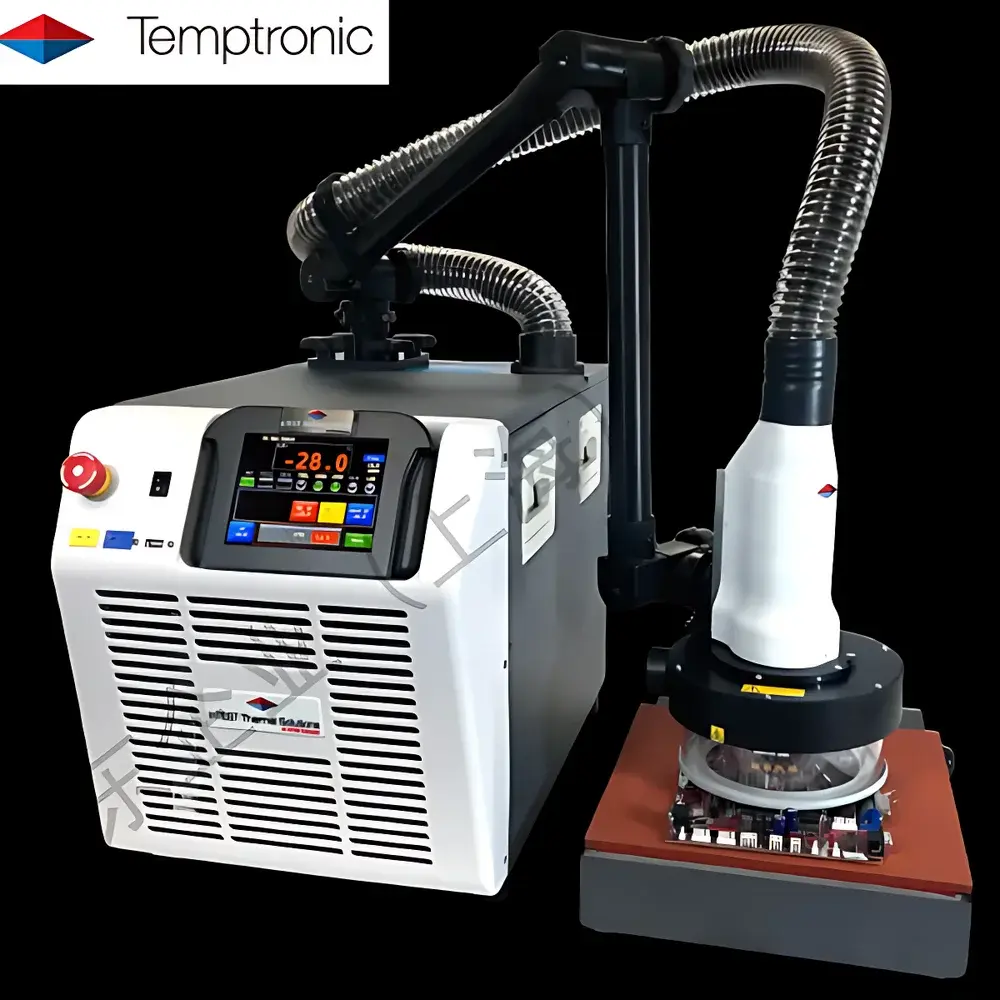
inTEST BT28 Thermal Shock Test System
| Brand | inTEST–Temptronic |
|---|---|
| Origin | USA |
| Manufacturer Type | Authorized Distributor (Imported) |
| Model | BT28 |
| High Temperature Range | +125°C |
| Low Temperature Range | −10°C |
| Thermal Shock Range | −10°C to +125°C |
| Temperature Stability | ±0.1°C |
| Heating Rate | −10°C to +125°C in ≤10 s |
| Cooling Rate | +125°C to −10°C in ≤10 s |
| Airflow Output | 14 scfm |
| Temperature Accuracy | ±1.0°C (NIST-traceable calibration) |
| Temperature Resolution | 0.1°C |
| Sensor Type | T-type or K-type thermocouple |
| Remote Interfaces | Ethernet, IEEE-488 (GPIB), RS-232, USB Serial |
| Overtemperature Protection | Factory-set at +225°C (user-configurable limits) |
| Dimensions (W×D×H) | 35.4 × 59.5 × 42.5 cm (base) |
| Weight | 38.3 kg (system), 31.8 kg (without arm/head) |
| Noise Level | <60 dBA (operational), <50 dBA (standby) |
| Refrigerant | Non-ozone-depleting, non-toxic, non-flammable blend |
Overview
The inTEST BT28 Thermal Shock Test System is a high-performance, benchtop-grade thermal shock chamber engineered for rapid, repeatable, and metrologically traceable temperature transitions in semiconductor device testing, electronic component qualification, and reliability validation. Unlike conventional environmental chambers relying on slow convection or limited airflow, the BT28 employs forced-air thermofluidic actuation—leveraging SwiftTherm™ dynamic thermal management—to achieve full-range thermal shocks between −10°C and +125°C in ≤10 seconds. Its core architecture integrates dual independent heating/cooling circuits with real-time closed-loop feedback control, enabling precise air temperature delivery at a nominal 14 standard cubic feet per minute (scfm). Designed for integration into automated test environments—including ATE platforms and inline burn-in stations—the BT28 delivers laboratory-grade thermal reproducibility (±0.1°C stability) while maintaining compliance with industry-critical standards such as JEDEC JESD22-A104 (Temperature Cycling), MIL-STD-883 Method 1010 (Thermal Shock), and IEC 60068-2-14 (Environmental Testing – Part 2-14: Tests – Test N: Change of Temperature).
Key Features
- SwiftTherm™ rapid transition technology enables sub-10-second thermal shocks across the full operating range (−10°C ↔ +125°C), significantly reducing test cycle time in high-volume production and accelerated life testing.
- ECO-Stream™ airflow optimization ensures uniform thermal distribution with minimal acoustic output (<60 dBA operational noise) and reduced energy consumption versus legacy thermal shock systems.
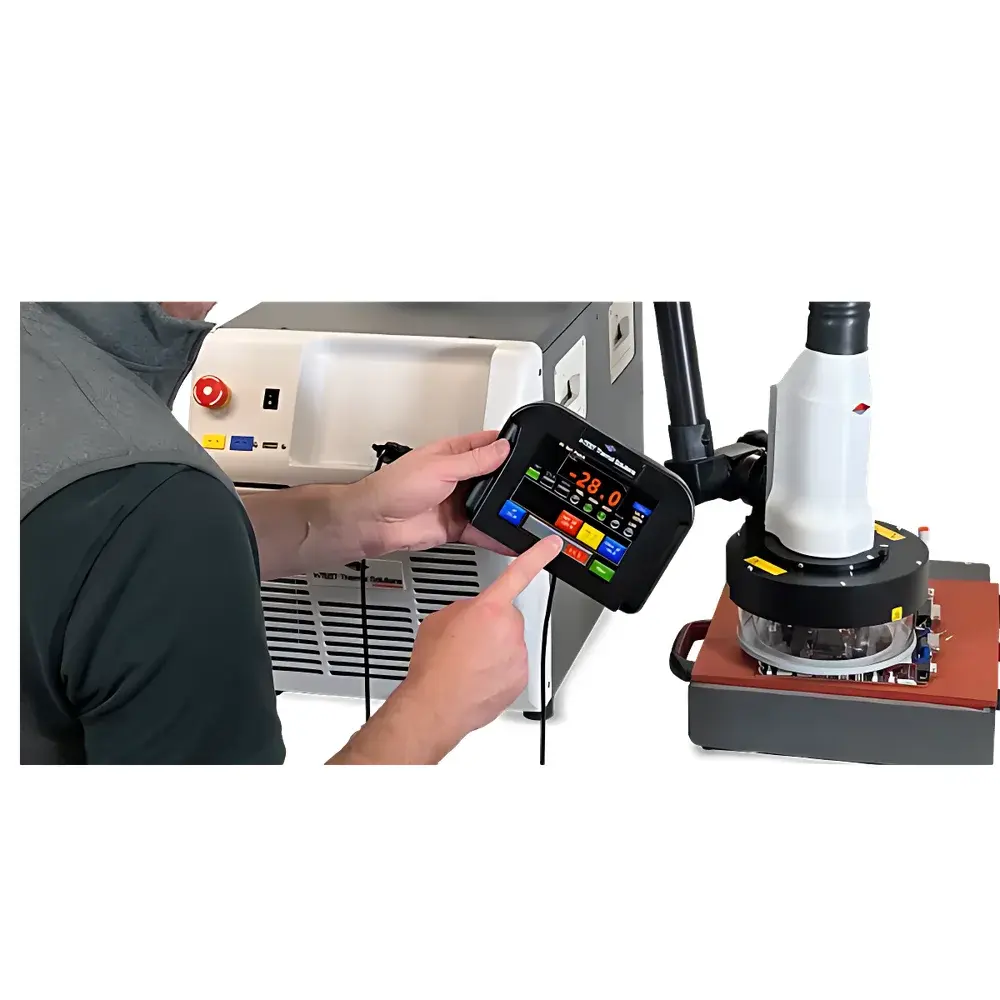
- Detachable 7-inch capacitive touchscreen control panel—wirelessly connected via Ethernet—offers flexible placement up to 2.7 m from the base unit, supporting ergonomic workstation integration and remote operator access.
- Embedded real-time controller with dual-mode operation: local HMI interface and full remote command capability via IEEE-488 (GPIB), RS-232, USB serial, or TCP/IP Ethernet protocols.
- User-definable thermal safety limits, programmable ramp profiles, and persistent storage of test configurations support GLP/GMP-aligned workflow documentation and audit readiness.
- NIST-traceable temperature accuracy (±1.0°C) validated using calibrated T-type or K-type thermocouples; onboard data logging supports USB export of timestamped thermal history for post-test analysis.
Sample Compatibility & Compliance
The BT28 accommodates DUTs (devices under test) ranging from bare die and packaged ICs to PCBAs and optoelectronic modules, with maximum payload dimensions constrained only by its internal airflow path geometry (not chamber volume). Its open-air thermal stream design eliminates thermal mass interference typical of sealed chamber systems—ensuring direct, transient-responsive thermal coupling to the sample surface. The system meets essential regulatory and quality framework requirements including ISO/IEC 17025 calibration traceability, FDA 21 CFR Part 11-compliant data integrity (when paired with validated software), and alignment with IPC-J-STD-020 moisture sensitivity level (MSL) preconditioning protocols. All firmware and controller logic are designed to support full audit trails, user access controls, and electronic signature functionality for regulated manufacturing environments.
Software & Data Management
The BT28 operates natively with inTEST’s TempWare™ control suite—a Windows-based application supporting script-driven test sequencing, multi-step profile definition, and real-time thermal monitoring with configurable alarms. Data acquisition includes continuous recording of air temperature, setpoint deviation, sensor status, and system health metrics (compressor duty cycle, heater power, fan speed). Export formats include CSV and XML for integration with LIMS, MES, or statistical process control (SPC) platforms. Firmware updates are delivered via secure HTTPS, and all configuration changes are logged with user ID, timestamp, and parameter delta—enabling full revision control and 21 CFR Part 11 compliance when deployed with appropriate IT governance policies.
Applications
- Accelerated thermal cycling qualification of automotive-grade semiconductors per AEC-Q100 stress test requirements.
- Preconditioning of MEMS sensors and RF front-end modules prior to humidity exposure or mechanical shock testing.
- Thermal boundary mapping of high-power GaN and SiC devices during transient thermal resistance (Rth(j-c)) characterization.
- Validation of solder joint reliability in advanced packaging (e.g., fan-out wafer-level packages, 2.5D/3D IC stacks).
- Process development support for reflow profiling, underfill cure monitoring, and thermal interface material (TIM) performance benchmarking.
FAQ
What is the maximum recommended DUT size for optimal thermal shock performance?
For consistent airflow coupling and minimal thermal lag, inTEST recommends DUT footprints not exceeding 150 mm × 150 mm with height ≤40 mm. Larger assemblies may require custom airflow shrouds or fixture-mounted thermal sensors.
Does the BT28 support automated pass/fail criteria based on thermal response?
Yes—TempWare™ allows users to define acceptance thresholds for temperature deviation, dwell time compliance, and rate-of-change limits; results are auto-flagged and exported with test reports.
Is the refrigerant compliant with current global environmental regulations?
Yes—the BT28 uses a proprietary hydrofluoroolefin (HFO)-based blend that is zero ozone depletion potential (ODP), low global warming potential (GWP), non-toxic, and non-flammable—fully compliant with EU F-Gas Regulation (EU) No 517/2014 and U.S. EPA SNAP program requirements.
Can the BT28 be integrated into a robotic handling cell?
Absolutely—the system provides TTL-compatible I/O triggers, Ethernet-based SCPI command support, and hardware interlocks compatible with common industrial robot controllers (e.g., Fanuc, Universal Robots, ABB).
What calibration documentation is supplied with shipment?
Each BT28 ships with a NIST-traceable calibration certificate covering temperature accuracy across the full operating range, performed at three points (−10°C, +25°C, +125°C) using accredited reference standards.



