
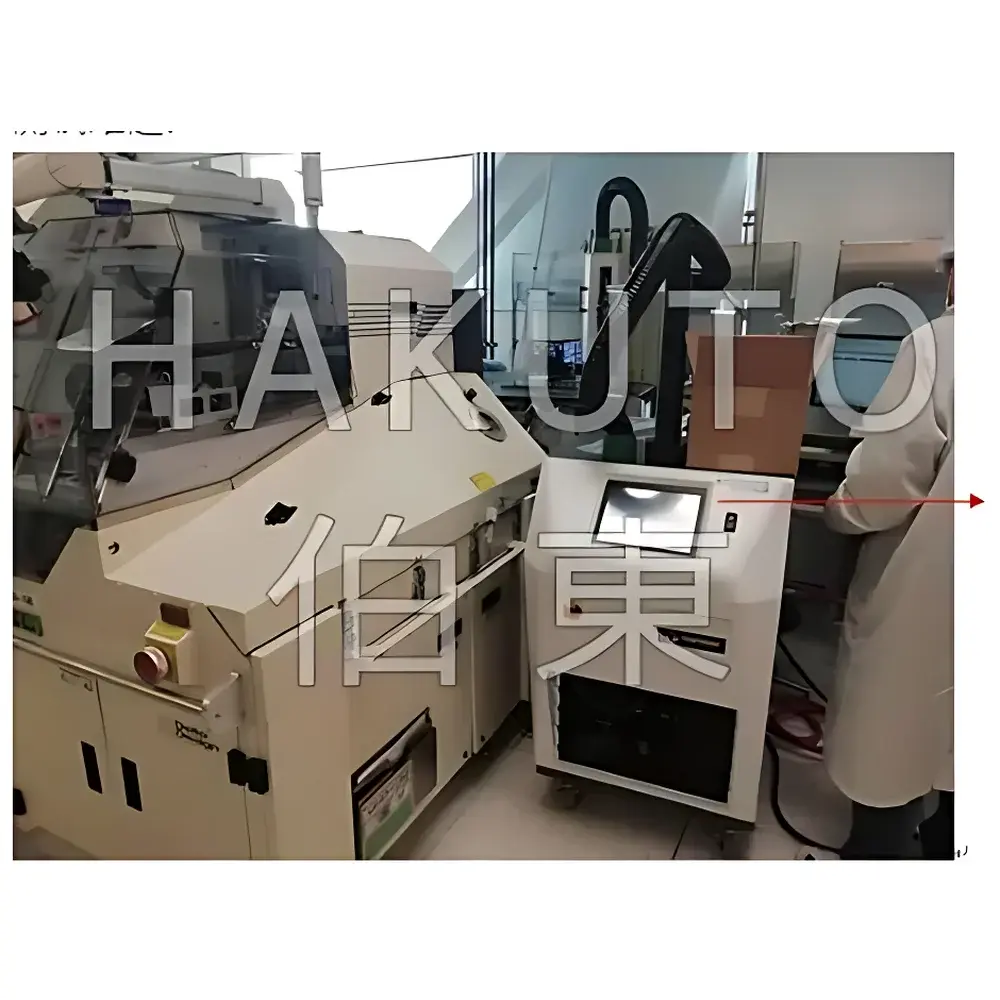
inTEST Temptronic ECO-710E ThermoStream® Thermal Test System for MCU and Semiconductor Device Temperature Cycling
| Brand | inTEST Temptronic |
|---|---|
| Origin | USA |
| Model | ECO-710E |
| Temperature Range | −80 °C to +225 °C |
| Thermal Shock Range | −80 °C to +225 °C |
| Temperature Stability | ±1.0 °C |
| Ramp Rate (Heating) | −55 °C to +125 °C in ≤10 s |
| Ramp Rate (Cooling) | +125 °C to −55 °C in ≤10 s |
| Airflow Output | 4–18 SCFM |
| Temperature Accuracy | ±1.0 °C (NIST-traceable calibration) |
| Power Supply | 200–250 VAC, 50/60 Hz, 20 A, single-phase |
Overview
The inTEST Temptronic ECO-710E ThermoStream® is a high-performance, closed-loop thermal test system engineered for rapid, precise, and repeatable temperature conditioning of semiconductor devices—including microcontroller units (MCUs), SoCs, ASICs, and power modules—during functional electrical testing, burn-in, failure analysis, and reliability qualification. Unlike conventional environmental chambers, the ECO-710E delivers dynamic thermal control via directed airflow: compressed, desiccated air is conditioned through integrated thermoelectric or vapor-compression cooling and resistive heating stages, then delivered through a flexible thermal probe directly onto the device-under-test (DUT) surface or into a custom test fixture. This localized, non-contact methodology enables sub-second thermal transitions while maintaining tight stability (±1.0 °C) and eliminating thermal mass-related lag. The system operates across an industry-leading range of −80 °C to +225 °C, supporting AEC-Q100 Grade 0–3 qualification, JEDEC JESD22-A104 (Temperature Cycling), and MIL-STD-883 Method 1010 (Thermal Shock), making it indispensable for automotive, industrial, and aerospace-grade IC validation.
Key Features
- Ultra-fast thermal ramping: Achieves −55 °C ↔ +125 °C transitions in ≤10 seconds—enabling high-throughput temperature cycling without mechanical chamber movement or long soak times.
- Integrated oil-free scroll compressor: Eliminates external air supply dependency; supports consistent dew point control (<−40 °C) critical for preventing condensation during low-temperature operation.
- Touchscreen HMI with intuitive workflow navigation: Predefined test profiles (e.g., AEC-Q100 TC0–TC5), real-time temperature logging, and user-configurable alarm thresholds (high/low temp, airflow loss, overpressure).
- NIST-traceable temperature accuracy: Calibrated to ±1.0 °C across full operating range using platinum RTD sensors mounted at thermal probe outlet and DUT interface point.
- Modular thermal probe design: Compatible with standard socket adapters (e.g., Delta Design, Cohu, LTX-Credence), wafer-level test handlers, and custom glass dome fixtures for bare-die or packaged-device evaluation.
- Compliance-ready architecture: Supports audit trails, electronic signatures, and configurable data export (CSV, XML) for GLP/GMP environments; compatible with FDA 21 CFR Part 11–compliant LIMS integration via optional Ethernet/IP or Modbus TCP interface.
Sample Compatibility & Compliance
The ECO-710E accommodates a broad spectrum of semiconductor packages—from QFN, BGA, and LGA MCUs to high-power SiC MOSFETs and GaN HEMTs—without requiring device-specific tooling. Its directed airflow design ensures uniform thermal loading on both surface-mount and leaded components, even under active bias conditions. The system meets key international standards for semiconductor reliability testing, including:
- AEC-Q100 Rev-H (Stress Test Qualification for Automotive Grade ICs)
- JEDEC JESD22-A104F (Temperature Cycling)
- JEDEC JESD22-A106B (Thermal Shock)
- IEC 60749-25 (Integrated Circuits – Mechanical and Climatic Test Methods – Temperature Cycling)
- ISO/IEC 17025:2017 (General requirements for the competence of testing and calibration laboratories)
For automotive MCU validation, the ECO-710E enables full-cycle execution of Level 0 (−40 °C to +150 °C) and Level 1 (−40 °C to +125 °C) stress profiles per AEC-Q100, with automated dwell time management and thermal gradient monitoring per JEDEC guidelines.
Software & Data Management
The embedded ThermoStream Control Software provides deterministic test sequencing, real-time thermal mapping, and synchronized acquisition of DUT electrical parameters (via TTL/RS-232 trigger outputs). All temperature setpoints, actual readings, ramp rates, and system status events are timestamped and stored locally with configurable retention policies. Exported datasets include ISO 8601-formatted timestamps, sensor IDs, and metadata tags compliant with ASTM E2917 (Standard Practice for Calibration of Thermocouples and Thermistors). Optional software modules support statistical process control (SPC) charting, Cp/Cpk calculation per test lot, and automated pass/fail reporting aligned with IPC-A-610 or IATF 16949 requirements. Audit logs record all operator actions, parameter changes, and calibration events—retained for ≥12 months by default.
Applications
- Automotive MCU qualification per AEC-Q100: Functional testing across extended temperature ranges (e.g., ADAS SoCs, battery management controllers, motor drive MCUs).
- Industrial IoT node validation: Accelerated life testing of edge-computing MCUs operating in uncontrolled ambient environments (−40 °C to +85 °C).
- Fault isolation and failure analysis: Correlating parametric drift (e.g., leakage current, clock jitter, reset threshold) with controlled thermal excursions.
- Package-level thermal resistance (RθJA, RθJC) characterization under dynamic load conditions.
- Reliability screening for high-reliability applications: MIL-PRF-19500, DO-254, and EN 50129 compliance testing.
FAQ
What distinguishes the ECO-710E from traditional thermal chambers?
The ECO-710E uses directed, conditioned airflow instead of chamber-based convection—eliminating thermal inertia, enabling sub-10-second transitions, and allowing in-situ electrical testing without DUT relocation.
Is the system suitable for wafer-level testing?
Yes—when paired with compatible prober interfaces and thermal chucks, the ECO-710E supports front-side thermal conditioning of 200 mm and 300 mm wafers during probe station operation.
Does it support automated test integration?
Yes—standard TTL, RS-232, and Ethernet interfaces enable seamless integration with ATE platforms (e.g., Advantest, Teradyne) and test executive software (e.g., NI TestStand, Keysight PathWave).
How is temperature accuracy validated?
Each unit ships with NIST-traceable calibration certificates for both inlet air and probe outlet sensors; field recalibration is supported using certified reference thermometers per ISO/IEC 17025 procedures.
Can the system operate continuously at extreme temperatures?
Yes—the ECO-710E is rated for continuous operation at −80 °C and +225 °C; its dual-stage cooling architecture and thermal management firmware prevent compressor overload or heater element derating during extended dwell periods.



