
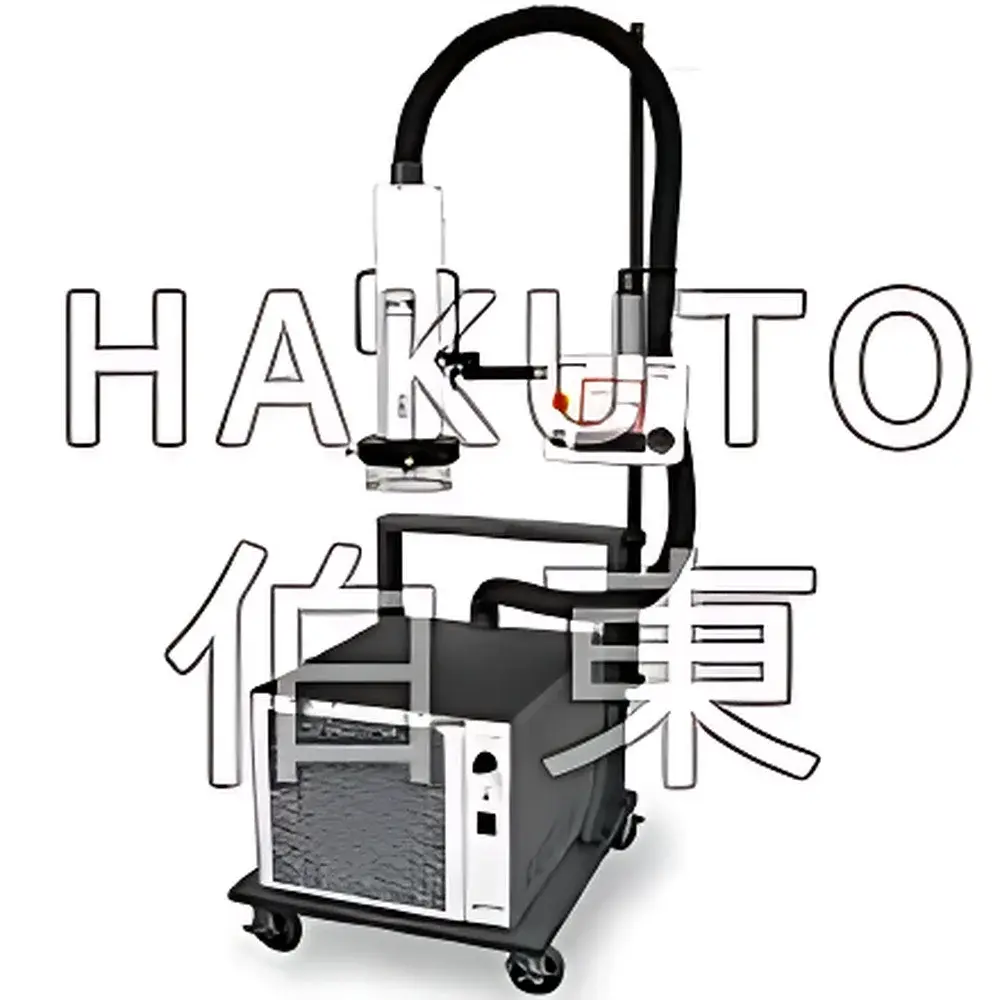
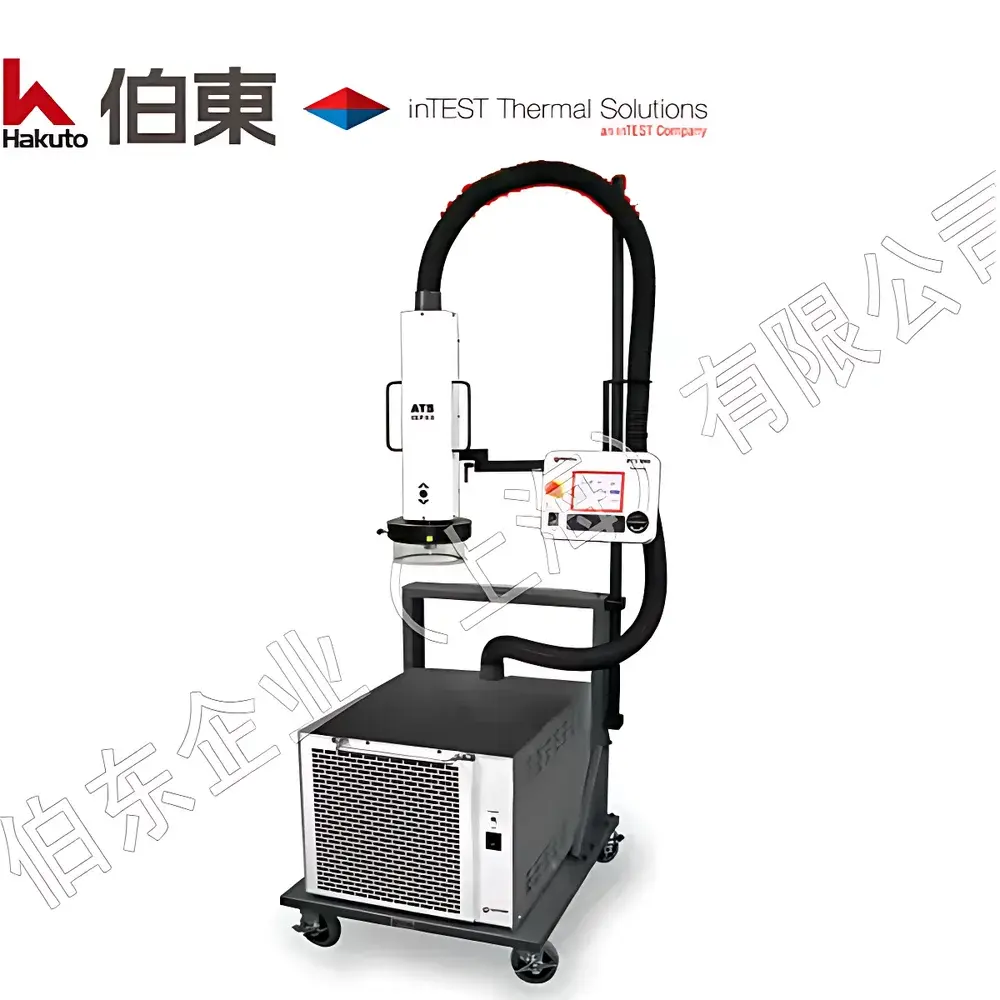
inTEST Temptronic ThermoStream ATS-515 High-Speed Thermal Shock System
| Brand | inTEST Temptronic |
|---|---|
| Origin | USA |
| Model | ATS-515 |
| Temperature Range | -45°C to +225°C |
| Ramp Rate | -40°C to +125°C <12 s |
| Temperature Accuracy | ±1.0°C (NIST-traceable calibration) |
| Temperature Resolution | 0.1°C |
| DUT Sensor Interface | T-type and K-type thermocouple inputs |
| Airflow Control | Dry air purge (0.25–1.5 L/s) |
| Power Supply | 200±10% VAC, 50 Hz, 16 A |
| Operating Ambient | 20–28°C, 0–60% RH (45% nominal) |
| Controller Dimensions (W×H×D) | 26.7 × 20.7 × 9.8 cm |
| Chiller Dimensions (W×H×D) | 51.3 × 41.4 × 74.9 cm |
| Hot Air Nozzle Diameter | 13.97 cm |
| System Weight | 112 kg (chiller: 74.5 kg |
| chiller + mobile cart | 100.8 kg) |
| Compliance | CE-marked, CFC-free refrigerant, RoHS-compliant |
Overview
The inTEST Temptronic ThermoStream ATS-515 is a high-speed, non-cryogenic thermal shock system engineered for precision dynamic temperature conditioning of electronic devices under test (DUTs). Unlike conventional environmental chambers that rely on large thermal mass and slow convection, the ATS-515 employs forced-air thermofluidics—delivering rapid, localized heating and cooling directly to the DUT surface via a controllable hot/cold air stream. Its core architecture eliminates dependence on liquid nitrogen (LN₂) or liquid CO₂, achieving ultra-low temperatures down to -45°C through advanced vapor-compression refrigeration combined with optimized airflow dynamics. Designed as the successor to the Temptronic TP04500 and Thermonics T-2600BV platforms, the ATS-515 integrates decades of thermal test engineering heritage into a compact, modular system capable of sub-12-second transitions between extreme setpoints. It supports real-time closed-loop control using integrated T- or K-type thermocouple feedback from the DUT itself—ensuring measurement fidelity aligned with actual junction or package-level thermal response rather than ambient chamber air.
Key Features
- High-fidelity thermal shock capability: -45°C to +225°C operating range with ramp rates of <12 s (-40°C → +125°C) and <40 s (+125°C → -40°C)
- Dry-air purge system (0.25–1.5 L/s) preventing condensation at cold interfaces—critical for moisture-sensitive IC packages and bare-die testing
- Modular design with optional mobile cart for flexible integration into automated test handlers, probe stations, or benchtop validation labs
- Intuitive rotary-control front panel interface complemented by full remote operation via IEEE-488 (GPIB), RS232, and LabVIEW™ drivers
- Programmable safety limits, user-defined thermal profiles, and onboard storage for up to 100 test sequences with timestamped execution logs
- NIST-traceable temperature accuracy of ±1.0°C and 0.1°C display resolution across the full operating span
- CFC-free, low-GWP refrigerant compliant with EU F-Gas Regulation (EC No. 517/2014) and RoHS Directive 2011/65/EU
- Self-diagnostic firmware with fault logging and predictive maintenance alerts to minimize unplanned downtime
Sample Compatibility & Compliance
The ATS-515 accommodates a broad spectrum of electronic components—from individual die and flip-chip packages to populated PCBs, RF modules, optoelectronic transceivers (e.g., SFP+, QSFP, eMMC, UFS), and automotive-grade power semiconductors. Its focused thermal delivery enables device-level stress testing without thermal crosstalk—a critical requirement for failure analysis (FA), qualification per JEDEC JESD22-A104 (Temperature Cycling) and JESD22-A106 (Thermal Shock), and reliability screening per AEC-Q200. The system meets CE marking requirements for electromagnetic compatibility (EMC Directive 2014/30/EU) and low-voltage safety (LVD Directive 2014/35/EU). Its software architecture supports audit-ready data integrity per FDA 21 CFR Part 11 when configured with appropriate access controls and electronic signature workflows. All thermal calibrations are performed against NIST-traceable standards, ensuring metrological consistency across global manufacturing and R&D sites.
Software & Data Management
The ATS-515 operates natively with inTEST’s ThermoStream Control Suite, offering both local GUI and script-driven automation. Test sequences can be defined via intuitive drag-and-drop profile builders or imported as ASCII-based .tsf files. Real-time temperature plots (DUT sensor vs. air stream) are logged with millisecond timestamp resolution and exported in CSV or MATLAB-compatible formats. Remote monitoring and control integrate seamlessly into existing test ecosystems via SCPI command sets over GPIB or serial. Optional add-ons include GLP/GMP-compliant audit trails, role-based user permissions, and encrypted data archiving. LabVIEW™ drivers enable direct integration with NI TestStand, PXI-based ATE systems, and custom Python/C# applications—facilitating traceable, repeatable thermal validation within automated production test flows.
Applications
- JEDEC-compliant thermal cycling and shock qualification of ASICs, FPGAs, microcontrollers, and memory devices
- Thermal boundary characterization of advanced packaging (2.5D/3D ICs, fan-out wafer-level packaging)
- Pre-conditioning of sensors and MEMS devices prior to functional testing
- Thermal validation of automotive electronics under ISO 16750-4 (Climate Load Conditions)
- Rapid prototyping of thermal management solutions for high-power GaN/SiC modules
- Failure root-cause analysis via accelerated thermal stress mapping on solder joints and interconnects
- Environmental stress screening (ESS) in aerospace and defense avionics per MIL-STD-810H Method 503.5
FAQ
Does the ATS-515 require external cryogenic fluids such as liquid nitrogen?
No. The system achieves -45°C solely through its integrated, high-efficiency vapor-compression chiller—eliminating LN₂ handling hazards, infrastructure costs, and supply chain dependencies.
Can the ATS-515 perform simultaneous heating and cooling on different DUT locations?
Not simultaneously from a single nozzle—but dual-nozzle configurations (optional) support independent thermal zoning for multi-site DUTs or comparative testing across adjacent components.
Is the temperature accuracy validated across the entire range?
Yes. Factory calibration includes point verification at -45°C, 25°C, 100°C, and 225°C, all referenced to NIST-traceable standards; users may perform field verification using certified thermocouple calibrators.
How does the dry-air purge function enhance test repeatability?
By maintaining dew-point suppression below -40°C at the nozzle exit, it prevents frost formation on cold DUT surfaces—preserving thermal contact integrity and eliminating transient errors caused by latent heat absorption during phase change.
What level of software validation support is available for regulated industries?
IQ/OQ documentation packages, 21 CFR Part 11 compliance kits (including electronic signature templates and audit trail configuration guides), and GAMP 5-aligned validation protocols are available upon request.



