
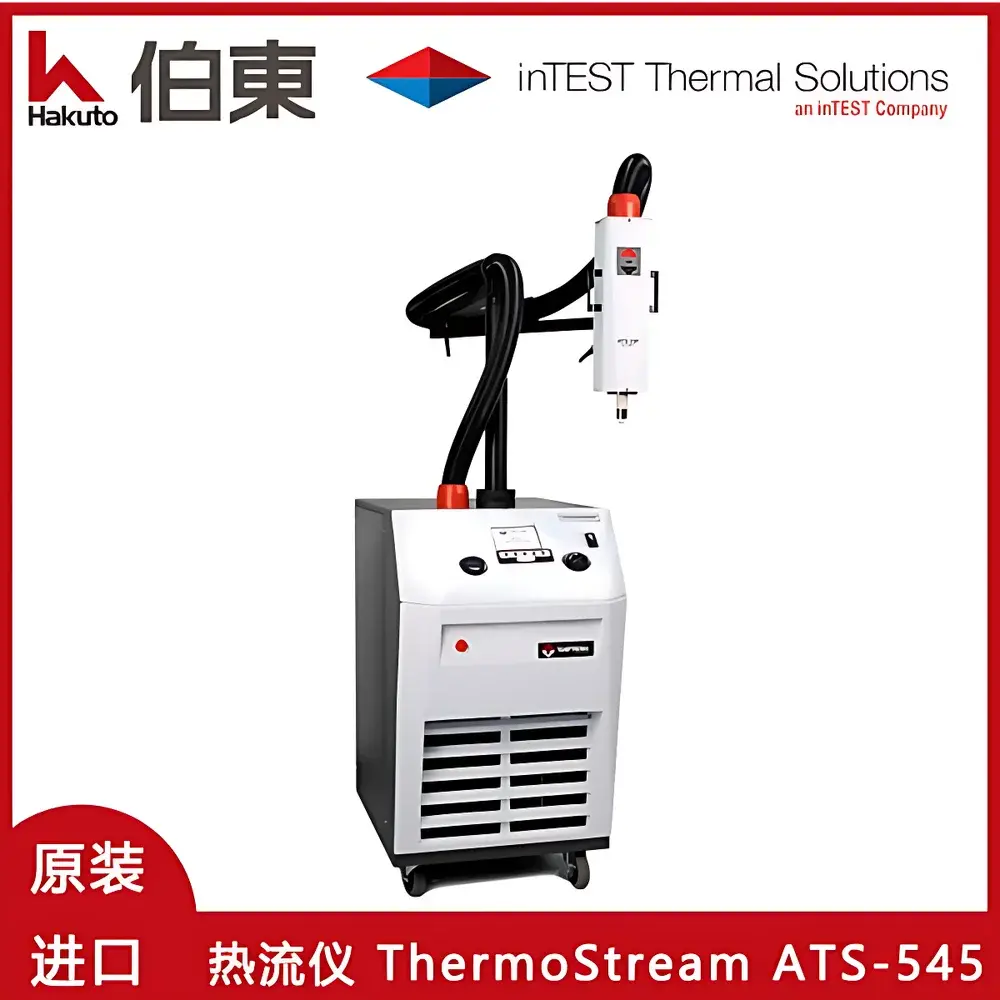
inTEST ThermoStream ATS-545 High-Speed Thermal Shock Test System
| Brand | inTEST–Temptronic |
|---|---|
| Origin | USA |
| Model | ATS-545 |
| High-Temperature Range (°C) | 0 to +225 (50 Hz) |
| Low-Temperature Range (°C) | −75 to 0 (50 Hz) |
| Thermal Shock Range (°C) | −75 to +225 (50 Hz) |
| Temperature Stability | Excellent |
| Ramp Rate (°C/min) | ~10 s for −55 °C to +125 °C |
| Ramp Rate (°C/min) | ~10 s for +125 °C to −55 °C |
| Airflow Output | 4–18 scfm (1.9–8.5 L/s) |
| Temperature Accuracy | ±1 °C (NIST-traceable calibration) |
| Temperature Resolution | ±0.1 °C |
| Sensor Type | T- or K-type thermocouple |
| Refrigeration | Auto-cascade, non-ozone-depleting refrigerant, LN₂-free |
| ESD Protection | Integrated patented design |
| Operating Noise | <65 dBA |
Overview
The inTEST ThermoStream ATS-545 is a high-speed, closed-loop thermal shock test system engineered for precision dynamic temperature conditioning of semiconductor devices, integrated circuits (ICs), and printed circuit board (PCB) assemblies during functional and reliability testing. Unlike conventional environmental chambers, the ATS-545 employs forced-air convective thermal transfer via a focused, controllable airstream—enabling rapid, localized thermal cycling directly onto the device under test (DUT). Its core architecture integrates an auto-cascade refrigeration system with dual-stage compression, eliminating dependency on cryogenic consumables such as liquid nitrogen (LN₂) or liquid carbon dioxide (LCO₂). This design delivers repeatable, NIST-traceable temperature control across a full operational range of −75 °C to +225 °C, with sub-10-second transitions between −55 °C and +125 °C—meeting stringent requirements for JEDEC JESD22-A104 (Temperature Cycling) and JESD22-A106 (Thermal Shock) qualification protocols.
Key Features
- Auto-cascade refrigeration system using environmentally compliant, non-flammable, zero-ozone-depletion-potential (ODP) refrigerants—fully compliant with EPA SNAP and EU F-Gas Regulation
- Patented ESD-safe airflow delivery with integrated grounding pathways, ensuring electrostatic discharge protection at the DUT interface without compromising thermal performance
- Dual-mode operation: Air Mode (ambient isolation) and DUT Mode (direct thermal coupling), enabling both board-level and single-component-level thermal stress application
- Real-time, closed-loop temperature feedback via T- or K-type thermocouples embedded in the thermal stream nozzle—supporting dynamic setpoint adjustment based on actual DUT surface temperature
- Adjustable ramp rate control and programmable dwell times, configurable via intuitive rotary interface and optional Ethernet/RS-232 communication
- Integrated overtemperature safety cutoff (factory-set at +230 °C), automatic chiller standby during heating-only phases, and continuous dry-air purge to suppress condensation on sensitive substrates
Sample Compatibility & Compliance
The ATS-545 is optimized for thermal stress validation of surface-mount IC packages (e.g., QFN, BGA, LGA), optoelectronic transceivers (SFP, QSFP, OSFP), MEMS sensors, and bare-die modules mounted on load boards or burn-in sockets. Its compact thermal stream head allows targeted conditioning of individual components on densely populated PCBs—without inducing thermal crosstalk to adjacent devices. The system supports compliance-driven workflows aligned with ISO/IEC 17025-accredited laboratories, and its calibration traceability to NIST standards satisfies audit requirements for automotive AEC-Q200, aerospace AS9100, and medical device ISO 13485 environments. While not a chamber-based solution, its performance meets or exceeds the thermal transition criteria defined in MIL-STD-883 Method 1010.8 and IEC 60068-2-14.
Software & Data Management
The ATS-545 operates standalone via its front-panel rotary controller with LED display, but also supports remote integration through ASCII-based serial command sets (RS-232/Ethernet) for synchronization with automated test equipment (ATE), handler interfaces, or test management platforms such as NI TestStand or Keysight PathWave. Logged thermal profiles—including time-stamped temperature, airflow, and status events—are exportable in CSV format for post-test analysis. When deployed in regulated environments, the system can be configured to generate audit-ready logs with user authentication, electronic signatures, and timestamped change history—supporting alignment with FDA 21 CFR Part 11 and GLP/GMP documentation expectations.
Applications
- Accelerated temperature cycling (ATC) and thermal shock screening of ASICs, FPGAs, and power management ICs during qualification and lot acceptance testing
- Thermal boundary validation of optical transceivers under operational bias conditions—critical for datacom and telecom reliability assurance
- Failure analysis root-cause correlation by correlating thermal transient response with parametric drift (e.g., VGS(th), RDS(on)) in GaN/SiC power devices
- Pre-conditioning of solder joints and underfill materials prior to mechanical shear or drop testing
- Development and verification of thermal management strategies for heterogeneous packaging (2.5D/3D IC stacks, chiplets)
FAQ
Does the ATS-545 require external cryogenic gases such as LN₂?
No. It uses an integrated auto-cascade refrigeration system with non-ozone-depleting refrigerants—eliminating logistical, safety, and cost constraints associated with cryogen handling.
Can the system control temperature at the DUT surface—not just at the nozzle outlet?
Yes. Closed-loop thermocouple feedback from the thermal stream enables real-time correction of setpoints based on measured DUT interface temperature, improving thermal fidelity beyond open-loop chamber systems.
Is the ATS-545 compliant with industry-standard thermal test methodologies?
It is routinely deployed to execute JEDEC JESD22-A104, JESD22-A106, and MIL-STD-883 Method 1010.8 protocols. Its ramp rates, stability, and repeatability are validated per ASTM E2554 statistical process control guidelines for thermal test instrumentation.
What maintenance intervals are recommended for long-term operational reliability?
Annual preventive maintenance is advised—including refrigerant pressure verification, thermocouple calibration check, air filter replacement, and chiller oil analysis—per inTEST’s Field Service Manual Rev. 4.2.
How does the ATS-545 differ from legacy Temptronic TPO4310 and Thermonics T-2820 systems?
The ATS-545 consolidates and enhances core technologies from both platforms: improved ramp consistency via upgraded compressor sequencing, expanded low-end capability (−75 °C vs. −65 °C), enhanced ESD robustness, and unified firmware architecture supporting backward-compatible test script migration.



