
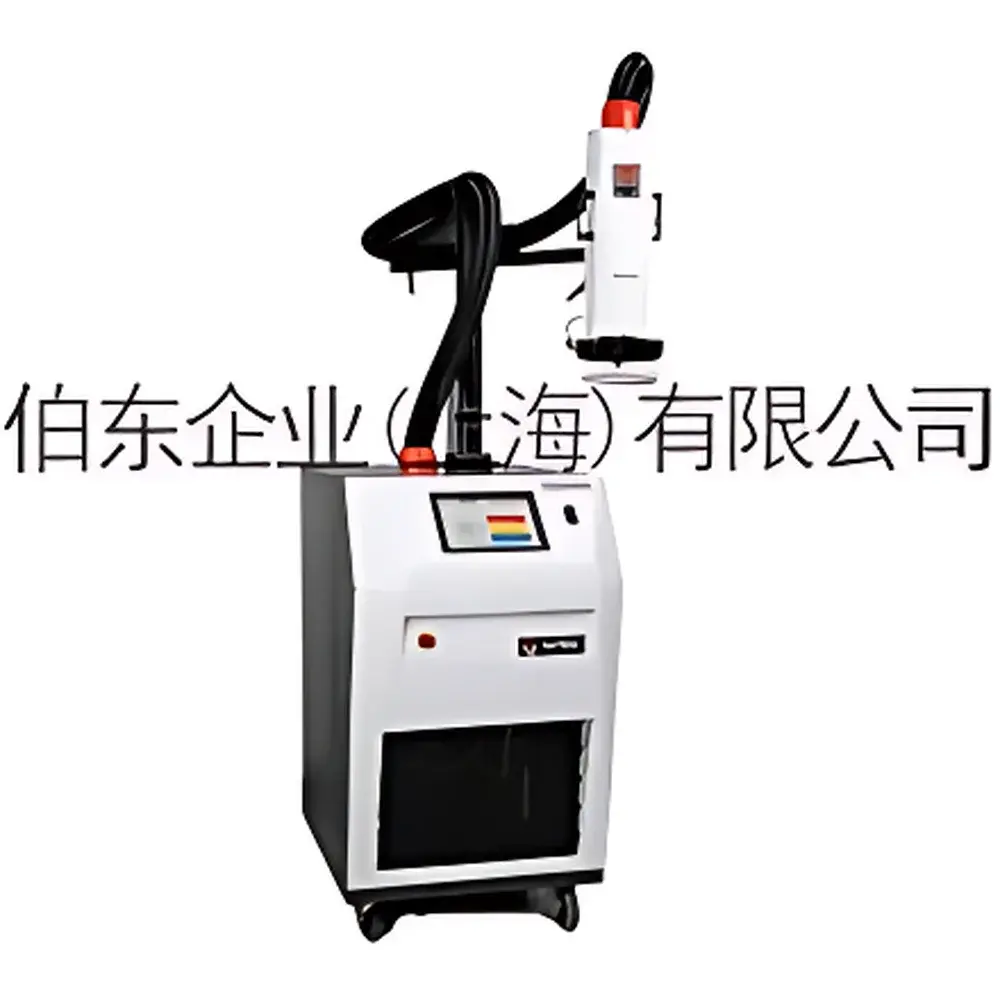
inTEST ThermoStream ATS-730E High-Speed Thermal Shock Test System
| Brand | inTEST–Temptronic |
|---|---|
| Origin | USA |
| Model | inTEST ATS-730E |
| Temperature Range | −85 °C to +225 °C (50 Hz) / −90 °C to +225 °C (60 Hz) |
| Airflow Output | 4–18 scfm (1.8–8.5 L/s) |
| Transition Rate | −55 °C to +125 °C in ≈10 s |
| Temperature Accuracy | ±1 °C (NIST-traceable) |
| Temperature Stability | ±0.01 °C |
| Temperature Resolution | 0.1 °C |
| Sensor Type | T-type or K-type thermocouple |
| Control Interfaces | IEEE-488, RS232, Ethernet |
| Compliance | CE, RoHS, CFC-free |
| Dimensions (W×D×H) | 61.0 × 72.4 × 108.0 cm |
| Net Weight | 236 kg |
| Optional Configurations | Robotic arm, turntable, height-adjustable stand, heated lid, handheld thermal probe |
Overview
The inTEST ThermoStream ATS-730E is a high-speed, non-chamber-based thermal shock test system engineered for precision dynamic temperature stress testing of electronic components and assemblies during design validation, reliability qualification, and production burn-in. Unlike conventional environmental chambers that rely on bulk air volume conditioning, the ATS-730E employs a proprietary open-loop, forced-convection airflow architecture—built upon inTEST’s New ThermoStream® OCM (Optimized Control Module) platform—to deliver rapid, localized thermal transients directly onto device-under-test (DUT) surfaces. Its core operational principle leverages real-time closed-loop feedback from integrated T-type or K-type thermocouples embedded in the DUT or thermal probe, enabling adaptive temperature regulation with ±1 °C accuracy (NIST-traceable) and exceptional thermal stability of ±0.01 °C under steady-state conditions. Designed specifically for semiconductor packaging, PCB-level IC validation, and ATE-integrated thermal cycling, the system supports both Air Mode (ambient airflow control) and DUT Mode (direct sensor-coupled temperature regulation), making it uniquely suited for single-component thermal shock without affecting adjacent devices.
Key Features
- Ultra-fast thermal transition: Achieves −55 °C ↔ +125 °C transitions in approximately 10 seconds—enabled by high-capacity dual-stage refrigeration and optimized gas flow dynamics.
- Wide operational range: −85 °C to +225 °C (50 Hz); −90 °C to +225 °C (60 Hz), supporting extreme condition testing for wide-bandgap semiconductors and aerospace-grade electronics.
- NIST-traceable temperature accuracy: ±1 °C across full range, verified via calibrated thermocouple inputs and internal reference junction compensation.
- Modular human-machine interface: Touchscreen control panel with intuitive graphical workflow; firmware-based UI eliminates dependency on legacy Windows OS, ensuring long-term software maintainability and cybersecurity resilience.
- Comprehensive remote integration: Native support for IEEE-488 (GPIB), RS232, and Ethernet protocols; LabVIEW™ drivers provided for seamless ATE and automated test system integration.
- Electrostatic discharge (ESD)-safe design: Fully grounded airflow path and conductive housing compliant with ANSI/ESD S20.20 requirements for sensitive device handling.
- Intelligent auxiliary functions: Automatic defrost cycle, heated lid option to prevent condensation on DUT surfaces, and optional robotic arm or rotary stage for unattended multi-position testing.
Sample Compatibility & Compliance
The ATS-730E is optimized for direct thermal stress application on discrete ICs, bare dies, QFN/BGA packages, power modules, MEMS sensors, and populated PCBs—without requiring fixture encapsulation or chamber loading. Its handheld thermal probe and adjustable workstand allow precise spatial targeting, while the heated lid accessory creates a localized microenvironment to suppress moisture condensation during low-temperature dwell phases. The system complies with key international standards including CE marking (2014/30/EU EMC Directive and 2014/35/EU Low Voltage Directive), RoHS 2011/65/EU, and is fully CFC-free. For regulated environments, audit-ready operation is supported through configurable logging, timestamped event records, and user-access-level controls aligned with GLP and GMP principles. While not a medical device, its temperature traceability and deterministic control logic make it suitable for applications referenced in JEDEC JESD22-A104 (Temperature Cycling) and JESD22-A106 (Thermal Shock).
Software & Data Management
The ATS-730E operates on an embedded real-time OS with deterministic timing guarantees—critical for synchronized thermal profiling in automated test sequences. All temperature setpoints, ramp rates, dwell times, and sensor readings are logged internally with millisecond-resolution timestamps and exportable via USB or network transfer in CSV format. The system supports user-defined test profiles with up to 99 steps per sequence, including conditional branching based on DUT temperature feedback. Remote command execution adheres to SCPI (Standard Commands for Programmable Instruments) syntax over GPIB and RS232, and includes extended Ethernet commands for TCP/IP socket communication. Optional data archiving solutions integrate with enterprise MES platforms via RESTful API adapters. Audit trail functionality—including operator ID, parameter changes, and calibration history—is available as a factory-installed feature for FDA 21 CFR Part 11–aligned environments when paired with external identity management systems.
Applications
- Qualification of automotive-grade SoCs and ADAS processors under AEC-Q100 Grade 0/1 thermal shock profiles.
- Failure analysis root cause identification via accelerated thermal cycling of solder joints and underfill interfaces.
- In-line thermal validation of flip-chip and 2.5D/3D stacked die assemblies during package development.
- Reliability screening of GaN and SiC power modules subjected to repeated −40 °C/+150 °C excursions.
- Thermal boundary condition simulation for thermal interface material (TIM) performance evaluation under dynamic load.
- ATE co-location: Integration into handler-based test cells for parallel thermal stress and functional test sequencing.
FAQ
What distinguishes the ATS-730E from traditional thermal shock chambers?
The ATS-730E uses directed, high-velocity airflow instead of chamber-based convection—enabling faster transitions, higher spatial resolution, and true single-device targeting without thermal crosstalk.
Is NIST-traceable calibration documentation included?
Yes—each unit ships with a NIST-traceable calibration certificate covering temperature accuracy across the full operating range, valid for 12 months from shipment.
Can the system be integrated into a Class 100 cleanroom environment?
Yes—the airflow path is sealed and filter-compatible; optional HEPA-filtered inlet kits and stainless-steel housings are available for ISO 14644-compliant installations.
Does the ATS-730E support custom thermocouple types beyond T and K?
No—only T-type and K-type thermocouples are supported for DUT-mode feedback; however, third-party signal conditioning modules may be interfaced externally via analog voltage output.
What maintenance intervals are recommended for the refrigeration subsystem?
Compressor oil and refrigerant integrity checks are recommended every 24 months; full preventive maintenance—including heat exchanger inspection and airflow calibration—is advised annually or after 2,000 operational hours.



