
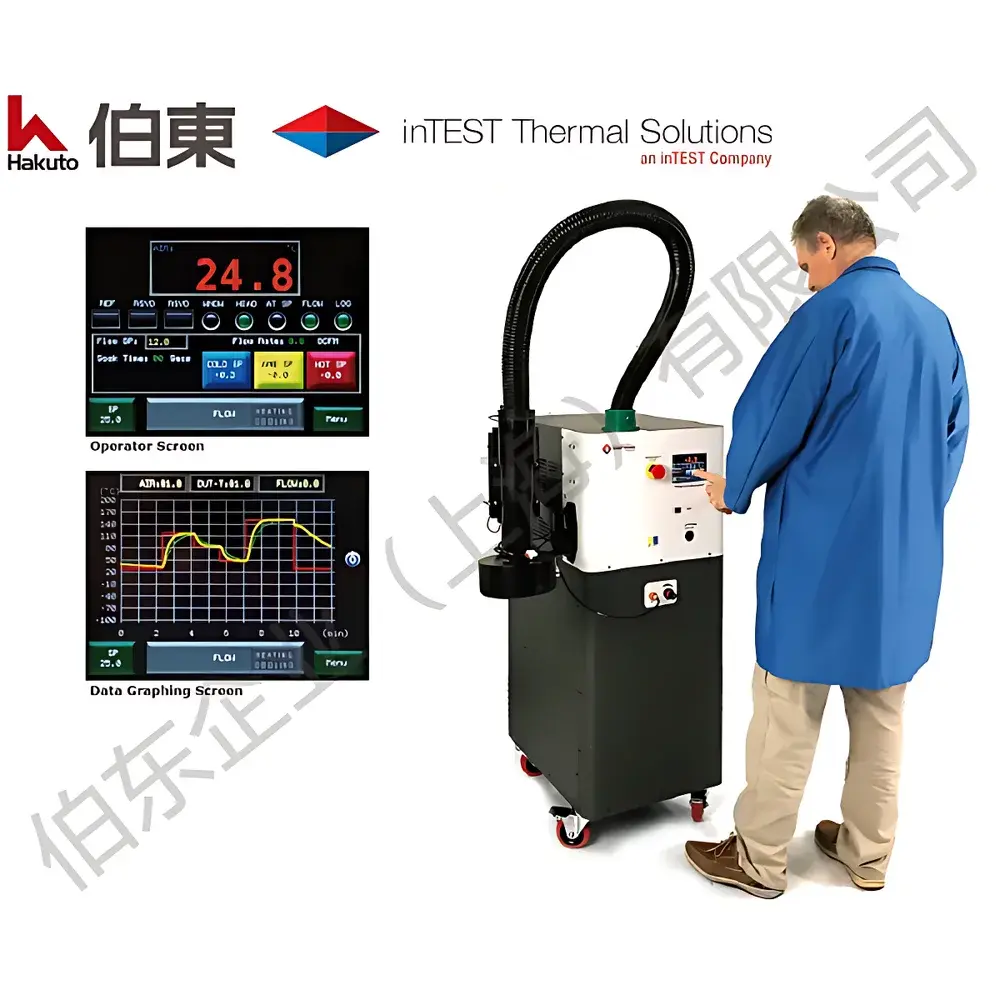
inTEST ThermoStream ECO-560 Thermal Shock Test System
| Brand | inTEST–Temptronic |
|---|---|
| Origin | USA |
| Model | ECO-560 |
| High Temperature Range | +200 °C |
| Low Temperature Range | −60 °C |
| Thermal Shock Range | −60 °C to +200 °C |
| Frequency | 50/60 Hz |
| Temperature Stability | ±0.01 °C |
| Ramp Rate (Heating) | −40 °C to +150 °C in <15 s |
| Ramp Rate (Cooling) | +125 °C to −40 °C in <35 s |
| Airflow Output | 4–18 SCFM (1.9–8.5 L/s) |
| Temperature Display Resolution | ±0.1 °C |
| Temperature Accuracy | ±1.0 °C (NIST-traceable calibration) |
| DUT Temperature Control | Proprietary closed-loop algorithm with direct DUT sensing |
| Thermocouple Inputs | Type T & K |
| Power Supply | 200–250 VAC, 50/60 Hz, 30 A (1-phase, 230 V nominal) |
| Operating Ambient | 20–28 °C (23 °C nominal), 0–60% RH (45% rated) |
| Dimensions (W×D×H) | 46.4 × 66.7 × 142.2 cm |
| Weight (Unit) | 181 kg |
| Weight (Packed) | 227 kg |
| Acoustic Noise | <57 dBA |
Overview
The inTEST ThermoStream ECO-560 Thermal Shock Test System is a high-performance, nitrogen-free thermal shock platform engineered for rapid, precise, and localized temperature cycling of electronic components and assemblies. Unlike conventional environmental chambers that rely on large-volume air or liquid media, the ECO-560 employs directed, high-velocity inert gas flow—typically dry compressed air—to deliver controlled thermal transients directly onto the device under test (DUT). Its core architecture is based on dual-stage thermoelectric and mechanical refrigeration, enabling full-range thermal shock from −60 °C to +200 °C without cryogenic consumables such as liquid nitrogen (LN₂) or liquid CO₂ (LCO₂). This design eliminates operational hazards, reduces maintenance overhead, and ensures repeatable, NIST-traceable thermal profiles compliant with JEDEC JESD22-A104, MIL-STD-883 Method 1010, and IEC 60068-2-14 standards.
Key Features
- Ultra-fast thermal ramping: Achieves −40 °C to +150 °C transitions in under 15 seconds and +125 °C to −40 °C in less than 35 seconds—enabling accelerated reliability testing per AEC-Q200 and automotive qualification protocols.
- NIST-traceable temperature accuracy of ±1.0 °C and stability of ±0.01 °C, validated across the full operating range using calibrated Type T and K thermocouples.
- Proprietary DUT-centric control algorithm that reads temperature directly from the component surface (not ambient chamber air), dynamically adjusting airflow temperature and velocity to maintain target DUT thermal setpoints.
- Dry-air purge system (0.5–3 SCFM) prevents condensation and frost formation on sensitive PCB surfaces during low-temperature transitions—critical for wafer-level and bare-die testing.
- Fluorocarbon-free refrigerant system compliant with EPA SNAP and EU F-Gas Regulation (Regulation (EU) No 517/2014), ensuring environmental safety and regulatory alignment.
- Modular interface architecture supporting Ethernet, IEEE-488 (GPIB), and RS-232 communication; fully compatible with LabVIEW™ and LabWindows/CVI™ for automated test sequence integration.
Sample Compatibility & Compliance
The ECO-560 is optimized for discrete ICs, packaged semiconductors, power modules, RF front-end devices, MEMS sensors, and populated PCBs—including high-density BGA and QFN packages. Its focused airflow nozzle allows selective thermal stress application to individual components on a board—without affecting adjacent devices—a capability not achievable in traditional walk-in thermal chambers. The system meets GLP and GMP documentation requirements through optional audit-trail-enabled software, supports 21 CFR Part 11-compliant electronic signatures when integrated with validated host systems, and facilitates ISO/IEC 17025-compliant calibration management via external traceable reference probes.
Software & Data Management
The embedded controller provides intuitive local operation via a high-resolution touchscreen interface, while remote execution is enabled via TCP/IP or GPIB. All temperature profiles, ramp rates, dwell times, and DUT sensor readings are timestamped and exportable in CSV format. Optional inTEST ThermalSuite™ software adds advanced features including multi-step profile scripting, real-time DUT temperature overlay graphs, statistical process control (SPC) charting, and automatic pass/fail evaluation against user-defined thermal excursion limits. Data logs include metadata such as operator ID, system firmware version, calibration status, and environmental ambient conditions—supporting full traceability for internal audits and third-party certification bodies.
Applications
- Qualification testing of automotive-grade electronics per AEC-Q100 and AEC-Q200 specifications.
- Failure analysis and root-cause investigation of solder joint fatigue, die attach delamination, and intermetallic growth in advanced packaging.
- Thermal cycling validation of high-power GaN and SiC devices under dynamic load conditions.
- Pre-conditioning of sensors and actuators prior to functional testing in harsh-environment applications (e.g., aerospace, downhole oil & gas).
- Reliability screening of 5G mmWave RF modules where localized heating and cooling must avoid thermal crosstalk between adjacent antenna elements.
- Research and development of next-generation heterogeneous integration platforms requiring sub-second thermal transient fidelity.
FAQ
Does the ECO-560 require liquid nitrogen or other cryogenic media to achieve −60 °C?
No. It uses an integrated, fluorocarbon-free mechanical refrigeration system with staged compression and heat recovery—eliminating dependency on LN₂, LCO₂, or hazardous coolants.
Can the system control temperature based on the actual DUT surface temperature rather than chamber air temperature?
Yes. Its proprietary feedback loop uses real-time thermocouple input from the DUT itself to modulate airflow temperature and velocity—ensuring accurate thermal delivery regardless of board layout or thermal mass asymmetry.
Is the ECO-560 suitable for testing components mounted on load boards used in ATE environments?
Yes. Its compact footprint, programmable nozzle positioning, and fast thermal response make it ideal for integration into automated test equipment setups where board-level thermal profiling is required.
What calibration and compliance documentation is provided with shipment?
Each unit ships with a NIST-traceable calibration certificate covering temperature accuracy, ramp rate verification, and airflow output validation—valid for 12 months under standard operating conditions.
How is humidity managed during low-temperature operation to prevent condensation?
The system incorporates a continuous dry-air purge mode (adjustable 0.5–3 SCFM) that maintains dew point below −40 °C at the DUT interface—preventing frost, oxidation, or moisture-related failure mechanisms.



