
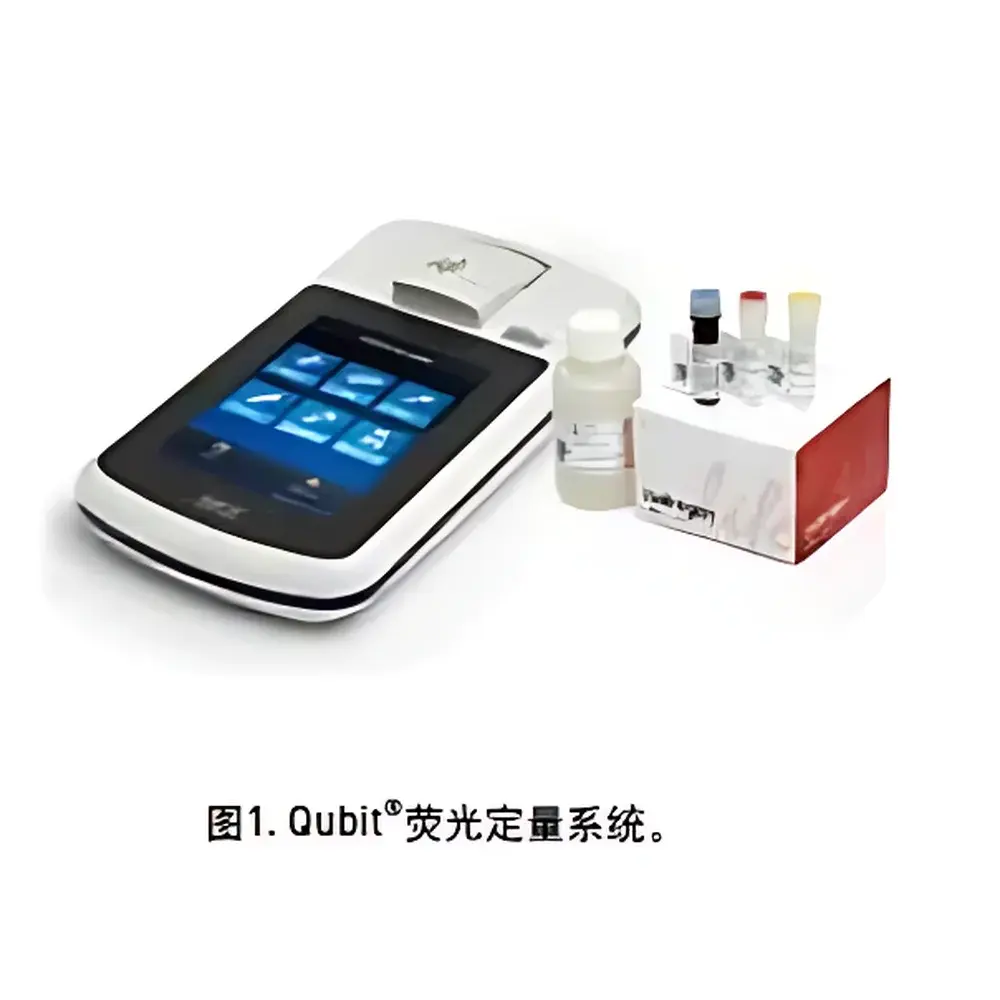
Invitrogen Qubit 3.0 Fluorometer
| Brand | Thermo Fisher Scientific |
|---|---|
| Origin | Singapore |
| Manufacturer Type | Original Equipment Manufacturer (OEM) |
| Origin Category | Imported Instrument |
| Model | Qubit 3.0 |
| Pricing | Available Upon Request |
Overview
The Invitrogen Qubit 3.0 Fluorometer is a benchtop nucleic acid and protein quantification instrument engineered for precision, selectivity, and reproducibility in low-concentration sample analysis. Unlike UV absorbance-based spectrophotometers—which measure total optical density at 260 nm and are highly susceptible to contaminants such as free nucleotides, salts, solvents, and aromatic compounds—the Qubit 3.0 employs fluorescence-based detection using target-specific dyes. This principle leverages the binding-induced enhancement of fluorescent signal upon selective interaction with double-stranded DNA (dsDNA), single-stranded DNA (ssDNA/oligonucleotides), RNA, microRNA, or protein. The instrument operates on the core photometric principle of excitation-emission wavelength discrimination, where each assay kit utilizes a proprietary dye with optimized spectral properties (e.g., Qubit dsDNA HS Assay: λex ≈ 500 nm, λem ≈ 525 nm). This ensures minimal cross-reactivity and enables accurate quantification down to 10 pg/μL for dsDNA and 12.5 μg/mL for protein—performance unattainable with conventional UV-Vis methods.
Key Features
- Touchscreen interface powered by an Android-based operating system with intuitive navigation and context-sensitive prompts
- Dual-core processor architecture enabling rapid data acquisition, real-time calculation, and seamless assay switching
- Integrated barcode scanner for automatic assay kit recognition and calibration validation
- Onboard memory supporting storage of up to 1,000 sample results with timestamp, user ID, and assay metadata
- USB port for data export (CSV format) and firmware updates; no external PC required for routine operation
- Pre-calibrated optical path with fixed excitation/emission filter sets optimized per assay chemistry
- Low-volume measurement capability: requires only 1–20 μL of sample per assay
Sample Compatibility & Compliance
The Qubit 3.0 supports a fully validated assay portfolio including Qubit dsDNA High Sensitivity (HS), Broad Range (BR), ssDNA, RNA, microRNA, and Protein Assays. Each assay is rigorously tested for specificity against common laboratory interferents—including guanidine HCl, EDTA, phenol, ethanol, and residual SDS—ensuring reliable performance across diverse extraction workflows (e.g., column-based, magnetic bead, TRIzol®-derived lysates). The platform complies with Good Laboratory Practice (GLP) documentation requirements through audit-trail-capable data logging. While not FDA 21 CFR Part 11–certified out-of-the-box, the instrument supports traceable user authentication and electronic record retention compatible with regulated environments when deployed with appropriate SOPs and IT infrastructure.
Software & Data Management
The embedded software provides guided workflow execution—from assay selection and standard curve generation to concentration interpolation and QC flagging (e.g., outlier detection based on replicate CV thresholds). All calibration curves are stored with lot-specific dye response parameters, ensuring inter-assay consistency. Exported CSV files contain raw fluorescence values, calculated concentrations, dilution factors, and pass/fail indicators per sample. Optional integration with Thermo Fisher’s Cloud Connect platform enables secure remote data backup, multi-instrument fleet monitoring, and role-based access control—facilitating centralized lab management and compliance readiness.
Applications
The Qubit 3.0 is routinely deployed in next-generation sequencing (NGS) library preparation QC, where accurate input quantification directly impacts cluster density and sequencing yield. It is also essential for qPCR assay development, transfection optimization (e.g., plasmid DNA titration prior to lipofection), CRISPR guide RNA validation, and biobanking applications requiring long-term nucleic acid stability assessment. Its sensitivity and selectivity make it ideal for FFPE-derived RNA integrity checks, single-cell lysate analysis, and extracellular vesicle-associated nucleic acid quantification—applications where UV-based methods produce systematic overestimation due to co-purified contaminants.
FAQ
Can the Qubit 3.0 quantify degraded RNA or fragmented DNA?
Yes—Qubit RNA assays detect intact ribose-phosphate backbone structures regardless of fragment length, provided the dye-binding motif remains accessible. However, extreme degradation may reduce signal intensity below detection limits; complementary analysis via Bioanalyzer or TapeStation is recommended for integrity assessment.
Is calibration required before each use?
No—each assay kit includes pre-diluted standards with lot-specific calibration curves stored in the instrument’s memory upon barcode scan. Routine verification with a single standard is sufficient for daily QC.
Does the Qubit 3.0 support custom assay development?
No—the optical configuration and firmware are locked to Thermo Fisher’s proprietary assay chemistries. Third-party dyes or protocols are not supported due to spectral and kinetic compatibility constraints.
What is the recommended maintenance schedule?
Annual optical alignment verification and LED intensity calibration are advised; no routine cleaning of internal optics is required under normal use conditions. External surfaces should be wiped with 70% ethanol between users.
How does Qubit compare to NanoDrop in terms of accuracy for plasmid preparations?
Qubit typically reports 20–40% lower concentrations than NanoDrop for miniprep samples due to elimination of contaminant absorbance—this reflects true dsDNA mass and improves downstream reproducibility in enzymatic reactions.



