
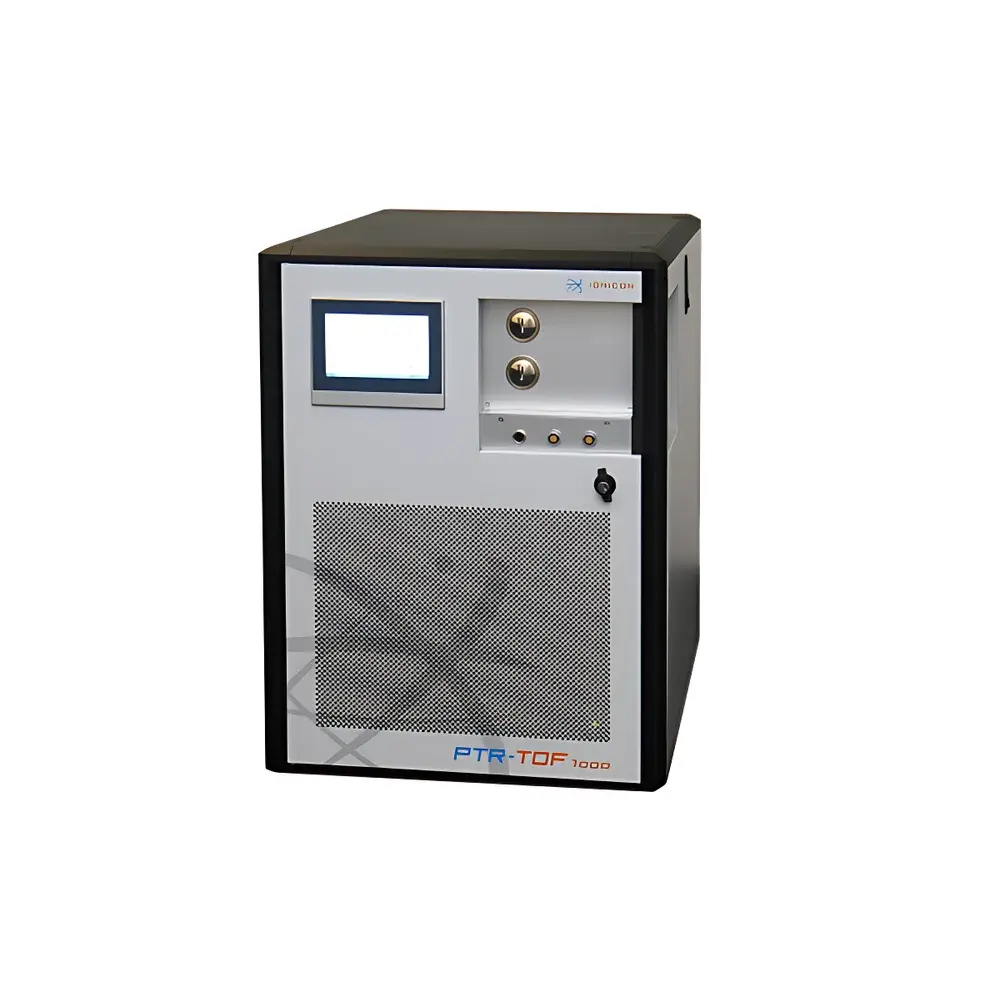
IONICON PTR-TOF 1000 Proton Transfer Reaction Time-of-Flight Mass Spectrometer
| Brand | IONICON Analytik G.m.b.H. |
|---|---|
| Origin | Austria |
| Model | PTR-TOF 1000 |
| Detection Principle | Proton Transfer Reaction (PTR) coupled with Time-of-Flight Mass Spectrometry |
| Instrument Type | Online Real-Time Analyzer |
| Typical Configuration | Integrated VOC Monitoring System |
| Detection Range | 10 pptv – 1 ppmv |
| Resolution | 1 pptv |
| Accuracy | ±10 pptv |
| Response Time | ≤100 ms |
| Mass Range | 1–10,000 Th |
| Mass Resolving Power | >1500 (m/Δm) |
| Sampling Flow Rate | 50–800 sccm |
| Inlet & Reaction Chamber Heating | 40–180 °C and 40–120 °C respectively |
| Power Supply | 100–230 V AC, max. 1000 W |
| Dimensions (W×H×D) | 60 × 91 × 80 cm |
| Weight | 150 kg |
| Data Interfaces | Ethernet, RS232 |
Overview
The IONICON PTR-TOF 1000 is a high-performance, real-time online analytical instrument engineered for quantitative trace gas analysis of volatile organic compounds (VOCs) and inorganic species at sub-pptv levels. It integrates proton transfer reaction (PTR) ionization—a soft, selective, and fragmentation-minimized chemical ionization technique—with orthogonal acceleration time-of-flight mass spectrometry (oa-TOF-MS). This architecture enables simultaneous detection of hundreds of compounds without chromatographic separation, delivering sub-second temporal resolution, high mass accuracy (<5 ppm), and exceptional sensitivity. Designed for continuous unattended operation in ambient air, stack emissions, indoor environments, and laboratory reaction chambers, the PTR-TOF 1000 meets the stringent requirements of environmental monitoring networks, atmospheric chemistry research, industrial hygiene, and process emission verification.
Key Features
- Real-time quantification with ≤100 ms response time—enabling dynamic process monitoring and fast transient event capture.
- Detection limits down to 10 pptv (1σ, 1 min integration), validated against certified reference standards under ISO 16000-6 and EPA TO-15 protocols.
- Mass resolving power exceeding 1500 (m/Δm) across the full 1–10,000 Th range, supporting unambiguous compound identification via exact mass and isotopic pattern matching.
- Thermally regulated inlet system (40–180 °C) and reaction chamber (40–120 °C) minimize surface adsorption/desorption artifacts and ensure robust performance for polar, semi-volatile, and thermally labile compounds.
- Integrated vacuum architecture with turbomolecular pumping achieves stable base pressure <5×10⁻⁸ mbar, ensuring long-term signal stability and reproducibility (RSD <3% over 24 h).
- Modular design compliant with IEC 61000-6-2/6-4 for electromagnetic compatibility and CE marking for safe deployment in industrial and field laboratories.
Sample Compatibility & Compliance
The PTR-TOF 1000 accepts gaseous samples directly from ambient air, ducted exhaust streams, or controlled reactor effluents. Its non-destructive PTR ionization efficiently detects aldehydes, ketones, aromatic hydrocarbons, oxygenated VOCs (e.g., methanol, acetaldehyde), sulfur-containing compounds (e.g., H₂S, DMS), and select inorganics (NH₃, HCN, NO₂) without derivatization. The system conforms to key regulatory frameworks including EN 14662 (ambient air quality), ISO 16017-1 (indoor air VOC measurement), and supports audit-ready data acquisition aligned with GLP and 21 CFR Part 11 requirements when paired with optional secure logging modules.
Software & Data Management
Controlled via TOF-DAQ v3.x software (Windows-based), the instrument provides synchronized acquisition, real-time spectral visualization, automated peak annotation using NIST/EPA/IONICON compound libraries, and batch processing with retention-time-free alignment. Raw data (.tdf format) are stored in vendor-neutral HDF5 containers, enabling third-party integration with Python (via pyTDF), MATLAB, or R workflows. Audit trails, user access control, electronic signatures, and encrypted database backups satisfy FDA and EMA data integrity expectations for regulated applications.
Applications
- Ambient air quality monitoring networks tracking biogenic and anthropogenic VOC fluxes in urban, rural, and forested sites.
- Industrial fugitive emission detection and source apportionment in petrochemical, pharmaceutical, and coating manufacturing facilities.
- Indoor air quality assessment in schools, hospitals, and office buildings—quantifying formaldehyde, terpenes, and cleaning agent residuals.
- Atmospheric simulation chamber studies requiring millisecond-resolved kinetics of oxidation pathways and secondary organic aerosol (SOA) precursor formation.
- Food packaging headspace analysis and breath metabolomics research leveraging rapid, calibration-free semi-quantitative profiling.
FAQ
What ionization method does the PTR-TOF 1000 use, and why is it advantageous for VOC analysis?
It employs proton transfer reaction (PTR) using H₃O⁺ reagent ions—providing soft, predictable ionization with minimal fragmentation, near-unit ionization efficiency for most VOCs, and inherent selectivity against permanent gases (N₂, O₂, CO₂).
Can the system be calibrated for absolute quantification without internal standards?
Yes—absolute concentrations are calculated from fundamental reaction kinetics, known reagent ion density, and instrument transmission factors, traceable to SI units via primary standard gas mixtures (e.g., NIST SRM 1861).
Is remote monitoring and diagnostics supported?
Yes—Ethernet connectivity enables secure remote access via VPN, live status dashboards, automated alarm notifications (email/SNMP), and firmware updates through IONICON’s cloud-enabled support portal.
How is data integrity ensured for compliance-critical deployments?
With optional 21 CFR Part 11-compliant software modules, the system enforces role-based permissions, immutable audit logs, electronic signatures, and periodic cryptographic hash validation of raw datasets.
What maintenance intervals are recommended for sustained operational reliability?
Annual vacuum pump oil replacement, biannual ion source cleaning, and quarterly mass calibration using perfluorotributylamine (PFTBA) are advised; all procedures documented in ISO 9001-certified service manuals.







