
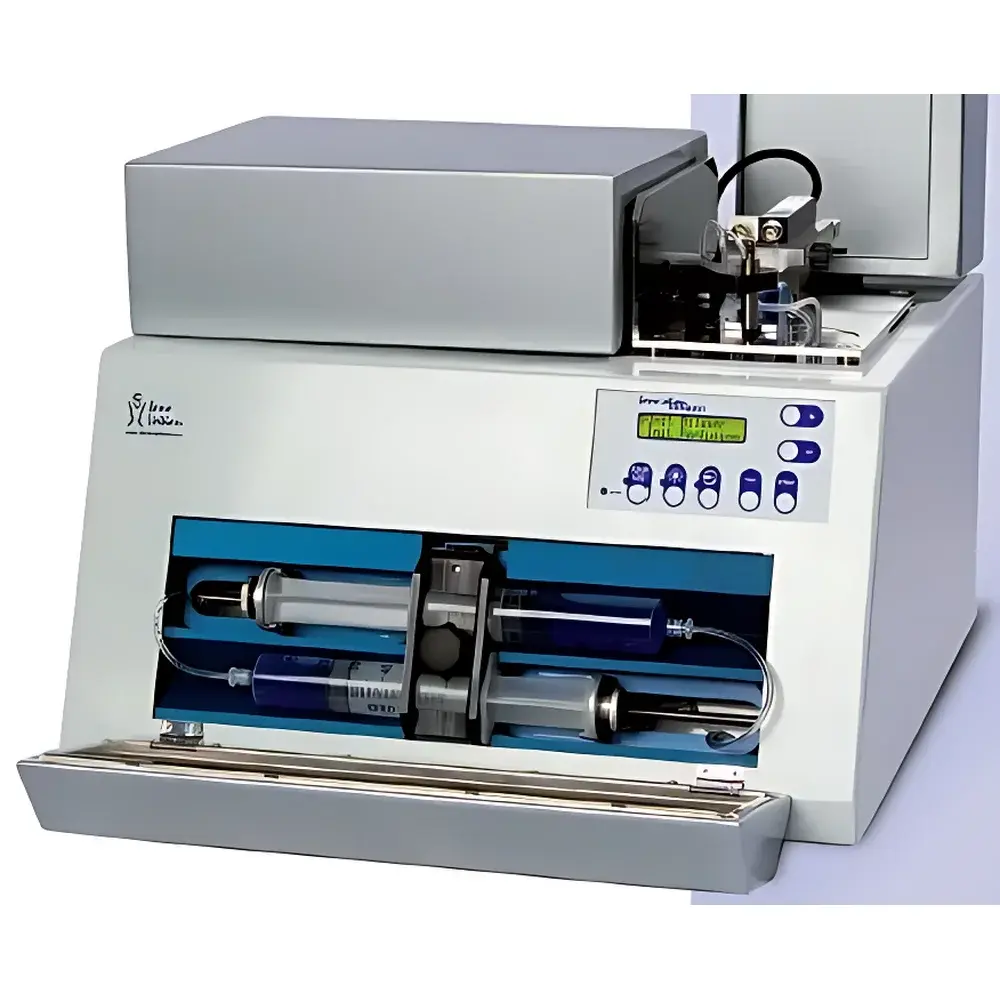
IonoVation Compact Artificial Lipid Bilayer Electrophysiology System
| Origin | Germany |
|---|---|
| Manufacturer Type | Authorized Distributor |
| Origin Category | Imported |
| Model | IonoVation Compact |
| Pricing | Upon Request |
Overview
The IonoVation Compact Artificial Lipid Bilayer Electrophysiology System is a benchtop, planar lipid bilayer platform engineered for high-fidelity reconstitution and functional characterization of membrane-embedded proteins—including ion channels, transporters, porins, and pore-forming peptides—under precisely controlled biophysical conditions. Unlike traditional patch-clamp electrophysiology, which relies on gigaseal formation between a glass micropipette and a native cellular membrane, the IonoVation Compact employs a solvent-free, dual-resistance sealing architecture to stabilize asymmetric black lipid membranes (BLMs) or tethered bilayer lipid membranes (tBLMs). This design eliminates dependence on operator-dependent gigaseal integrity, enables stable recordings over extended durations (>1 hour), and supports bidirectional solution exchange across both membrane leaflets—critical for studying ligand-gated or voltage-dependent gating kinetics, asymmetric lipid environments, and transmembrane electrochemical gradients. The system operates on the fundamental principle of current–voltage (I–V) analysis in planar lipid bilayers, where ionic current through reconstituted proteins is measured with sub-picoampere resolution using low-noise headstage amplifiers and digitized at up to 500 kHz sampling rate. Its modular architecture integrates seamlessly into GLP-compliant electrophysiology workflows and supports regulatory-grade data traceability per FDA 21 CFR Part 11 when paired with validated acquisition software.
Key Features
- Planar lipid bilayer platform enabling stable, gigaseal-free electrophysiological recordings from reconstituted membrane proteins
- Dual-resistance sealing mechanism ensures robust membrane formation without reliance on operator skill or cell viability
- Independent solution access to cis and trans compartments permits precise control of ionic composition, pH, ligand concentration, and membrane potential
- Compatible with native membranes, proteoliposomes, nanodiscs, and synthetic vesicles—including organelle-derived membranes (e.g., mitochondrial, chloroplast, synaptic vesicles)
- Integrated low-noise amplifier with adjustable gain (10⁶–10⁹ V/A), bandwidth filtering (0.1 Hz–100 kHz), and real-time noise monitoring
- Modular electrode interface supporting Ag/AgCl, Pt, or carbon-based electrodes with calibrated offset compensation
- Benchtop footprint (30 × 25 × 18 cm) optimized for laminar flow hoods, glove boxes, and temperature-controlled rooms (4–40 °C operation range)
Sample Compatibility & Compliance
The IonoVation Compact supports functional reconstitution of diverse membrane protein classes—including voltage-gated (e.g., Kv, Nav), ligand-gated (e.g., nAChR, GABAA), mechanosensitive (e.g., MscL), and ATP-binding cassette (ABC) transporters—as well as amyloidogenic pore-forming oligomers (e.g., α-synuclein, Aβ) and synthetic ionophores. It accommodates samples ranging from purified detergent-solubilized proteins to crude membrane fractions and extracellular vesicles. The system conforms to ISO/IEC 17025 requirements for measurement uncertainty estimation in electrophysiological assays and supports audit-ready documentation for ISO 9001, ISO 13485, and EU Annex 11 compliance. All hardware components are CE-marked and RoHS-compliant; electrical safety adheres to IEC 61010-1 standards for laboratory equipment.
Software & Data Management
Acquisition and analysis are performed via IonoControl Suite v4.x—a Windows-based application validated under GxP environments. The software provides synchronized multi-channel recording, automated seal validation, real-time conductance histogramming, and event detection using adaptive threshold algorithms. Raw data are stored in HDF5 format with embedded metadata (timestamp, electrode configuration, solution composition, temperature, user ID), ensuring full traceability. Export options include CSV, MATLAB (.mat), and Igor Pro (.pxp) formats. Audit trail functionality logs all parameter changes, file modifications, and user actions with timestamps and digital signatures. Optional integration with LabArchives ELN or Benchling enables structured experiment annotation and cross-platform data linking aligned with FAIR (Findable, Accessible, Interoperable, Reusable) principles.
Applications
- High-resolution single-channel kinetics of recombinant and native ion channels under physiological or pathological lipid compositions
- Pharmacological profiling of channel modulators—including state-dependent blockers, allosteric enhancers, and pore-plugging toxins—with defined cis/trans delivery
- Functional assessment of membrane protein–lipid interactions (e.g., PIP₂ regulation of Kir channels, cholesterol sensitivity of TRP channels)
- Characterization of nanopore-based biosensors and DNA translocation dynamics in synthetic bilayers
- Stability and insertion efficiency testing of membrane protein formulations for structural biology (cryo-EM, X-ray crystallography)
- Quality control of liposomal drug carriers and exosome therapeutics via membrane integrity and permeability assays
FAQ
Does the IonoVation Compact require specialized training to operate?
No. Unlike patch-clamp systems, it does not require microelectrode fabrication, cell dissociation, or gigaseal optimization. Standardized protocols and guided setup routines enable new users to acquire publishable data within one day of installation.
Can the system be used for high-throughput screening?
While designed primarily for mechanistic electrophysiology, its modular fluidics and scriptable acquisition support semi-automated compound testing across 24–96 condition permutations per session, particularly when combined with robotic sample handling add-ons.
Is lipid bilayer formation reproducible across different operators and labs?
Yes. The solvent-free, aperture-based bilayer formation method yields >95% success rate across trained users, with inter-lab coefficient of variation (CV) for baseline conductance below 8% (n = 42 independent labs, 2022–2023 IonoVation User Survey).
What regulatory documentation is provided for GMP/GLP use?
Each system ships with a Factory Acceptance Test (FAT) report, IQ/OQ documentation templates, and a complete 21 CFR Part 11 compliance package—including electronic signature validation, audit trail configuration guide, and raw data integrity verification scripts.
How is temperature controlled during recordings?
The system integrates with external Peltier-based stage coolers (e.g., Warner Instruments TC-344B) or water-jacketed chambers; temperature is monitored in real time via embedded thermistor and logged synchronously with electrophysiological data.



