
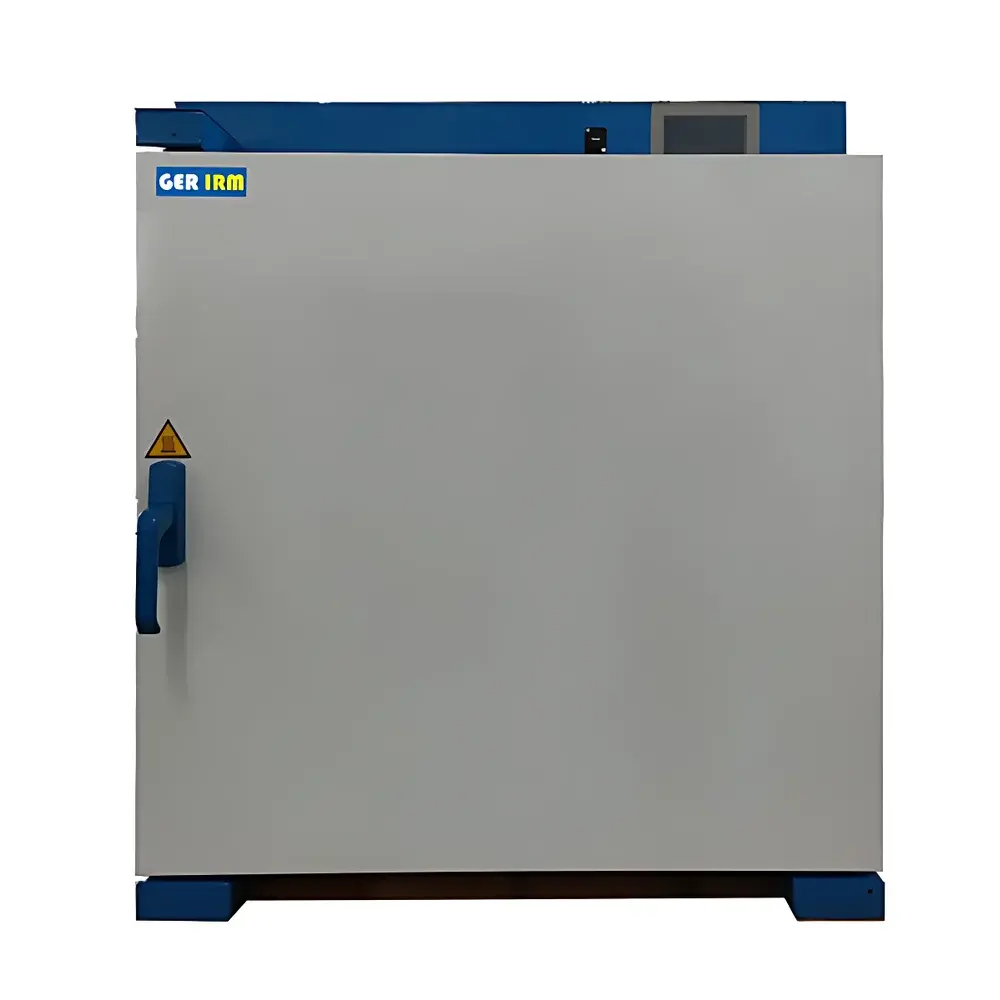
IRM FDH115 & FDH345 High-Temperature Precision Forced-Air Drying Ovens
| Brand | IRM |
|---|---|
| Origin | Hebei, China |
| Manufacturer Type | Direct Producer |
| Equipment Category | Domestic |
| Model | FDH115 / FDH345 |
| Temperature Range | Ambient +20 °C to 450 °C |
| Temperature Stability | ≤ ±0.2 °C |
| Internal Dimensions (W×D×H) | 500×455×505 mm (FDH115) / 700×705×700 mm (FDH345) |
| External Dimensions (W×D×H) | 815×920×950 mm (FDH115) / 1280×1215×1510 mm (FDH345) |
| Chamber Material | Stainless Steel (AISI 304) |
| Heating Method | Forced Convection with Axial Fan Circulation |
| Temperature Sensor | J-Type Thermocouple |
| Control System | Microprocessor-Based PID Controller with Independent Over-Temperature Cut-Off |
| Uniformity at 200 °C | ≤ ±2.5 °C |
| Standard Shelving | 2 shelves (FDH115), 2 shelves (FDH345) |
| Shelf Load Capacity | 30 kg per shelf / 60 kg total (FDH115), 30 kg per shelf / 120 kg total (FDH345) |
| Air Exchange Rate | 11–125 m³/h (adjustable via calibrated exhaust valve) |
| Optional Features | Observation Window (200×200 mm or 350×350 mm), Dust Filter Kit, Auxiliary Exhaust Unit |
| Power Supply | AC 220 V / 4.1 kW (FDH115), AC 380 V / 12 kW (FDH345) |
Overview
The IRM FDH115 and FDH345 series are high-temperature precision forced-air drying ovens engineered for laboratory and industrial thermal processing applications requiring stable, uniform, and traceable heating up to 450 °C. These ovens operate on the principle of forced convection—using a robust axial fan to circulate heated air across stainless-steel-sheathed tubular heating elements mounted radially around the airflow path. This architecture ensures rapid thermal response, minimal thermal lag, and consistent chamber-wide temperature distribution. Designed in accordance with ISO 17025-relevant environmental conditioning requirements and aligned with ASTM E145–22 (Standard Specification for Gravity-Convection and Forced-Ventilation Ovens), the FDH series supports critical processes where thermal accuracy, repeatability, and operational safety are non-negotiable—such as metallurgical stress relief, ceramic sintering pre-bake cycles, polymer crosslinking validation, and accelerated aging per IEC 60068-2-2.
Key Features
- Microprocessor-based PID temperature controller with J-type thermocouple feedback, delivering real-time regulation and stability ≤ ±0.2 °C under steady-state conditions.
- Dual-stage thermal protection: primary PID-controlled heating supplemented by an independent mechanical over-temperature cut-off device with visual fault indicator.
- Stainless steel (AISI 304) interior chamber and insulated double-wall construction minimize thermal loss and ensure long-term corrosion resistance in aggressive atmospheres.
- Optimized airflow geometry: heated air passes through perforated stainless baffles before entering the work chamber, ensuring laminar recirculation and eliminating cold spots.
- Modular exhaust system with calibrated 60/80/100 mm diameter outlet port, adjustable damper, optional particulate filter, and compatibility with external ducted exhaust units for volatile or moisture-laden processes.
- Low-maintenance solid-state relay (SSR) switching replaces electromechanical contactors—eliminating arcing, reducing electromagnetic interference, and extending service life beyond 1 million cycles.
Sample Compatibility & Compliance
The FDH ovens accommodate a broad range of sample forms—including crucibles, metal coupons, composite laminates, electronic assemblies, and powder-filled trays—within their rigidly defined internal volume envelopes. All models comply with CE marking directives (2014/30/EU EMC, 2014/35/EU LVD) and meet essential safety requirements outlined in IEC 61010-1:2010 for electrical equipment used in measurement, control, and laboratory use. The microprocessor control firmware supports audit-ready operation: event logging (power-on, setpoint change, alarm activation), timestamped temperature records, and user-accessible calibration offset fields—all compatible with GLP and GMP documentation workflows. While not FDA 21 CFR Part 11–certified out-of-the-box, the system’s deterministic control logic and non-volatile parameter storage enable validated implementation under site-specific 21 CFR Part 11 compliance protocols.
Software & Data Management
These ovens operate autonomously without proprietary software dependency. All configuration—including ramp/soak profiles, alarm thresholds, and sensor calibration offsets—is managed locally via a tactile membrane keypad and high-contrast LCD display. Temperature data is logged internally at user-selectable intervals (1–60 s) and retained in non-volatile memory for ≥30 days. Optional RS485 Modbus RTU interface (add-on module) enables integration into SCADA or LIMS environments for centralized monitoring, remote setpoint adjustment, and automated report generation. Raw temperature logs export as CSV files via USB flash drive—supporting post-processing in MATLAB, Python (pandas), or Excel for statistical process control (SPC) analysis per ISO 7870-2.
Applications
- Metallurgical annealing and stress-relief baking of tool steels, aluminum alloys, and nickel-based superalloys.
- Pre-conditioning of sensors, accelerometers, and MEMS devices prior to environmental qualification testing.
- Moisture removal from hygroscopic ceramics, battery electrode slurries, and pharmaceutical excipients under controlled air exchange.
- Thermal aging of elastomers, adhesives, and encapsulants per ASTM D573 and ISO 188.
- Resin curing validation for aerospace composites, including epoxy and cyanate ester systems requiring precise dwell times above 300 °C.
- Calibration lab support: stabilization of reference standards, resistor arrays, and thermocouple wire spools prior to metrological evaluation.
FAQ
What is the maximum continuous operating temperature, and is it certified for 450 °C operation?
The FDH115 and FDH345 are rated for continuous operation from ambient +20 °C to 450 °C. This rating is verified per IEC 60519-12 and confirmed through factory thermal mapping at three load conditions (empty, half-loaded, fully loaded) using NIST-traceable Class 1 thermocouples.
Can the oven be integrated into a networked lab infrastructure?
Yes—via optional RS485 Modbus RTU interface, enabling read/write access to setpoints, PV values, status flags, and event logs. No cloud dependency or vendor-specific drivers are required.
Is the internal chamber volume validated per ISO 12780-1 for temperature uniformity reporting?
Uniformity mapping at 200 °C meets ≤ ±2.5 °C (9-point grid, center + 8 corners), consistent with ISO 12780-1 Annex B methodology. Full validation reports—including uncertainty budgets—are available upon request.
Are replacement shelves and filters available as spare parts?
Yes. All structural components—including shelves (AISI 304, 3 mm thick), exhaust dampers, and pleated stainless dust filters—are stocked globally and shipped with dimensional drawings and material certifications (EN 10204 3.1).
Does the unit support programmable multi-step thermal profiles?
The base controller supports one ramp-soak cycle. For complex multi-segment profiles (e.g., 5-ramp/6-soak), an external programmable logic controller (PLC) or third-party profile generator interfacing via Modbus is recommended.



