
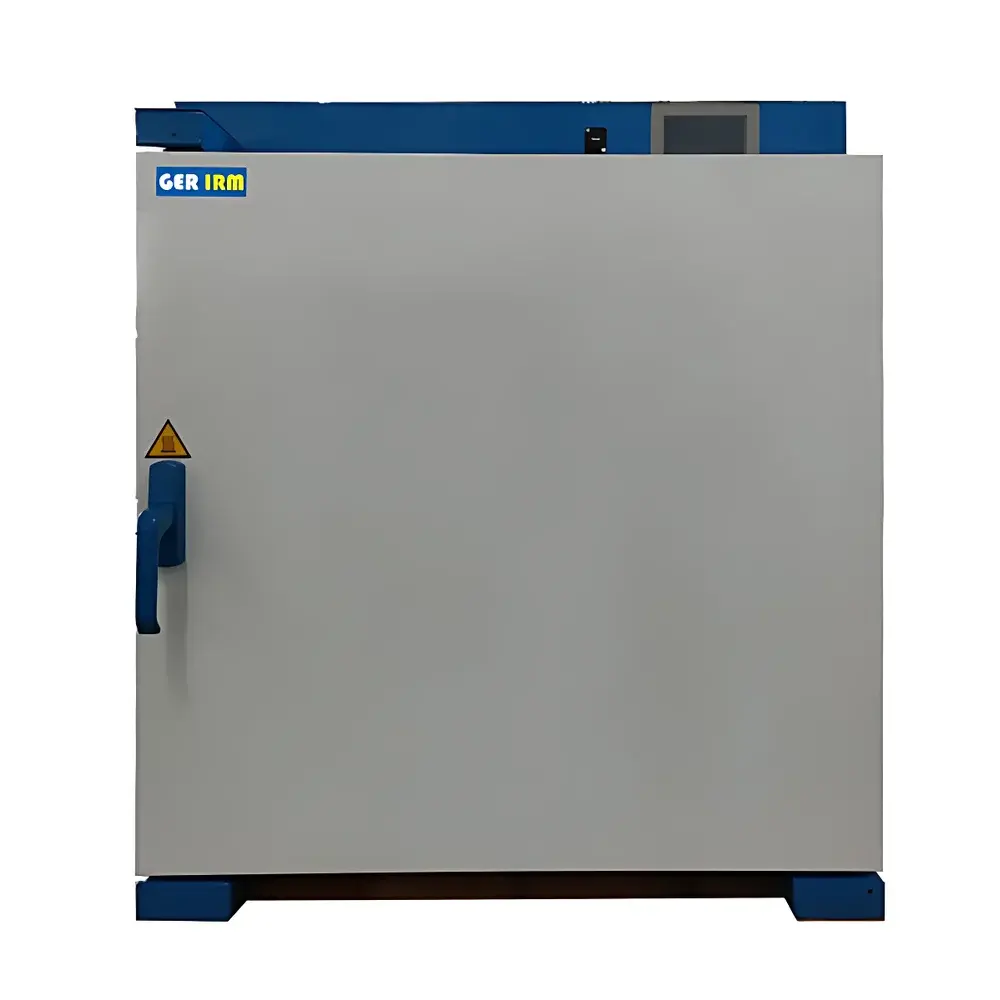
IRM FDHN115 / FDHN345 Anaerobic High-Temperature Forced-Air Drying Oven
| Brand | IRM |
|---|---|
| Origin | Hebei, China |
| Manufacturer Type | Direct Manufacturer |
| Country of Origin | China |
| Model | FDHN115 / FDHN345 |
| Temperature Range | Ambient +20 °C to 450 °C |
| Temperature Uniformity (at 200 °C) | ≤2.5 °C |
| Temperature Fluctuation | ≤±0.2 °C |
| Internal Dimensions (W×D×H, mm) | 500×455×505 / 700×705×700 |
| External Dimensions (W×D×H, mm) | 815×920×950 / 1280×1215×1510 |
| Chamber Volume | 115 L / 345 L |
| Interior Material | Stainless Steel (SUS304) |
| Heating Method | Forced-air Circulation with Adjustable Fan Speed |
| Air Exchange Rate | 11 m³/h / 25 m³/h |
| Standard Features | N₂ Inlet Port with Flowmeter, LCD Touchscreen Controller, 100 Programs × 16 Segments, Delayed/Time-Scheduled Operation, Independent Over-Temperature Protection, Power-Fail Recovery, USB Data Export, RS485 Interface, Door Interlock Switch, Password-Protected Access |
| Optional | Printer, Chart Recorder, Observation Window (200×200 mm / 350×350 mm) |
| Shelf Capacity | 2–3 (FDHN115) / 2–4 (FDHN345), Max Load per Shelf: 30 kg / 60 kg (FDHN115) or 120 kg (FDHN345) |
| Power Supply | AC 220 V / 4.1 kW (FDHN115) or AC 380 V / 12 kW (FDHN345) |
Overview
The IRM FDHN115 and FDHN345 Anaerobic High-Temperature Forced-Air Drying Ovens are engineered for precision thermal processing under controlled inert atmospheres—primarily nitrogen—enabling stable, oxygen-free drying, curing, aging, and heat-treatment applications across materials science, pharmaceutical stability testing, electronics packaging, and advanced ceramic R&D. Unlike conventional convection ovens, these models integrate a dedicated nitrogen inlet port with calibrated flow control, ensuring reproducible low-oxygen environments (<100 ppm O₂ achievable with proper purge protocols). The ovens operate on the principle of forced-air convection, where a variable-speed centrifugal blower circulates heated air uniformly through a stainless-steel chamber, minimizing thermal gradients and supporting ISO/IEC 17025-compliant temperature uniformity (≤2.5 °C at 200 °C) and exceptional stability (≤±0.2 °C fluctuation). Designed for continuous duty in GLP- and GMP-aligned laboratories, both models comply with IEC 61010-1 safety standards and support audit-ready operation via timestamped data logging and password-restricted parameter access.
Key Features
- Programmable multi-segment thermal profiles: Up to 100 user-defined programs, each with 16 adjustable segments (ramp, soak, cooling), supporting complex aging or step-curing protocols.
- Dual-mode airflow control: Selectable forced-convection or natural-convection operation via touchscreen interface—enabling method flexibility without hardware modification.
- Real-time environmental control: Integrated digital flowmeter and N₂ inlet valve allow precise inert gas dosing; optional mass flow controller integration available for trace-O₂ critical processes.
- Intelligent thermal management: Adjustable heating rate, auto-tuning PID algorithm, and independent mechanical over-temperature cut-off (non-software-dependent) ensure fail-safe operation up to 450 °C.
- Robust data integrity architecture: Built-in USB export logs temperature, setpoint, fan speed, and gas status every 10 seconds; RS485 Modbus RTU interface enables SCADA or LIMS integration.
- Compliance-enabling design: Password-protected parameter editing, electronic audit trail (via exported .csv), door interlock shutdown, and power-fail recovery meet core requirements of FDA 21 CFR Part 11 Annex 11 and EU GMP Annex 15 for qualified equipment.
Sample Compatibility & Compliance
These ovens accommodate diverse sample formats—including crucibles, petri dishes, PCB assemblies, polymer films, battery electrode wafers, and pre-weighed stability batches—within their fully welded SUS304 chambers. The absence of catalytic surfaces and use of high-purity stainless steel minimize contamination risk during high-temperature anaerobic exposure. Chamber geometry supports ASTM E2234 (standard practice for qualification of thermal processing equipment) and aligns with ISO 17025 clause 6.4.3 for environmental condition monitoring. Optional observation windows (tempered borosilicate glass) permit visual process verification without compromising atmosphere integrity. All electrical components conform to CE marking directives (EMC 2014/30/EU, LVD 2014/35/EU), and thermal insulation meets EN 60519-1 for industrial heating equipment safety.
Software & Data Management
The embedded 7-inch resistive touchscreen runs a deterministic real-time OS with no external dependencies. Configuration includes temperature setpoint, segment duration, ramp rate (°C/min), fan speed (%), exhaust damper position, and N₂ flow trigger thresholds. Logged data is stored internally and exportable to FAT32-formatted USB drives as time-stamped CSV files compliant with ALCOA+ principles (Attributable, Legible, Contemporaneous, Original, Accurate, Complete, Consistent, Enduring, Available). The RS485 interface supports Modbus RTU protocol for bidirectional communication with LabVIEW, DeltaV, or custom MES platforms—enabling automated batch reporting, remote alarm notification, and electronic signature workflows compatible with 21 CFR Part 11-compliant validation packages.
Applications
- Pharmaceutical: Accelerated stability studies (ICH Q1A–Q1E) under inert conditions to prevent oxidative degradation of APIs and excipients.
- Materials Science: Sintering pre-ceramic polymers, carbonization of PAN fibers, and thermal aging of composites per ASTM D3045.
- Electronics: Moisture removal from PCBs prior to conformal coating, solder paste drying, and die-attach curing under N₂ blanket.
- Battery R&D: Electrode drying and solid-electrolyte interphase (SEI) formation studies requiring sub-ppm oxygen control.
- Quality Control Labs: Residue-on-ignition (ROI) analysis per USP , loss-on-drying (LOD) per USP , and moisture content validation per ISO 554.
FAQ
What inert gas compatibility does this oven support?
The system is configured for nitrogen (N₂) delivery with standard inlet fittings and flowmeter; argon or forming gas (N₂/H₂) may be used with appropriate pressure regulation and compatibility verification of seals and sensors.
Is temperature uniformity validated across the full operating range?
Uniformity is specified at 200 °C per ISO 17025 Annex C guidelines; users performing qualification should conduct mapping per IQ/OQ protocols using calibrated Class A PT100 sensors at 9–16 points.
Can the oven be integrated into a centralized lab automation network?
Yes—RS485 Modbus RTU allows direct connection to PLCs or SCADA systems; optional Ethernet-to-Modbus gateways enable TCP/IP integration for enterprise-level data aggregation.
Does the unit support GMP-compliant electronic record retention?
USB-exported CSV logs include operator ID (if entered), timestamps, setpoints, and deviations—sufficient for raw data archiving; full 21 CFR Part 11 compliance requires supplemental identity verification and electronic signature software deployed at the host system level.
What maintenance intervals are recommended for long-term reliability?
Blower motor lubrication annually, door gasket inspection quarterly, and thermocouple calibration biannually against NIST-traceable references—documented in the included Maintenance Log template.



