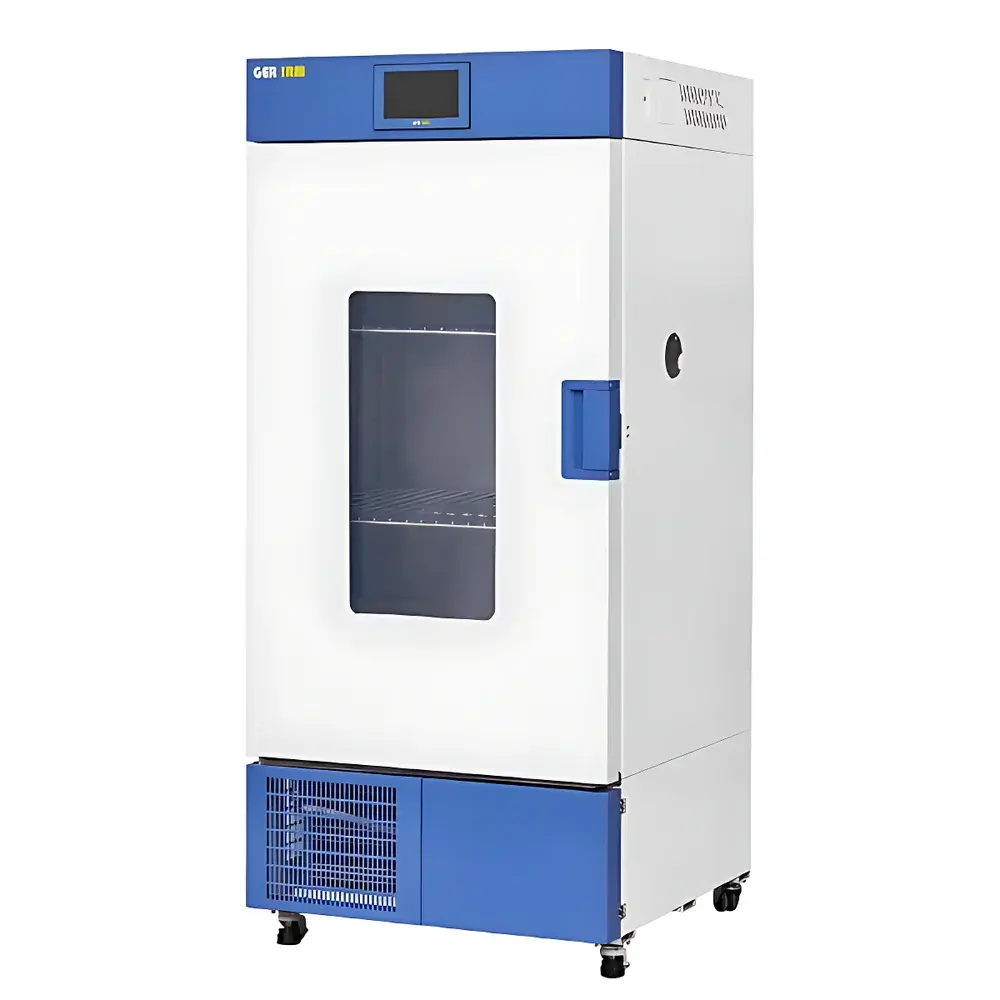
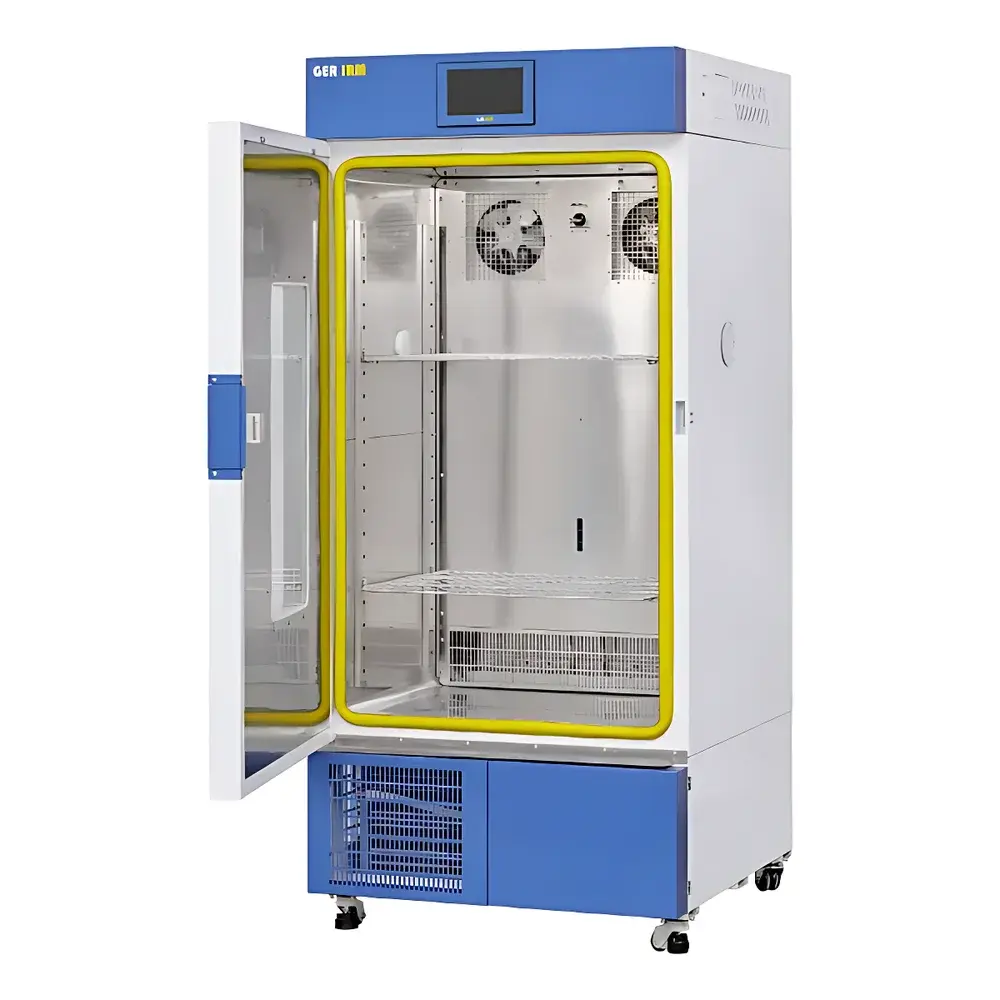

IRM MST260 Drug Stability Testing Chamber
| Brand | IRM |
|---|---|
| Origin | Beijing, China |
| Manufacturer Type | Manufacturer |
| Country of Origin | China |
| Model | MST260 |
| Pricing | Available Upon Request |
| Internal Volume | 305 L |
| Internal Dimensions (W×D×H) | 640 × 450 × 1060 mm |
| External Dimensions (W×D×H) | 780 × 790 × 1600 mm |
| Temperature Range | 0–80 °C (dark), 10–80 °C (with illumination) |
| Temperature Resolution | 0.1 °C |
| Temperature Uniformity | ≤ ±0.1 °C |
| Humidity Range | 20–98 %RH |
| Humidity Uniformity | ≤ ±1 %RH |
| Illumination Intensity | 0–6000 lx (±300 lx accuracy) |
| Refrigerant | R134a or R22 |
| Heating & Humidification Power | 2.0 kW |
| Cooling Capacity | 280 W |
| Power Supply | AC 220 V, 2.2 kW |
| Water Tank Capacity | 20 L |
| Standard Shelves | 2 (up to 20 configurable) |
| Weight | ~193 kg |
| Test Port | Two Ø50 mm ports (left/right) |
| Control Interface | 7-inch capacitive touchscreen |
| Operating Modes | Constant, Timer, Programmable (1–30 segments) |
| Data Logging | Event log, alarm history, real-time trend curves |
| Data Export | USB flash drive |
| Safety Protections | Leakage protection circuit breaker, independent over-temperature cutoff, water-level monitoring (low-level & overflow), compressor high-pressure/overheat protection, fan overheat protection, door-open alarm, power-failure alarm, sensor fault detection |
| Compliance Features | Audit trail, electronic signature support, 3-tier user permission system (Operator/Supervisor/Administrator), operation log with timestamp and user ID |
Overview
The IRM MST260 Drug Stability Testing Chamber is a GMP-compliant environmental simulation system engineered for long-term, regulated stability studies in accordance with ICH Q1–Q5 guidelines. It employs a balanced forced-air convection architecture with dual PID-controlled heating, refrigeration, and humidification subsystems to maintain precise, reproducible conditions across the full operational envelope—0–80 °C (dark) or 10–80 °C (with illumination) and 20–98 %RH. Its core thermal management relies on the proprietary “HACC” (High-Accuracy Climate Control) technology, integrating high-stability platinum resistance temperature sensors (PT100), capacitive humidity transducers with auto-calibration compensation, and a low-vibration, oil-free hermetic compressor (R134a or R22). The chamber achieves ≤ ±0.1 °C temperature uniformity and ≤ ±1 %RH humidity uniformity under no-load conditions at 20 °C ambient—validated per ISO 14644-3 and ASTM E2234 test protocols. Designed for continuous 24/7 operation—including frost-free performance above 20 °C—the MST260 supports ICH-defined storage conditions (e.g., 25 °C/60 %RH, 30 °C/65 %RH, 40 °C/75 %RH) and photostability testing per ICH Q1B using its calibrated 0–6000 lx LED illumination array (±300 lx accuracy).
Key Features
- Triple-layer insulated stainless-steel chamber with electrostatically coated exterior and seamless interior welds for corrosion resistance and cleanroom compatibility.
- Intelligent adaptive defrost cycle minimizing temperature perturbation during maintenance intervals; validated zero-frost operation above 20 °C for uninterrupted long-term studies.
- Full-spectrum LED lighting system with adjustable intensity (0–6000 lx), spectral output matching ISO 10977 requirements for photostability assessment.
- Redundant safety architecture: independent mechanical over-temperature cutoff (separate from main controller), earth-leakage circuit breaker (ELCB), dual-level water management (low-level shutdown + anti-overflow sensor), and real-time compressor diagnostics (pressure, current, temperature).
- Ergonomic mobility: heavy-duty casters with locking brakes (load capacity ≥ 300 kg), facilitating repositioning within QC labs or shared stability suites.
- Dual Ø50 mm access ports with silicone gaskets enable integration with external monitoring probes, gas analyzers, or purge systems without compromising chamber integrity.
Sample Compatibility & Compliance
The MST260 accommodates standard pharmaceutical packaging formats—including blister packs, HDPE bottles, glass vials, and secondary cartons—on up to 20 adjustable stainless-steel shelves (standard configuration: 2 shelves). Its internal volume (305 L) and optimized airflow design ensure uniform exposure across all sample positions, verified via 9-point mapping per ASTM E2234. Regulatory compliance is embedded at the firmware level: 3-tier role-based access control (Operator/Supervisor/Administrator), immutable audit trail recording all parameter changes, user logins, alarms, and mode transitions with UTC timestamps and digital signatures. All data—including trend curves, event logs, and alarm histories—can be exported via USB in CSV format for archival or submission to regulatory authorities. The system supports 21 CFR Part 11 readiness through optional PKI certificate integration and electronic signature workflows aligned with FDA and EMA expectations for GLP/GMP environments.
Software & Data Management
The 7-inch industrial-grade capacitive touchscreen runs a deterministic real-time OS with deterministic task scheduling, ensuring consistent response latency and preventing UI freezes during extended logging cycles. The embedded HMI provides intuitive navigation across six primary functions: constant-setpoint control, timer-based activation, multi-segment programmable profiles (up to 30 steps with ramp/soak logic), manual override, calibration adjustment, and system diagnostics. All operational parameters—including setpoints, actual values, alarms, and user actions—are written to non-volatile memory with battery-backed clock. In case of power loss, the unit resumes the last active program automatically with no data loss. Optional thermal printer interface enables hard-copy generation of critical status reports (e.g., daily condition summary, alarm recap) compliant with internal SOPs. Data export includes time-stamped CSV files containing second-resolution temperature/humidity/light readings, ideal for statistical analysis in JMP, Minitab, or Python-based stability modeling pipelines.
Applications
- ICH Q1A(R2) long-term, accelerated, and intermediate stability studies for APIs and finished dosage forms.
- ICH Q1B photostability testing under Option 1 (optionally equipped with UV filter kits) and Option 2 illumination protocols.
- Accelerated aging simulations for packaging validation (e.g., moisture barrier performance, seal integrity under stress).
- Reference standard storage under controlled conditions meeting USP and Ph. Eur. 2.2.47 requirements.
- Stability-indicating method development support, including forced degradation condition screening (e.g., 40 °C/75 %RH for hydrolysis studies).
- Environmental qualification of warehouse zones and cold-chain logistics staging areas per GDP Annex 9.
FAQ
Does the MST260 comply with 21 CFR Part 11 requirements?
Yes—the system supports electronic records and signatures when configured with optional PKI authentication and audit-trail-enabling firmware. Full Part 11 compliance requires site-specific validation (IQ/OQ/PQ) and administrative controls, which IRM provides in documented form.
Can the chamber operate continuously for 6-month stability studies without maintenance?
Yes—its frost-free design above 20 °C, sealed refrigeration loop, and self-diagnostic compressor monitoring enable unattended operation for >180 days. Scheduled preventive maintenance (e.g., filter replacement, sensor verification) is recommended every 6 months.
What is the validation support package offered by IRM?
IRM supplies DQ/IQ/OQ documentation templates, factory calibration certificates (NIST-traceable PT100 and humidity sensors), mapping protocol guidance, and on-site PQ support services upon request.
Is remote monitoring possible via Ethernet or Wi-Fi?
The MST260 features an RS485 Modbus RTU port for integration into building management systems (BMS) or centralized lab monitoring platforms. Ethernet/Wi-Fi connectivity is available as a factory-installed option with TLS 1.2 encrypted data transmission.
How is photostability illumination calibrated and verified?
Each unit ships with a factory-issued calibration report for the integrated LED array, traceable to NIST SRM 2219. Users may perform field verification using a handheld lux meter conforming to DIN 5032-7 Class B specifications.