
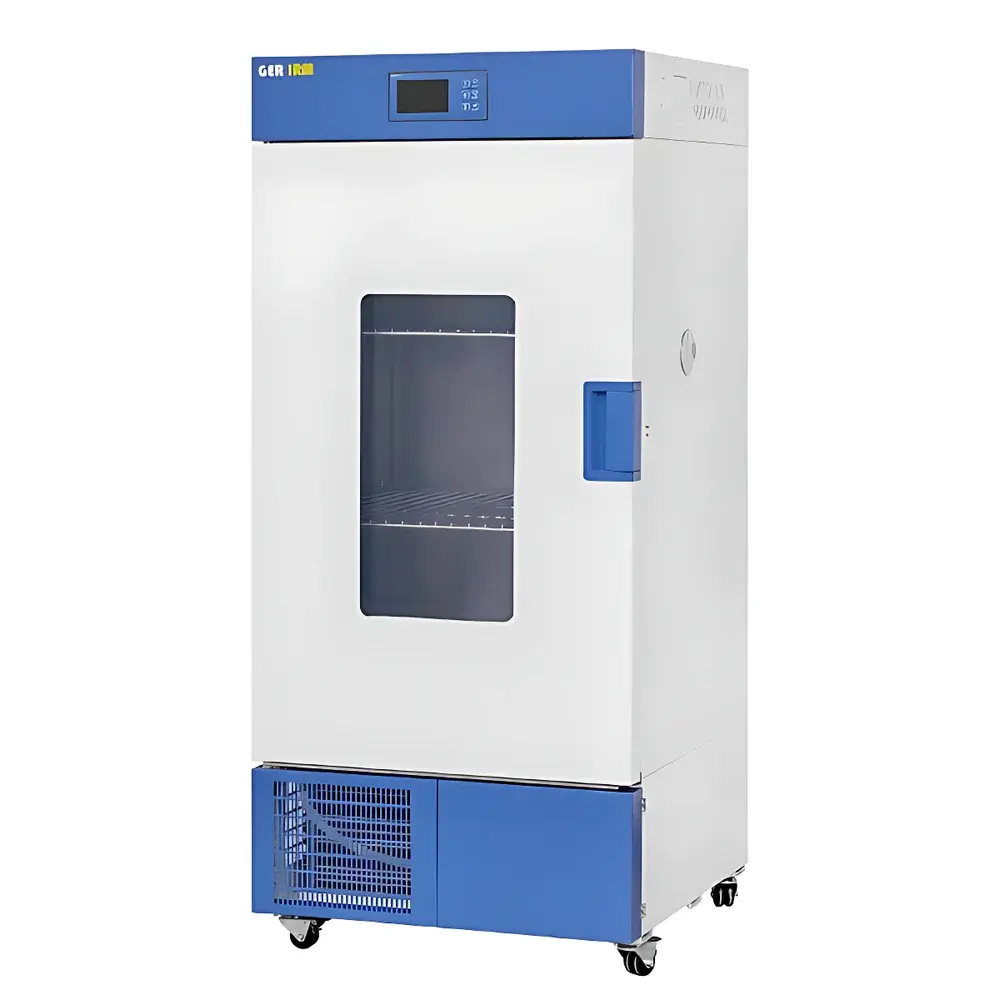

IRM NICH260 Temperature and Humidity Controlled Incubator
| Brand | IRM |
|---|---|
| Origin | Beijing, China |
| Manufacturer Type | Direct Manufacturer |
| Model | NICH260 |
| Heating Method | Air-jacketed |
| Cooling Method | Compressor-based |
| Humidification Reservoir | Integrated Water Tank |
| Temperature Range (with Humidification) | −10 °C to +90 °C |
| Temperature Range (without Humidification) | −10 °C to +90 °C |
| Temperature Fluctuation | ±0.2 °C |
| Temperature Uniformity | ±0.5 °C (at 20 °C) |
| Humidity Range | 20–98% RH |
| Humidity Accuracy | ±1.2% RH |
| Capacity | 305 L |
| External Dimensions (W×D×H) | 780 mm × 790 mm × 1600 mm |
Overview
The IRM NICH260 Temperature and Humidity Controlled Incubator is an engineered environmental chamber designed for precise, long-term maintenance of biological samples under tightly regulated thermal and hygroscopic conditions. It operates on a dual-control principle: air-jacketed heating ensures rapid thermal response and minimal internal gradient formation, while a high-efficiency hermetic compressor system enables stable cooling across the full operational range (−10 °C to +90 °C). Humidity is actively maintained via an integrated 20 L reservoir and PID-controlled steam generator, delivering consistent moisture delivery without manual refilling. The unit meets the fundamental requirements of cell culture, microbiological growth, stability testing (ICH Q1–Q5), and accelerated aging protocols where reproducible ambient simulation is critical. Its architecture supports continuous operation at ≥20 °C without frost accumulation—a key reliability factor for extended incubation cycles in pharmaceutical QC labs and academic core facilities.
Key Features
- Air-jacketed heating system with independent PID control for rapid temperature stabilization and reduced thermal overshoot
- Hermetically sealed R134a refrigeration circuit with dual-stage protection (high/low pressure cutoff, compressor overheat sensor, condenser fan thermal cutoff)
- Integrated 20 L humidification reservoir with auto-refill capability and anti-dry-burn safety interlock
- ±0.2 °C temperature fluctuation and ±0.5 °C uniformity (measured at 20 °C, empty chamber, ISO 14644-1 Class 8 cleanroom ambient)
- Humidity control accuracy of ±1.2% RH across 20–98% RH range, validated per ASTM E2912–22 standard test method
- Two 50 mm diameter access ports (left/right side), fitted with silicone gaskets and removable caps for probe insertion or gas exchange
- Heavy-duty locking casters (load capacity ≥120 kg per wheel) enabling safe repositioning within shared lab spaces
- Comprehensive safety suite: leakage-current protected circuit breaker, independent mechanical overtemperature limiter, door-open alarm, power-fail alert, sensor fault detection, and audible/visual warning escalation
Sample Compatibility & Compliance
The NICH260 accommodates standard ISO/ANSI-compliant culture vessels—including T-flasks (up to 175 cm²), multiwell plates (6–96-well), Petri dishes, and bioreactor bags—within its 305 L working volume. Internal dimensions (640 × 450 × 1060 mm) allow vertical stacking of up to 20 adjustable stainless-steel shelves (2 supplied, 18 optional). All wetted surfaces are electropolished 304 stainless steel; interior corners feature radius ≥R10 to prevent microbial entrapment. The unit complies with IEC 61010-1 (Safety Requirements for Electrical Equipment for Measurement, Control, and Laboratory Use) and meets essential requirements of EU Directive 2014/30/EU (EMC) and 2014/35/EU (LVD). For regulated environments, the optional ICH-series touchscreen version supports audit-trail-enabled event logging (per FDA 21 CFR Part 11), electronic signature capture, and GMP-aligned user permission tiers (Operator / Supervisor / Administrator).
Software & Data Management
The NICH260 is available in two control configurations: the base NICH series features membrane-keypad input with 4-line LCD display supporting fixed-setpoint, timer-based, and multi-step program modes (1–30 segments). The advanced ICH-series variant integrates a 7-inch capacitive touchscreen running embedded Linux OS with real-time data visualization. It records timestamped temperature/humidity profiles, alarm events, door openings, and system faults with >12-month local storage (SD card slot). Data export is supported via USB 2.0 (CSV format), and optional RS485/Modbus RTU interface enables integration into centralized BMS or LIMS platforms. All logged entries include operator ID, action type, and system state—enabling full traceability during regulatory inspections (e.g., WHO TRS 986 Annex 5, EU GMP Annex 15).
Applications
- Long-term mammalian and insect cell culture under physiological (37 °C / 5% CO₂-compatible with external gas mixing) or hypothermic (25 °C) conditions
- Microbial growth studies (bacteria, fungi, yeasts) requiring defined humidity to prevent agar plate desiccation
- Stability testing per ICH Q1A(R3) guidelines for pharmaceuticals, including intermediate condition (30 °C / 65% RH) and accelerated condition (40 °C / 75% RH)
- Seed germination assays and plant tissue culture where relative humidity directly influences callus formation and organogenesis
- Material degradation testing of medical device packaging (ISO 11607-1) and polymer-based diagnostics under controlled hygrothermal stress
- Environmental simulation for electronics reliability testing (JEDEC JESD22-A101)
FAQ
What is the difference between the NICH and ICH control systems?
The NICH series uses a membrane keypad and monochrome LCD for basic setpoint, timer, and 30-segment program operation. The ICH series adds a 7-inch touchscreen, real-time trend graphs, audit-trail logging, U盘 data export, and configurable user permissions—required for GLP/GMP environments.
Can the unit operate continuously at 4 °C with 80% RH?
Yes. The compressor-based cooling system maintains stable operation at 4 °C; humidity control remains functional down to 0 °C ambient, though condensation management requires periodic reservoir inspection below 10 °C.
Is validation documentation provided?
IRM supplies IQ/OQ templates compliant with ASTM E2500–22 and ISO/IEC 17025. Factory-assembled units undergo pre-shipment temperature/humidity mapping (9-point sensor grid) and calibration certificate issuance traceable to NIM (China National Institute of Metrology).
How is frost prevented during low-temperature humidified operation?
Frost formation is inherently suppressed above 20 °C. Below this threshold, the unit employs adaptive defrost cycling triggered by evaporator coil temperature and runtime thresholds—not timed intervals—minimizing thermal disturbance to samples.
Related Products




