
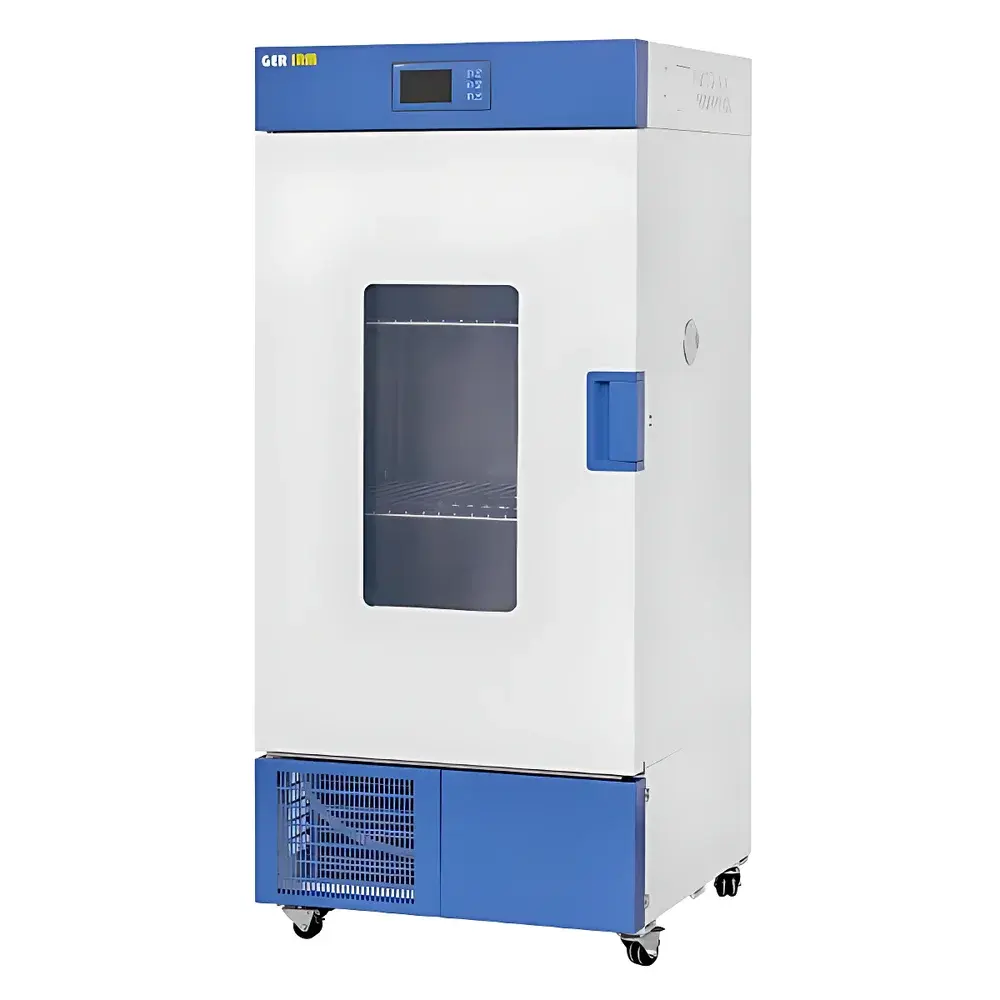

IRM NIM260 Mold Incubator
| Brand | IRM |
|---|---|
| Origin | Beijing, China |
| Manufacturer Type | Direct Manufacturer |
| Country of Origin | China |
| Model | NIM260 |
| Control Method | Mechanical Button Interface |
| Air Circulation | Forced Convection |
| Temperature Range | −10 °C to +85 °C |
| Temperature Fluctuation | ±0.2 °C |
| Temperature Uniformity | ±0.5 °C (at 20 °C) |
| Capacity | 305 L |
| External Dimensions | 780 × 790 × 1600 (H) mm |
| Internal Dimensions | 640 × 450 × 1060 (H) mm |
Overview
The IRM NIM260 Mold Incubator is a precision-engineered environmental chamber designed specifically for controlled fungal culture, mycological research, pharmaceutical stability testing, and microbiological quality control applications. It operates on a robust forced-convection thermal management system, enabling stable, repeatable temperature environments across a broad operational range of −10 °C to +85 °C — a critical capability for cultivating thermotolerant or psychrotolerant mold strains, conducting accelerated shelf-life studies, or performing ISO 11133-compliant media performance verification. The unit employs an intelligent PID-based temperature regulation algorithm, delivering high reproducibility (±0.2 °C fluctuation) and spatial uniformity (±0.5 °C at 20 °C reference), validated under no-load conditions per IEC 61000-4-30 and ISO/IEC 17025-aligned test protocols.
Key Features
- Forced convection architecture with optimized airflow distribution ensures rapid thermal equilibration and minimal vertical/horizontal gradients across the 305 L working volume.
- Mechanical button interface provides intuitive, tactile operation with dedicated keys for setpoint adjustment, timer activation, and mode selection — engineered for glove-compatible use in cleanroom or GMP production environments.
- Dual independent safety systems: primary electronic overtemperature protection and secondary mechanical cut-off relay, both compliant with EN 61000-6-2 EMC immunity standards.
- Integrated UV-C germicidal lamp (254 nm) as standard, supporting routine decontamination between batches without chemical agents — validated per ISO 15883-1 for non-invasive bioburden reduction.
- Two 50 mm diameter pass-through ports (left/right side), sealed with silicone grommets, enable uninterrupted sensor insertion, gas sampling, or external probe monitoring during active incubation.
- Heavy-duty locking casters (load capacity ≥120 kg) facilitate safe repositioning within shared laboratory spaces while maintaining structural stability during vibration-sensitive assays.
- Comprehensive hardware-level safeguards include compressor overpressure/overheat protection, condenser fan thermal cutoff, door-open alarm with audible/visual notification, power-fail detection with auto-restart logic, and real-time sensor fault diagnostics.
Sample Compatibility & Compliance
The NIM260 accommodates standard microbiological formats including Petri dishes (up to 150 mm), multi-well plates, slant tubes, and liquid culture flasks. Its interior chamber (640 × 450 × 1060 mm) supports up to 20 adjustable stainless-steel shelves (2 included, full configuration optional), allowing flexible stacking configurations for heterogeneous sample loads. The unit meets core regulatory prerequisites for pharmaceutical QC laboratories: design conforms to EU Annex 1 principles for contamination control; thermal validation protocols align with USP and ICH Q5C; event logging capabilities support audit readiness for FDA 21 CFR Part 11 (when paired with IM-series touchscreen controllers); and mechanical construction satisfies GLP/GMP documentation requirements for equipment qualification (IQ/OQ/PQ).
Software & Data Management
While the NIM260 model utilizes a dedicated mechanical control interface, its firmware architecture is fully compatible with IRM’s iHACC (intelligent Humidity and Accuracy Control Core) platform — enabling seamless migration to IM-series touchscreen variants if future digital traceability is required. The embedded controller supports three operational modes: constant-setpoint incubation, time-limited runs (1 min to 999 h), and multi-segment programmable cycles (1–30 steps). All runtime events — including temperature deviations exceeding user-defined thresholds, door openings, power interruptions, and safety interlock activations — are timestamped and stored in non-volatile memory. Data export via USB interface is supported upon upgrade to IM-series firmware, facilitating integration into LIMS or ELN platforms under 21 CFR Part 11-compliant audit trails.
Applications
- Fungal identification and strain preservation per CLSI M38 and EUCAST E.Def 9.3 guidelines.
- Pharmaceutical raw material and finished product stability testing per ICH Q1A(R3).
- Environmental monitoring (EM) program execution in Grade A/B cleanrooms per ISO 14644-1 and EU GMP Annex 1.
- Validation of sterilization indicators and biological monitors (e.g., Geobacillus stearothermophilus spore strips).
- Biological safety cabinet and isolator performance verification using challenge organisms.
- Academic and industrial mycotoxin production studies requiring precise low-temperature induction protocols.
FAQ
What is the recommended calibration frequency for the NIM260 incubator?
Per ISO/IEC 17025 and ASTM E2874, annual calibration against NIST-traceable reference thermometers is advised; quarterly in-house verification using calibrated PT100 probes is recommended for GMP-regulated operations.
Can the NIM260 operate continuously at −10 °C?
Yes — the high-efficiency R134a refrigeration system and insulated double-wall chamber (polyurethane foam, 80 mm thickness) support sustained sub-zero operation with ≤0.3 °C/h drift over 72-hour cycles.
Is the UV lamp ozone-free?
Yes — the integrated low-pressure mercury lamp emits exclusively at 254 nm and contains no quartz dopants that generate ozone, complying with OSHA PEL limits for occupational UV exposure.
Does the unit meet IP rating requirements for humid environments?
The electrical compartment carries IP54 ingress protection (dust-protected, splash-resistant), validated per IEC 60529 for placement in controlled-humidity laboratories with ambient RH up to 85% non-condensing.
How is temperature uniformity verified during factory acceptance testing?
Nine-point mapping per ISO 15330 is performed using nine calibrated Class A PT100 sensors placed at standardized locations (corners, center, mid-height), with results documented in the Certificate of Conformance shipped with each unit.





