
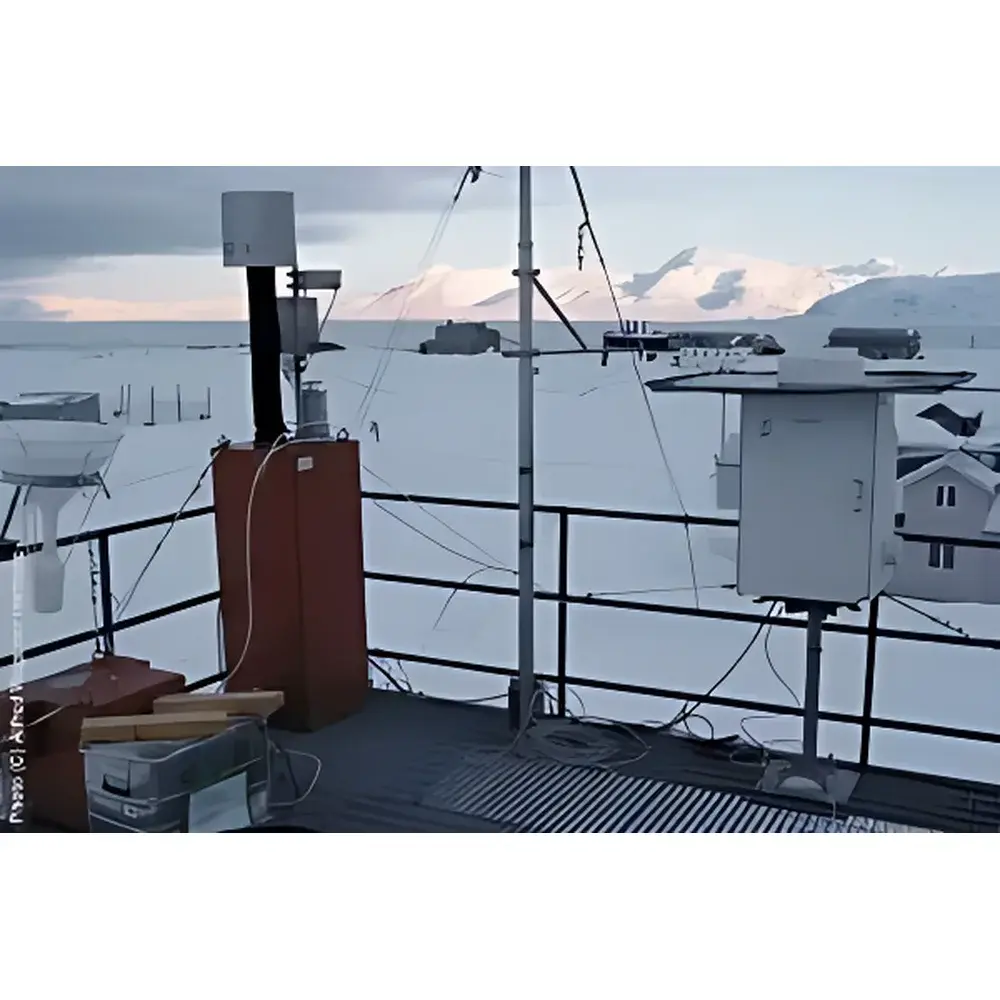
ISAP Arctic-Grade Aerosol Sampler
| Brand | ISAP |
|---|---|
| Origin | Germany |
| Manufacturer Type | Authorized Distributor |
| Origin Category | Imported |
| Model | ISAP Arctic-Grade Aerosol Sampler |
| Pricing | Available Upon Request |
Overview
The ISAP Arctic-Grade Aerosol Sampler is an engineered solution for continuous, reliable atmospheric aerosol collection under extreme cold-weather conditions—specifically designed for deployment in polar regions, high-altitude alpine stations, and sub-Arctic research outposts where ambient temperatures routinely fall below −40 °C and may reach as low as −65 °C. Unlike conventional PM10 samplers, which suffer from electronic component failure, elastomer seal embrittlement, snow ingestion, and wind-induced sampling bias, this instrument integrates cryo-stable electronics, passive anti-snow geometry, and thermally compensated flow control to maintain ISO 10993-compliant sampling integrity across extended unattended operation cycles. Its operational principle relies on isokinetic inertial separation coupled with gravimetric or filter-based collection (e.g., quartz fiber, Teflon, or polycarbonate membranes), ensuring representative capture of particulate matter ≤10 µm aerodynamic diameter (PM10) even during blizzard events and high-wind episodes.
Key Features
- Cryo-hardened enclosure rated for continuous operation at −65 °C ambient, with integrated thermal buffering to prevent condensation-induced sensor drift
- Passive snow-shedding inlet design featuring a conical deflector and elevated intake port (≥1.5 m above ground level) to minimize snow accumulation and blockage
- Low-temperature-rated elastomeric seals (fluoroelastomer FKM and perfluoroelastomer FFPM compounds) validated per ASTM D1418 for sealing integrity down to −70 °C
- Wind-compensated isokinetic sampling head with real-time flow adjustment via heated mass flow controller (MFC), maintaining ±2% volumetric accuracy across wind speeds up to 25 m/s
- Modular power architecture supporting dual-source operation: 24 V DC (solar/battery hybrid) or 110–240 V AC, with low-power sleep mode (<1.2 W standby)
- Optional integrated meteorological sensor suite including ultrasonic anemometer (wind speed/direction), capacitive hygrometer (RH), PT100 temperature probe, tipping-bucket rain gauge, pyranometer (solar irradiance), UV-A/B radiometer, and triaxial accelerometer (vibration monitoring)
Sample Compatibility & Compliance
The ISAP Arctic-Grade Aerosol Sampler accommodates standard 47 mm and 81 mm filter substrates—including quartz fiber (for OC/EC analysis), Teflon (for ICP-MS trace metal quantification), and mixed-cellulose ester (for microscopy)—with interchangeable filter holders compatible with EPA Method IO-3.1, EN 12341:2014, and ISO 7708:1995. All wetted components meet USP Class VI biocompatibility requirements. The system complies with GLP data integrity standards, supports audit trails for flow calibration events, and enables full traceability of sampling metadata (start/stop time, temperature-compensated flow rate, filter ID, operator ID) in accordance with FDA 21 CFR Part 11 when paired with optional secure firmware modules.
Software & Data Management
Data acquisition and remote supervision are managed through the ISAP Control Suite v3.2—a Linux-based embedded application supporting local SD card logging (up to 16 GB) and encrypted TLS 1.3 transmission to centralized environmental data platforms (e.g., EUDAT B2SAFE, NOAA’s AERONET API). Real-time diagnostics include flow deviation alerts, filter load estimation via pressure differential trending, and cold-start sequence validation. Firmware updates are performed via signed OTA packages with SHA-256 verification. Raw data exports conform to NetCDF-4 format with CF-1.8 metadata conventions, enabling direct ingestion into Python (xarray), R (ncdf4), or MATLAB workflows.
Applications
- Long-term baseline monitoring of black carbon, sulfate, and sea-salt aerosols across Arctic Circumpolar Observatories (e.g., Zeppelin Station, Summit Camp, Neumayer III)
- Source apportionment studies linking anthropogenic emissions (e.g., shipping, oil extraction) to regional deposition patterns in Svalbard and Greenland Ice Sheet margins
- Validation of satellite-derived AOD products (e.g., MODIS, Sentinel-3 OLCI) under low-sun-angle, high-albedo conditions
- Climate model input generation for aerosol–cloud interaction parameterization in CESM and EC-Earth frameworks
- Supporting WHO Global Air Quality Guidelines implementation in remote Indigenous communities exposed to episodic biomass burning plumes transported across polar vortex pathways
FAQ
What is the lowest operational temperature specification for the ISAP Arctic-Grade Aerosol Sampler?
The unit is fully functional at sustained ambient temperatures of −65 °C, with all critical subsystems (flow control, data logging, telemetry) validated per IEC 60068-2-1 (cold test) and MIL-STD-810H Method 502.7.
Does the sampler require active heating of the inlet or filter housing?
No. Active heating is deliberately avoided to prevent volatilization artifacts; instead, thermal inertia and low-conductivity insulation maintain filter temperature within ±5 °C of ambient, preserving semi-volatile organic compound (SVOC) integrity.
Can it be integrated with existing station infrastructure (e.g., Campbell Scientific CR1000X)?
Yes. Analog (0–5 V, 4–20 mA) and digital (RS-485 Modbus RTU, NMEA 0183) interfaces are provided for seamless integration with legacy environmental data loggers.
Is remote firmware update capability available without physical access?
Yes. Over-the-air (OTA) updates are supported via LTE-M or Iridium Short Burst Data (SBD), with cryptographic signature verification and rollback protection.
What filter types are certified for use with this sampler under ISO 21501-4 protocols?
Quartz fiber filters (Pallflex QMA) and PTFE membrane filters (Gelman Supor-450) are pre-validated for PM10 cut-point performance per ISO 21501-4 Annex C, with documented aspiration efficiency curves across 0.5–100 µm.
Related Products







