
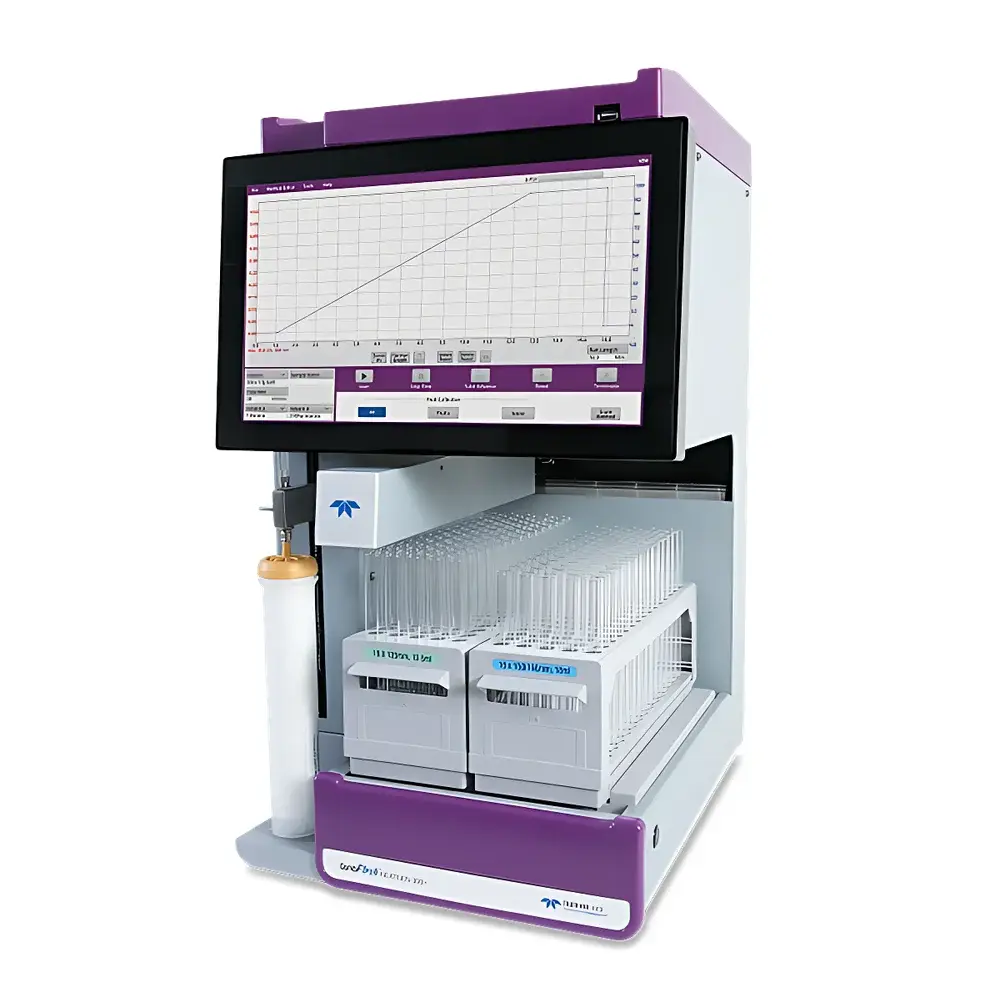
ISCO CombiFlash NextGen Advanced Preparative Liquid Chromatography System
| Brand | ISCO |
|---|---|
| Origin | USA |
| Manufacturer Type | Authorized Distributor |
| Origin Category | Imported |
| Model | CombiFlash NextGen |
| Application Level | Laboratory Grade |
| Instrument Type | Medium-to-Low Pressure Preparative LC |
| Flow Rate Range | 1–300 mL/min |
| Flow Accuracy | RSD ≤ 0.01% |
| Flow Precision | RSD ≤ 0.1% |
| Maximum Operating Pressure | 300 psi (20 bar) |
| Wavelength Range | 190–800 nm (UV-Vis) |
| Wavelength Reproducibility | ±1 nm |
| Baseline Noise | ≤1 × 10⁻⁵ AU |
| Data Acquisition Rate | 5 Hz |
| Detection Options | UV, UV-Vis, ELSD, Mass Spectrometry (MS)-compatible interface |
Overview
The ISCO CombiFlash NextGen is an engineered medium-pressure preparative liquid chromatography (PLC) system designed for high-throughput, reproducible purification of synthetic organic compounds, natural products, peptides, oligonucleotides, and polymeric materials in research and development laboratories. Based on robust gradient elution principles and dual-pump solvent delivery architecture, the system operates within a pressure range up to 300 psi (20 bar), supporting both normal-phase and reversed-phase chromatographic modes. Its core functionality integrates real-time flow control, wavelength-tunable UV-Vis detection, and intelligent column recognition—enabling rapid method deployment without manual calibration or parameter re-entry. Unlike analytical HPLC systems, the NextGen platform prioritizes scalability, sample loading capacity, and operational autonomy while maintaining compliance with fundamental chromatographic performance criteria defined in ASTM D7246 and ISO 17025-accredited workflows.
Key Features
- Intelligent RFID-enabled column recognition: Automatically detects RediSep® and RediSep Gold® cartridge dimensions, packing chemistry (e.g., silica, C18, amino), and recommended flow/pressure limits upon insertion.
- Single-touchscreen PeakTrak™ software interface: Provides unified control over pump operation, gradient programming, detector configuration, fraction collection logic, and real-time chromatogram visualization—all from a 10.1-inch capacitive display.
- Dynamic parameter adjustment during run: Users may modify gradient slope, wavelength setpoint, flow rate, or collection window mid-separation without interrupting the process or requiring method reinitialization.
- Multi-detection compatibility: Supports interchangeable detectors—including fixed-wavelength UV (254 nm), full-spectrum UV-Vis (190–800 nm), evaporative light scattering (ELSD), and mass spectrometer interfaces for hyphenated LC-MS purification verification.
- Automated solvent and waste monitoring: Integrated level sensors provide continuous feedback on reservoir volume and waste container fill status, triggering alerts prior to depletion or overflow.
- Self-cleaning solid-loop injection valve: Optional high-pressure version rated to 300 psi enables direct solid sample introduction with automated rinse cycles between injections, minimizing carryover and manual intervention.
Sample Compatibility & Compliance
The CombiFlash NextGen accommodates a broad spectrum of sample matrices—from milligram-scale reaction mixtures to gram-level crude isolates—across both polar and nonpolar solvent systems (e.g., hexane/EtOAc, MeOH/H₂O, DCM/MeOH). Column formats include standard RediSep cartridges (4 g to 330 g), Gold series high-efficiency media, and custom-packed columns up to 50 mm ID. The system meets essential regulatory expectations for laboratory instrumentation under GLP environments: audit-trail-enabled software logs all user actions, method changes, and instrument events; detector data files are timestamped and digitally signed; and optional 21 CFR Part 11 compliance packages support electronic signatures and role-based access control. All hardware components comply with IEC 61010-1 safety standards for laboratory electrical equipment.
Software & Data Management
PeakTrak software serves as the central command layer for method development, execution, and post-run analysis. It supports method templates, batch processing queues, and customizable fraction-trigger rules based on UV threshold, time window, or peak apex detection. Raw chromatographic data is saved in vendor-neutral .csv and .cdf formats compatible with third-party cheminformatics platforms (e.g., ChemDraw, ACD/Labs). The software includes built-in purity assessment tools, peak integration validation reports, and export-ready summary tables for regulatory documentation. All acquisition parameters—including flow rate, gradient profile, wavelength, and collection mapping—are stored with metadata tags (user ID, date/time, instrument serial number) to satisfy traceability requirements in ISO/IEC 17025 and FDA-aligned quality systems.
Applications
- Synthetic chemistry: Rapid purification of Suzuki, Heck, and amidation reaction products with minimal method optimization.
- Natural product isolation: Fractionation of plant extracts using step-gradient or linear ramp protocols across silica or diol media.
- Peptide synthesis: Desalting and intermediate purification of Fmoc-protected sequences via C18 reverse-phase cartridges.
- Pharmaceutical process development: Early-stage impurity isolation and reference standard preparation under GMP-aligned documentation practices.
- Polymer characterization: Separation of oligomeric fractions by molecular weight using size-exclusion-compatible solvents and columns.
FAQ
Can the system operate unattended overnight?
Yes—the NextGen platform supports fully autonomous runs with automatic shutdown, solvent switching, and fraction collection sequencing. Safety interlocks prevent operation if waste levels exceed thresholds or column backpressure exceeds preset limits.
Is method transfer possible from older CombiFlash models?
All legacy CombiFlash methods (.cfm files) are backward-compatible with PeakTrak v4.2+, including gradient profiles, collection tables, and detector settings.
What validation documentation is available?
ISCO provides Factory Acceptance Test (FAT) reports, Installation Qualification (IQ) templates, and Operational Qualification (OQ) protocols aligned with USP and ASTM E2656 guidelines.
Does the system support multi-wavelength detection during a single run?
UV-Vis detector models allow simultaneous acquisition at two user-defined wavelengths (e.g., 214 nm and 254 nm), with independent baseline correction and peak tracking per channel.
How is system cleaning validated after high-load runs?
PeakTrak includes a dedicated “Column Rinse & System Flush” wizard that executes pre-programmed solvent sequences with flow-rate ramping and dwell-time control, logging pressure and UV baseline stability throughout the cycle.
Related Products





