
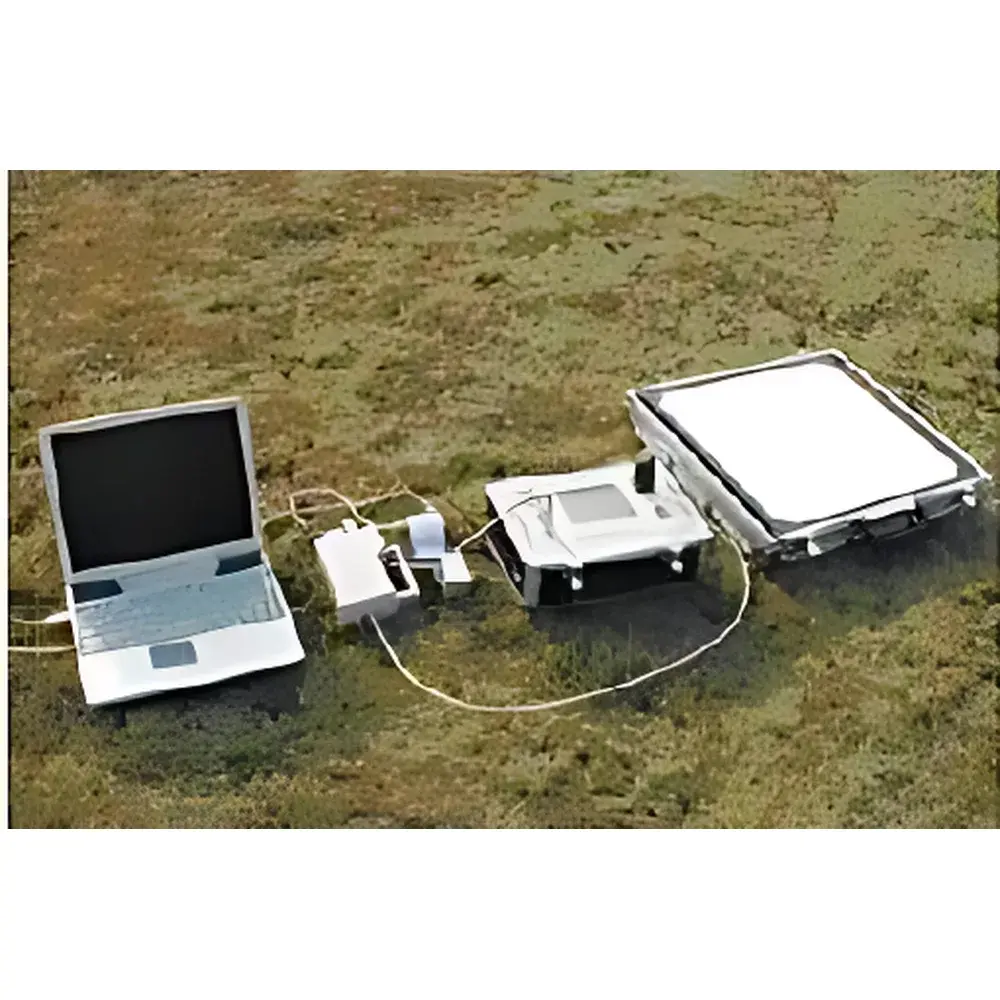
ISI921VF Continuous-Spectrum Field Spectroradiometer
| Origin | Beijing, China |
|---|---|
| Manufacturer Type | Authorized Distributor |
| Origin Category | Domestic (PRC) |
| Model | ISI921VF |
| Pricing | Available Upon Request |
| Instrument Type | Spectroradiometer |
| Spectral Channels | 512 / 256 / 128 |
| Spectral Range | 380–1050 nm |
| Spectral Resolution | 2 nm / 4 nm / 8 nm @ 700 nm |
| Wavelength Accuracy | ±0.7 nm / ±1.4 nm / ±2.8 nm |
| Measurement Dynamic Range | >1000:1 (60 dB) |
| Standard Configuration | Host Unit ×1, Optical Head ×1, Smart Battery Charger ×1, Rugged Carry Case ×1, USB Communication Cable ×1, Software CD ×1, 2-m Extendable Handheld Mast ×1 |
| Optional Accessories | Calibrated Reflectance Panels (various sizes & reflectance levels), GPS Module, Synchronized Imaging Module, Extended Mast (~10 m), Indoor Calibration Light Source, Fixed-Position Mounting Frame, BRDF Measurement Rig |
Overview
The ISI921VF Continuous-Spectrum Field Spectroradiometer is a portable, field-deployable spectroradiometric system engineered for high-fidelity spectral radiance and reflectance measurements across terrestrial, aquatic, and atmospheric surfaces. Operating on the principle of diffraction-grating-based optical dispersion coupled with linear CCD array detection, the instrument captures continuous spectral data from 380 nm to 1050 nm—spanning the full visible and near-infrared (VNIR) region critical for remote sensing validation, bio-optical characterization, and surface property quantification. Its modular architecture supports rapid reconfiguration between measurement modes (e.g., downwelling irradiance, upwelling radiance, bidirectional reflectance), and it remains the only commercially available spectroradiometer certified for in situ marine remote-sensing applications—including normalized water-leaving radiance (Lwn) derivation per NASA SeaWiFS and ESA MERIS protocols. Designed for operational robustness under variable environmental conditions (−10 °C to +50 °C, up to 90% RH non-condensing), the ISI921VF meets the physical and metrological requirements for field campaigns aligned with ISO 17025-accredited laboratories and CE-compliant instrumentation standards.
Key Features
- Three selectable spectral channel configurations (128/256/512 pixels) enabling trade-offs between spectral resolution (2–8 nm @ 700 nm), signal-to-noise ratio, and integration time optimization
- Calibration traceable to NIM (National Institute of Metrology, China) via factory-installed NIST-traceable irradiance and radiance standards
- Integrated thermal stabilization subsystem minimizing wavelength drift (<±0.05 nm/°C) during extended outdoor operation
- USB 2.0 interface supporting real-time data streaming and firmware updates without external power adapters
- Ruggedized magnesium alloy housing (IP54-rated) with anti-reflective, scratch-resistant optical window
- Onboard memory (8 GB) for autonomous logging when external PC connectivity is unavailable
Sample Compatibility & Compliance
The ISI921VF accommodates diverse measurement geometries through interchangeable optical heads and mounting options, including nadir-viewing, hemispherical, and directional configurations. It supports standardized reflectance measurements against certified ceramic or Spectralon® reference panels (2%, 10%, 50%, and 99% reflectance options). For aquatic deployments, the system complies with IOCCG (International Ocean Colour Coordinating Group) Protocol V3 for above-water radiometry, including dark-current correction, stray-light suppression, and polarization sensitivity compensation (<2.5% at 60° incidence). All calibration certificates include uncertainty budgets conforming to GUM (Guide to the Expression of Uncertainty in Measurement) principles. The instrument’s software and data handling procedures support audit trails required under GLP environments, and raw spectral files are stored in ENVI-compatible BIL format with embedded metadata (Wavelength, FWHM, integration time, GPS timestamp, temperature).
Software & Data Management
The bundled SpectraView Pro software (v4.2+) provides end-to-end spectral workflow management: real-time preview, dark/reference normalization, geometric correction, reflectance/radiance conversion, spectral index computation (e.g., NDVI, EVI, aph(λ)), and export to CSV, HDF5, or NetCDF-4. When equipped with the optional synchronized imaging module, co-registered RGB video frames are time-stamped and geotagged (via integrated GPS), enabling pixel-level spectral–spatial correlation for target identification and scene context annotation. Data provenance is preserved through immutable file headers containing operator ID, instrument serial number, calibration date, and environmental sensor logs (ambient temperature, humidity, pressure). Exported datasets comply with FAIR (Findable, Accessible, Interoperable, Reusable) principles and are compatible with NASA’s LP DAAC and ESA’s PEPS archive ingestion pipelines.
Applications
- Validation of satellite-derived land surface reflectance products (e.g., Landsat OLI, Sentinel-2 MSI, GF-6)
- In situ characterization of phytoplankton absorption and CDOM (colored dissolved organic matter) spectral signatures in coastal and inland waters
- Non-destructive crop health assessment via chlorophyll fluorescence and water-band indices
- Mineral identification and alteration mapping using diagnostic absorption features (e.g., Fe-OH, Al-OH, Mg-OH)
- BRDF modeling for climate-relevant albedo estimation over heterogeneous terrain
- Undergraduate and graduate laboratory instruction in optical remote sensing, environmental physics, and spectroscopic metrology
FAQ
Is the ISI921VF suitable for underwater deployment?
No—the ISI921VF is designed exclusively for above-water and terrestrial measurements. For underwater profiling, users should integrate its radiance data with companion in-water instruments (e.g., HyperPro II) following IOCCG intercalibration guidelines.
Does the system support automated spectral calibration in the field?
Yes—optional onboard tungsten-halogen and LED-based calibration sources enable rapid radiometric recalibration without returning to the lab, reducing drift-induced uncertainty between campaigns.
Can raw spectra be exported in formats compatible with ENVI or Python (e.g., NumPy arrays)?
Yes—SpectraView Pro exports calibrated spectra as ASCII CSV with wavelength headers and as binary BIL files with accompanying HDR metadata; Python libraries (e.g., spectral, h5py) provide native read support.
What GPS accuracy is achieved with the optional GPS module?
The integrated GPS module delivers <3 m CEP (Circular Error Probable) horizontal accuracy under open-sky conditions, with NMEA 0183 v4.10 output and UTC time synchronization.
Is firmware upgrade capability included, and how is it performed?
Firmware updates are delivered quarterly via secure download portal and installed via USB-connected host PC using SpectraView Pro’s built-in update utility—no hardware modification required.
Related Products







