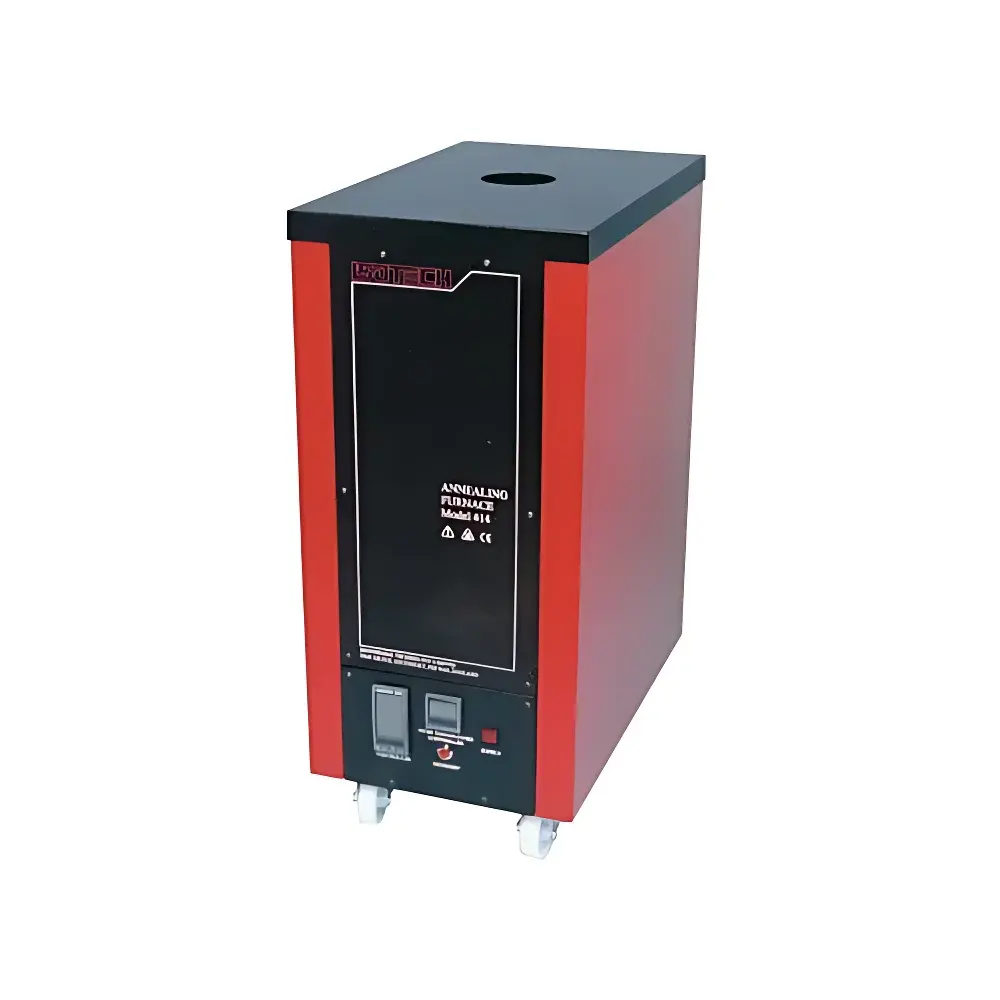
ISOTECH Model 414 Annealing Furnace
| Brand | ISOTECH |
|---|---|
| Origin | United Kingdom |
| Model | 414 |
| Maximum Operating Temperature | 1000 °C |
| Control System | Integrated Programmable Temperature Controller |
| Application | Annealing, Heat Treatment and Stabilization of Platinum Resistance Thermometers (PRTs) |
| Compliance | Designed for use in calibration laboratories adhering to ISO/IEC 17025, ASTM E1137/E2877, and IEC 60751 |
Overview
The ISOTECH Model 414 Annealing Furnace is a precision-engineered thermal treatment system designed specifically for the annealing, stabilization, and post-calibration heat treatment of platinum resistance thermometers (PRTs), including standard platinum resistance thermometers (SPRTs), industrial PRTs, and reference-grade sensors. Operating on resistive heating principles with high-stability ceramic insulation and optimized thermal mass distribution, the furnace delivers exceptional temperature uniformity and long-term thermal stability across its full operating range—from ambient up to 1000 °C. Its primary function is to relieve internal stresses induced during mechanical handling or thermal cycling, thereby restoring metrological stability and minimizing drift in resistance-temperature characteristics. The unit is engineered for integration into accredited calibration laboratories where traceable, repeatable, and documented thermal treatment protocols are required per international standards.
Key Features
- Maximum operating temperature of 1000 °C—validated for full compliance with annealing requirements specified in IEC 60751:2022 and ASTM E2877–22 for Class A and Class AA PRTs.
- Integrated programmable temperature controller enabling precise ramp rates, soak times, and multi-step thermal profiles—including controlled cooling sequences critical for stress-relief annealing.
- Uniformity better than ±1.5 °C over a 50 mm axial zone at 960 °C, verified using calibrated reference thermocouples and validated per ISO/IEC 17025 internal procedure requirements.
- Robust dual-layer construction: outer stainless-steel housing with high-emissivity ceramic fiber insulation and a high-purity alumina tube chamber resistant to thermal shock and oxidation.
- Digital interface supporting RS-232 or optional RS-485 connectivity for remote monitoring and data logging integration with laboratory information management systems (LIMS).
- Front-panel access with safety interlock and over-temperature cut-off protection meeting EN 61000-6-2 and EN 61000-6-3 electromagnetic compatibility requirements.
Sample Compatibility & Compliance
The Model 414 accommodates a wide range of PRT geometries, including probe-type, sheathed, and capsule-style sensors up to 300 mm in length and 8 mm in outer diameter. It supports both single- and dual-element configurations used in fixed-point cell calibrations and ITS-90 realization workflows. All operational procedures—including ramp rate selection (0.1–10 °C/min), soak duration (1–240 minutes), and cooling profiles—are configurable to align with manufacturer-recommended annealing schedules (e.g., Fluke Hart, WIKA, and ASL documentation). The furnace is routinely employed in laboratories maintaining ISO/IEC 17025 accreditation, and its thermal performance is documented through periodic verification using NIST-traceable reference thermometers and uncertainty budgets compliant with GUM (JCGM 100:2008).
Software & Data Management
While the Model 414 operates as a standalone instrument with local control, its serial interface enables seamless integration with third-party calibration software platforms such as MET/TEMP II, DTI-6500, or custom Python- or LabVIEW-based automation scripts. Logged temperature-time datasets include timestamped ramp/soak/cool events, controller setpoints, and real-time deviation from target—supporting audit-ready records for GLP and GMP environments. When connected to a compliant data acquisition system, the furnace satisfies FDA 21 CFR Part 11 requirements for electronic records and signatures, including user authentication, audit trail generation, and data integrity safeguards.
Applications
- Stress-relief annealing of SPRTs prior to fixed-point calibration (e.g., triple point of water, freezing point of zinc).
- Post-manufacturing stabilization of industrial PRTs used in pharmaceutical cleanroom monitoring and HVAC validation.
- Recovery of calibration stability following accidental mechanical shock or rapid thermal transients.
- Reference sensor maintenance in national metrology institutes (NMIs) and secondary standard laboratories.
- Supporting uncertainty reduction in temperature calibration chains by minimizing hysteresis and long-term drift components.
FAQ
What is the recommended annealing temperature for standard platinum resistance thermometers?
For most SPRTs and high-accuracy industrial PRTs, the standard annealing temperature is 660 °C (zinc point) or 961.78 °C (silver point), depending on sensor construction and historical drift behavior.
Does the Model 414 support automated thermal profiling?
Yes—the built-in programmable controller allows storage of up to 16 multi-segment profiles, each with independently defined ramp rates, dwell times, and cooling gradients.
Can the furnace be used for calibration verification beyond annealing?
No—it is not a calibration furnace; it does not provide measurement uncertainty statements or direct traceability. Its role is strictly thermal conditioning prior to or between calibrations.
Is the Model 414 suitable for inert-atmosphere annealing?
The standard configuration operates in ambient air; optional quartz tube purging kits with nitrogen or argon supply interfaces are available upon request for oxygen-sensitive applications.
How often should the furnace’s temperature uniformity be verified?
Per ISO/IEC 17025 clause 6.4.10, uniformity verification shall be performed at least annually—or after any major maintenance—and documented within the laboratory’s equipment management system.