
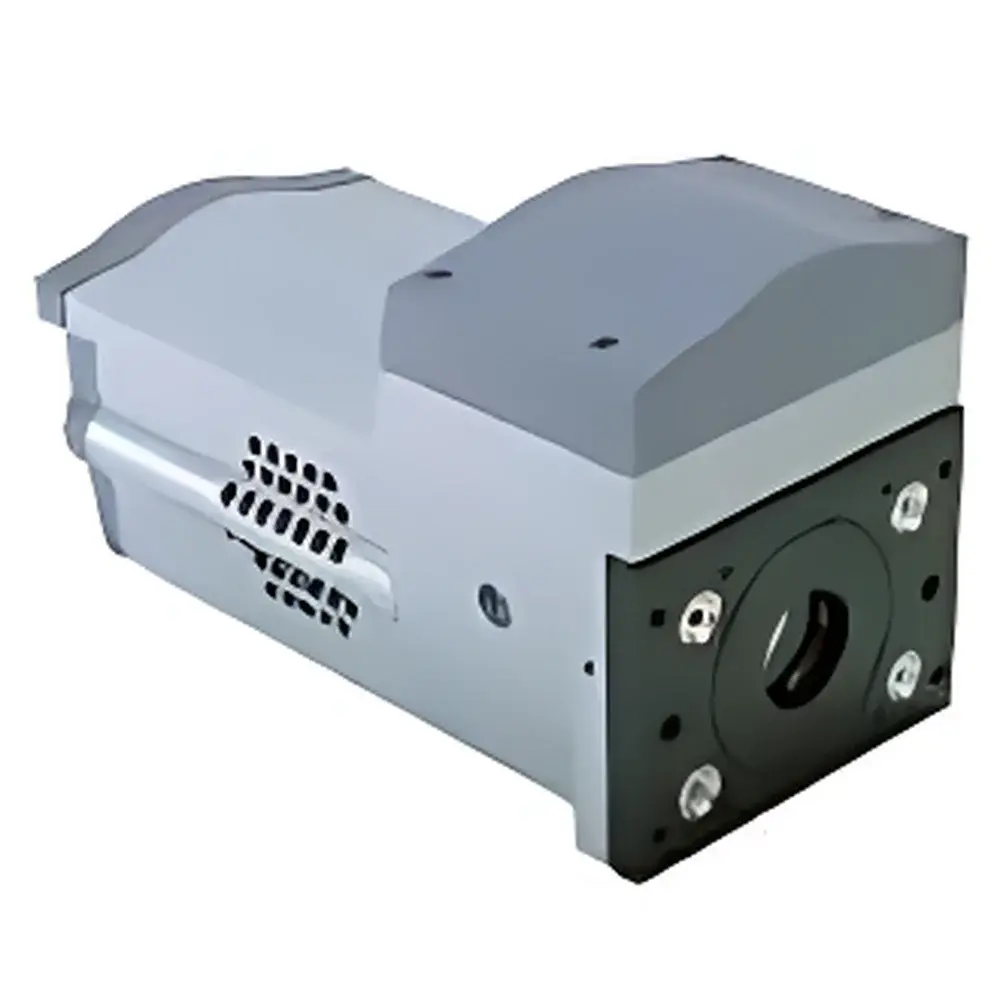
iStar Series Intensified CCD Camera by Andor Technology
| Brand | Andor |
|---|---|
| Origin | United Kingdom |
| Model | iStar Series |
| Sensor Format | 512 × 512 or 1024 × 1024 |
| Image Intensifier Diameter | 18 mm or 25 mm |
| Phosphor Screen | P43 or P46 |
| Minimum Optical Gate Width | 2 ns |
| Delay Resolution | 25 ps |
| Total Trigger-to-Gate Delay | 40 ns |
| Gating Technology | Intelligate™ Synchronized MCP–Photocathode Gating |
| Onboard Digital Delay Generator | Yes |
| Remote Control Interface | Wireless |
| UV Response | Optimized for deep-UV with >10⁷ on/off contrast ratio |
| Compliance | Designed for GLP/GMP-compliant time-resolved imaging workflows requiring traceable timing control |
Overview
The iStar Series Intensified CCD (ICCD) camera, engineered by Andor Technology in Belfast, UK, is a high-performance, gated imaging platform designed for ultra-low-light, time-resolved scientific applications. Built upon a robust optical intensification architecture—comprising a photocathode, microchannel plate (MCP), and phosphor screen—the iStar delivers single-photon sensitivity combined with precise temporal gating capability. Its core measurement principle relies on photoelectron amplification within the MCP under controlled voltage bias, followed by phosphor-based visible conversion and CCD readout. This enables true optical shuttering at nanosecond timescales, making it indispensable for experiments where signal isolation in both space and time is critical—such as combustion diagnostics, transient bioluminescence mapping, femtosecond pump-probe imaging, and plasma dynamics analysis.
Key Features
- Two sensor configurations: 512 × 512 and 1024 × 1024 pixel back-illuminated CCDs, optimized for quantum efficiency across UV–visible spectrum (185–850 nm)
- Selectable image intensifier formats: 18 mm and 25 mm diameter tubes, supporting flexible optical coupling and field-of-view scaling
- Phosphor screen options: P43 (green-emitting, fast decay ~1 µs) for high-speed dynamic imaging; P46 (blue-emitting, ultrafast decay <5 ns) for sub-nanosecond temporal fidelity
- True optical gate width down to 2 ns—verified via streak camera calibration—not electronic or software-limited approximation
- Intelligate™ technology ensures synchronous gating between photocathode and MCP, preserving high contrast (>10⁷) even at deep-UV wavelengths (e.g., 193 nm ArF excimer)
- Integrated digital delay generator with 25 ps resolution and total system latency of only 40 ns from external trigger input to gate activation
- Wireless remote operation via Ethernet or USB 3.0 interface eliminates physical tethering during vacuum chamber or laser enclosure integration
Sample Compatibility & Compliance
The iStar ICCD supports direct fiber-optic or lens-coupled imaging across diverse sample environments—including vacuum chambers, high-pressure reactors, cryostats, and biological incubators. Its sealed, thermoelectrically cooled housing (down to −45 °C) minimizes dark current and enables long-exposure acquisition without compromising signal-to-noise ratio. The system conforms to key regulatory frameworks for research instrumentation: timing parameters are fully traceable and loggable per ISO/IEC 17025 requirements; firmware supports audit-trail-enabled operation suitable for GLP and GMP environments; and all delay/gating sequences can be timestamped and exported in HDF5 or TIFF formats compatible with FDA 21 CFR Part 11-compliant data management systems.
Software & Data Management
Andor’s SOLIS software provides full instrument control—including real-time gate width/delay adjustment, multi-frame burst acquisition, and hardware-synchronized triggering with external lasers or detectors. All timing parameters are stored in metadata headers (EXIF + custom Andor tags), ensuring experimental reproducibility. For automated workflows, the SDK supports Python, MATLAB, and LabVIEW integration, enabling programmable sequence generation and batch processing. Raw images are saved in lossless 16-bit format; time-series datasets support frame-stacking, drift correction, and intensity normalization against reference dark frames acquired in situ.
Applications
- Combustion science: OH* chemiluminescence imaging with crank-angle-resolved gating in internal combustion engines
- Ultrafast spectroscopy: Time-gated Raman or fluorescence lifetime imaging (FLIM) in catalytic surface reactions
- Biophotonics: Low-light bioluminescent reporter assays in live-cell cultures under physiological conditions
- Laser-induced breakdown spectroscopy (LIBS): Nanosecond-gated spectral acquisition to suppress continuum background
- Plasma physics: Spatially resolved emission mapping synchronized to RF pulse envelopes in magnetically confined plasmas
- Time-of-flight mass spectrometry: Gated detection of ion arrival events with sub-ns temporal discrimination
FAQ
What is the difference between an ICCD and an EMCCD?
An ICCD uses optical intensification (photocathode + MCP + phosphor) prior to CCD readout, enabling true nanosecond optical gating and UV sensitivity. An EMCCD amplifies electrons *after* pixel charge accumulation using on-chip gain register multiplication—offering higher quantum efficiency but no intrinsic temporal gating capability.
Can the iStar operate in single-photon counting mode?
While not a photon-counting detector per se, its single-photoelectron amplification gain (>10⁶) and low noise floor (<0.5 e⁻ rms) allow reliable detection of isolated photon events when coupled with appropriate thresholding algorithms in post-processing.
Is deep-UV (e.g., 193 nm) imaging supported?
Yes—via optional solar-blind MgF₂ input window and P46 phosphor, the iStar maintains >10⁷ on/off contrast ratio at 193 nm, validated per ASTM E259-20 standards for UV detector characterization.
How is timing synchronization achieved with external lasers?
Through the built-in digital delay generator, users define precise trigger delays and gate widths relative to an external TTL or LVDS input, with jitter <10 ps RMS and full parameter logging in acquisition metadata.
Does the system support vacuum-compatible mounting?
Standard models feature stainless-steel housings and CF-35 or KF-25 flange options; custom vacuum feedthroughs for power/control lines are available upon request.




