
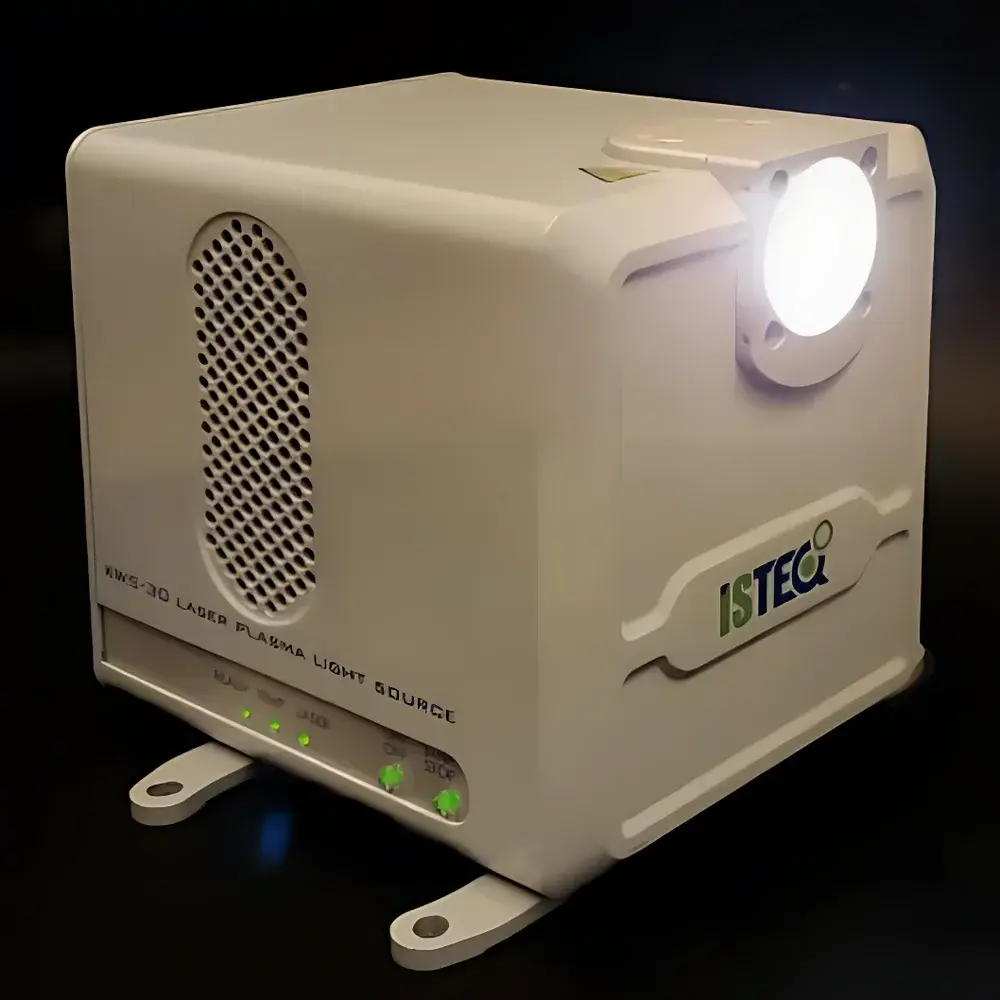
ISTEQ XWS-30 Compact Plasma Broadband Light Source
| Brand | ISTEQ |
|---|---|
| Origin | Netherlands |
| Model | XWS-30 |
| Spectral Range | 190–2500 nm (UV version) |
| Spectral Radiance | ~40 mW/(mm²·sr·nm) |
| Spatial Output Power | ~1.5 W |
| Fiber-Coupled Output Power | ~0.4 W |
| Emitter Size | 100 × 200 µm |
| Lifetime | 10,000 hours |
| Stability (STD) | <0.15% |
| Numerical Aperture | 0.5–0.55 (adjustable) |
| Dimensions (L×W×H) | 110 × 110 × 120 mm |
| Weight | 2 kg |
| Input Voltage | 100–240 V AC, 50/60 Hz |
| Cooling | Air-cooled |
| Purge Gas | High-purity N₂ or Ar (≥ Class 6), flow rate 1 L/min |
| Output Interfaces | C-mount, Thorlabs SM1, 30 mm cage system |
| Control Interface | USB-RS485 |
Overview
The ISTEQ XWS-30 Compact Plasma Broadband Light Source is an engineered solution for applications demanding high-brightness, spectrally continuous illumination across the deep ultraviolet to near-infrared spectrum (190–2500 nm). Unlike conventional arc lamps or LED-based sources, the XWS-30 employs a laser-pumped plasma discharge principle: a high-intensity pulsed laser beam is focused into a xenon-filled micro-chamber, generating a stable, spatially confined plasma emission spot (100 × 200 µm). This mechanism eliminates electrode degradation and spectral drift associated with traditional discharge lamps, delivering exceptional radiometric stability (<0.15% STD over 8 hours) and long-term repeatability. Its fully integrated architecture—housing the pump laser within the lamp head—removes the need for external driver units, enabling true plug-and-play operation in space-constrained environments such as OEM instrumentation, wafer inspection tools, and portable analytical platforms.
Key Features
- Laser-pumped plasma technology ensures electrode-free operation, eliminating spectral aging and intensity flicker typical of mercury or xenon arc lamps.
- Ultra-compact form factor (110 × 110 × 120 mm, 2 kg) with passive/air-cooled thermal management—no liquid cooling or external chillers required.
- High spectral radiance of ~40 mW/(mm²·sr·nm) at peak emission, optimized for efficient coupling into monochromators, spectrographs, and fiber-optic delivery systems.
- Dual spectral configurations: UV-optimized (190–2500 nm) and optical-fiber-ready (OFR, 250–2500 nm) variants, supporting both vacuum-UV metrology and robust NIR transmission.
- Adjustable numerical aperture (0.5–0.55) enables precise matching to downstream optics—ideal for collimation, imaging, or high-throughput fiber coupling.
- Standard mechanical interfaces include C-mount, Thorlabs SM1-threaded flange, and 30 mm cage system compatibility—facilitating rapid integration into modular optical benches.
- USB-RS485 digital interface supports remote power control, emission on/off sequencing, and real-time status monitoring under LabVIEW, Python, or custom SCADA environments.
Sample Compatibility & Compliance
The XWS-30 is designed for use in regulated and research-grade optical measurement systems where spectral fidelity and long-term calibration integrity are critical. Its stable plasma emission profile meets the irradiance uniformity requirements of ASTM E308 (computing colorimetric data), ISO 13406-2 (display backlight characterization), and JIS Z 8722 (reflectance standardization). For semiconductor process control applications—including DUV lithography alignment verification and thin-film thickness mapping—the source complies with cleanroom-compatible operational protocols: Class 6 (ISO 4) inert gas purging (N₂ or Ar, 1 L/min) prevents oxidation of internal optical surfaces and maintains consistent plasma ignition thresholds. While not intrinsically certified for medical device use, its radiometric stability and traceable output make it suitable for preclinical photobiomodulation studies conducted under GLP-compliant laboratory conditions. No hazardous substance declarations (RoHS, REACH) are violated; all materials conform to EU Directive 2011/65/EU.
Software & Data Management
The XWS-30 operates without proprietary software dependencies. Its RS485 command set—documented in the publicly available ISTEQ Communication Protocol Manual (v2.1)—enables seamless integration into existing automation frameworks. Supported commands include SET_POWER_LEVEL, QUERY_STABILITY_STATUS, READ_LAMP_HOURS, and TRIGGER_PURGE_CYCLE. Integration examples are provided for National Instruments LabVIEW (2020 SP1+), Python 3.8+ (via PySerial), and MATLAB R2021b+. Audit trails for power-on events, purge gas activation, and thermal warnings are logged internally with UTC timestamps—supporting basic 21 CFR Part 11 compliance when paired with validated host software. Firmware updates are delivered via signed binary files and verified through CRC-32 checksum validation prior to installation.
Applications
- Thin-film metrology: Serves as a broadband excitation source for ellipsometers and reflectometers used in PVD/CVD process development (e.g., SiO₂, TiO₂, ITO layer characterization).
- Semiconductor inspection: Provides stable DUV illumination for mask alignment systems and automated wafer defect detection tools operating below 250 nm.
- Photodynamic therapy (PDT) research: Delivers calibrated UVA–visible irradiance for in vitro photosensitizer activation studies under controlled fluence rates.
- Microfluidic diagnostics: Integrated into lab-on-a-chip readers for absorption and fluorescence-based biomarker detection across multi-wavelength assays.
- Solar simulation: Used as a spectral supplement in Class AAA solar simulators to enhance UV fidelity (IEC 60904-9 Ed. 3 compliance achievable with spectral correction filters).
- Fluorescence microscopy: Coupled via multimode fiber to widefield or confocal platforms requiring high photon flux without thermal load on objectives.
- FTIR and dispersive spectroscopy: Functions as a high-radiance background source for absorbance ratio measurements in environmental gas sensing and pharmaceutical QC.
FAQ
Is the XWS-30 compatible with vacuum ultraviolet (VUV) applications below 190 nm?
No—the XWS-30 UV variant is specified down to 190 nm due to fused silica window transmission limits. For sub-190 nm work, a magnesium fluoride (MgF₂) window option must be requested at time of order (lead time +8 weeks).
Can the numerical aperture be adjusted in situ during operation?
Yes—the NA is mechanically tunable via an integrated iris assembly; adjustment requires manual intervention but does not necessitate disassembly or recalibration.
What is the recommended purge gas pressure and line filtration specification?
Maintain inlet pressure between 1.5–2.5 bar (gauge); install a 0.01 µm particulate filter and oxygen/moisture trap upstream to ensure ≥99.999% purity and prevent plasma quenching.
Does the XWS-30 support TTL triggering for pulsed operation?
Not natively—the plasma discharge is continuous. However, external mechanical shutters (e.g., Uniblitz VS35) can be synchronized via the RS485 status port for gated illumination sequences.
How is radiometric calibration traceability established?
Each unit ships with a NIST-traceable spectral irradiance certificate (calibrated against PTB-standard sources at 1 m distance), valid for 12 months from date of manufacture.




