
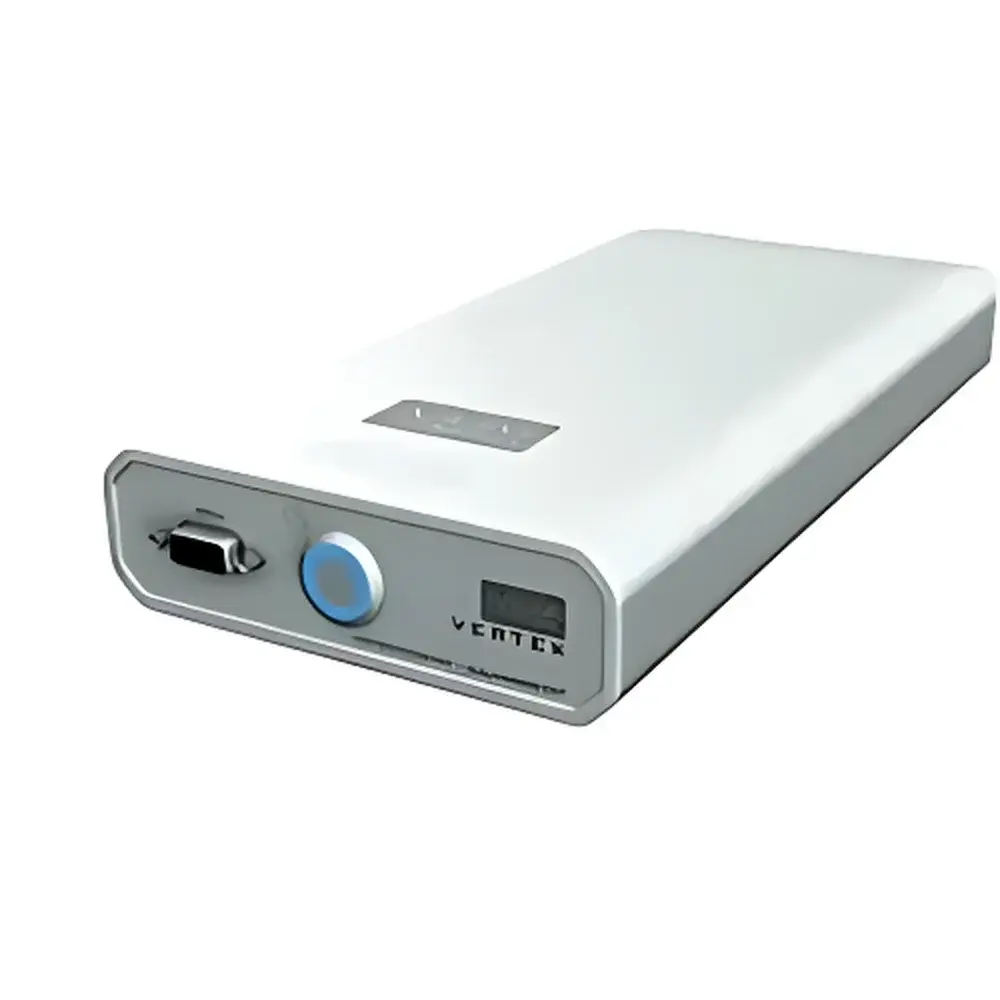
Ivium Vertex.100mA.EIS Electrochemical Workstation
| Brand | Ivium |
|---|---|
| Origin | Netherlands |
| Model | Vertex.100mA.EIS |
| Channel Count | Single-Channel |
| Current Range | 100 nA – 100 mA |
| Current Accuracy | ±0.3% |
| Potential Accuracy | ±0.3% |
| Potentiostat Bandwidth | >500 kHz |
| EIS Frequency Range | 10 µHz – 1 MHz |
Overview
The Ivium Vertex.100mA.EIS is a high-performance, single-channel potentiostat/galvanostat workstation engineered for precision electrochemical characterization across academic, industrial, and regulatory environments. Designed and manufactured by Ivium Technologies BV (Netherlands), the system implements true analog feedback control architecture with digital signal processing to ensure stability, linearity, and reproducibility in both DC and AC measurements. Its core measurement principle relies on four-electrode potentiostatic control—employing working, counter, reference, and auxiliary (optional) electrodes—to minimize uncompensated solution resistance (Ru) effects and enable accurate kinetic and impedance analysis. With a DC potential range of ±10 V, current range spanning seven decades (100 nA to 100 mA), and integrated electrochemical impedance spectroscopy (EIS) up to 1 MHz, the Vertex.100mA.EIS supports rigorous method development compliant with ASTM G106, ISO 16773, and ASTM D6386 standards for corrosion and battery testing. Its compact form factor (12 × 26 × 2.5 cm), low power consumption (<20 VA), and USB 2.0 interface facilitate seamless integration into fume hoods, gloveboxes, or automated test benches.
Key Features
- Integrated EIS capability: Full-frequency-range impedance acquisition from 10 µHz to 1 MHz with programmable perturbation amplitude (0.015 mV–1 V or 0.03%–100% of current range) and 16-bit DC offset compensation.
- High-resolution analog front-end: Dual 16-bit ADCs sampling at up to 100,000 points/second; potential resolution down to 0.4 µV (0.004% of ±10 V range); current resolution as low as 15 pA (0.015% of selected range).
- Real-time Ohmic drop (iR) compensation: 16-bit resolution, up to ±2 V correction per current range; configurable during all DC techniques including CV, LSV, and chronoamperometry.
- Built-in electrochemical noise (ECN) module: Simultaneous synchronized acquisition of potential and current noise at up to 500 Hz; no external hardware required; supports time-domain, FFT, and MEM spectral analysis.
- Hybrid technique support: Seamless switching between potentiostatic and galvanostatic modes (<1 µs transition time); multi-step sequences (up to 255 steps) combining OCP, potential/current steps, linear sweeps, and real-time EIS monitoring.
- Programmable filtering: Eight selectable analog filter cutoffs (1 MHz, 100 kHz, 10 kHz, 1 kHz, 10 Hz) plus digital Savitzky-Golay smoothing, baseline subtraction (polynomial/exponential), and automatic peak detection.
Sample Compatibility & Compliance
The Vertex.100mA.EIS is compatible with standard three-electrode cells (WE/CE/RE), dual-WE configurations for ECN, and custom electrochemical interfaces including rotating disk electrodes (RDE), flow cells, and microelectrodes. It meets essential safety and electromagnetic compatibility requirements per CE EN 61326-1:2013 and operates within ambient conditions of 5–40 °C and ≤80% RH non-condensing. For regulated laboratories, the system supports audit-ready data integrity through IviumSoft’s optional GLP/GMP-compliant mode, which enforces electronic signatures, user access levels, and full audit trails—including timestamped parameter changes, method execution logs, and raw data immutability—aligned with FDA 21 CFR Part 11 principles.
Software & Data Management
IviumSoft v6.x (Windows 10/11 compatible) serves as the unified platform for instrument control, real-time visualization, and post-acquisition analysis. The software features native support for batch processing via scripting (VBScript-based), enabling automated multi-sample workflows with looped parameter variation and conditional branching. All EIS datasets are stored in open-format .txt or .csv files with metadata headers, ensuring long-term readability without proprietary dependencies. Equivalent circuit fitting uses Levenberg-Marquardt nonlinear regression with drag-and-drop CDC element selection, initial value auto-calculation, and constrained parameter optimization. Export options include vector-based SVG/PDF graphics, Excel-compatible tables, and direct copy-paste into Word or MATLAB. Raw data files retain full 16-bit resolution and are timestamped with hardware-generated UTC clocks synchronized to PC system time.
Applications
The Vertex.100mA.EIS is routinely deployed in battery R&D (Li-ion, solid-state, flow batteries) for SEI formation studies, charge-transfer resistance mapping, and state-of-health estimation via low-frequency EIS. In corrosion science, it executes ASTM G5/G59-compliant polarization resistance, Tafel extrapolation, cyclic polarization, and electrochemical noise monitoring for localized corrosion assessment. Sensor developers utilize its sub-picoampere current resolution and fast pulse response (10 µs minimum step width) for amperometric biosensor calibration and redox polymer characterization. Fuel cell researchers apply dynamic EIS under controlled gas atmospheres to deconvolute mass transport and charge transfer limitations. In academia, its intuitive GUI, real-time plotting, and built-in teaching modules—including annotated CV simulations and guided corrosion analysis—support undergraduate and graduate electrochemistry curricula.
FAQ
Does the Vertex.100mA.EIS support true analog potentiostatic control?
Yes—it employs a dedicated analog feedback loop independent of the USB communication path, ensuring phase-stable operation up to 500 kHz and eliminating digital latency artifacts common in USB-native architectures.
Can I perform simultaneous EIS and DC techniques like CV or chronoamperometry?
Yes—the hybrid mode allows concurrent application of DC waveforms (e.g., potential ramp) while acquiring impedance spectra at user-defined frequencies, enabling in-situ monitoring of interfacial evolution during reaction progress.
Is the electrochemical noise (ECN) functionality hardware-integrated or add-on?
ECN is fully embedded in the base unit; no additional modules or cables are required. Dual-channel synchronous sampling at 500 Hz enables direct calculation of noise resistance (Rn) and spectral power density without post-hoc alignment.
What level of iR compensation does the system provide?
Up to ±2 V of programmable iR compensation per current range, implemented with 16-bit resolution and two-stage analog decoupling filters to suppress high-frequency interference during compensation.
Are raw data files exportable in vendor-neutral formats?
All measurement data—including time-series, EIS spectra, and fitted parameters—are saved as plain-text ASCII files (.txt/.csv) with complete metadata headers, ensuring interoperability with Python, Origin, or custom analysis pipelines.





