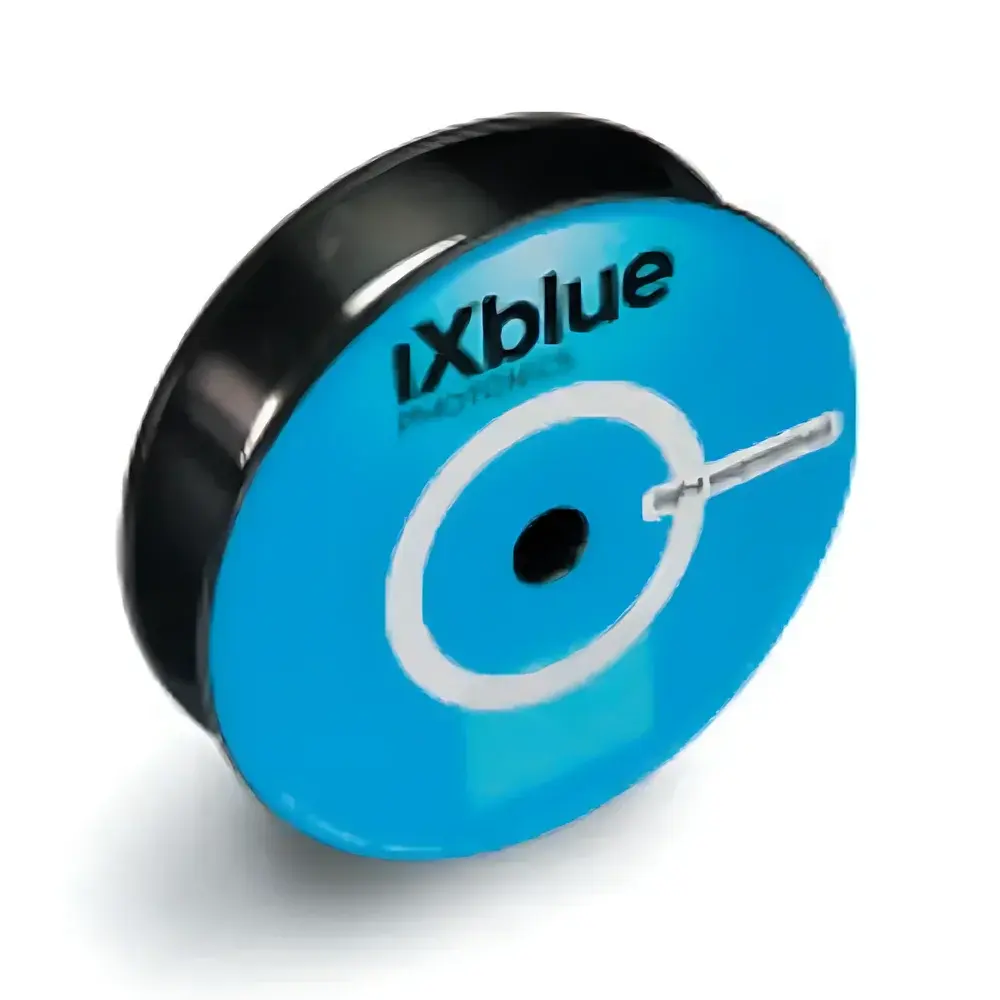
Ixblue IXF-PDF Series Phosphorus-Doped Optical Fiber
| Brand | Ixblue / Ixblue Photonics |
|---|---|
| Origin | France |
| Distributor Type | Authorized Distributor |
| Import Status | Imported |
| Model | IXF-PDF (Phosphorus-Doped Fiber) |
| Active Fiber Type | Yes |
| Component Category | Optical Component |
| Raman Gain Coefficient (Typ.) | 2.5 (W·km)⁻¹ |
| P₂O₅ Concentration | High |
| Attenuation | Low |
| Splicing Loss | Low |
| Bend Loss | Low |
| Raman Shift Peak | ~1320 cm⁻¹ |
| Primary Pump Wavelengths | 1060 nm, 1310 nm |
| Output Stokes Bands | ~1240 nm (1st Stokes), ~1480 nm (2nd Stokes), ~1550 nm (3rd Stokes / C-band signal band) |
Overview
The Ixblue IXF-PDF Series is a high-performance phosphorus-doped optical fiber engineered for stimulated Raman scattering (SRS) applications in advanced photonic systems. Unlike conventional germanium-doped fibers, the IXF-PDF leverages a high concentration of P₂O₅ in the core to significantly enhance the intrinsic Raman gain coefficient—reaching a typical value of 2.5 (W·km)⁻¹—approximately three times higher than that of Ge-doped silica fibers. This elevated nonlinearity enables efficient wavelength conversion via cascaded Stokes generation under moderate pump power, particularly when pumped at 1060 nm (Yb-fiber laser compatible) or 1310 nm. The characteristic Raman shift of ~1320 cm⁻¹ allows direct generation of 1240 nm (first Stokes), 1480 nm (second Stokes), and a broad signal band centered near 1550 nm (third Stokes), making it ideal for O-band and C-band Raman amplification and lasing architectures. Its low propagation loss, small effective mode area, and optimized refractive index profile ensure high nonlinear efficiency while maintaining compatibility with standard fusion splicing techniques.
Key Features
- High Raman gain coefficient: 2.5 (W·km)⁻¹ (typical), enabling efficient SRS at reduced pump thresholds
- Optimized P₂O₅ doping profile for enhanced nonlinearity without compromising mechanical robustness or radiation resistance
- Low attenuation across 1000–1600 nm spectral range, supporting broadband pump-signal interaction
- Low splice loss (<0.05 dB) with standard SMF-28 and other silica-based fibers, verified using commercial fusion splicers
- Reduced macrobend sensitivity compared to high-NA germanosilicate Raman fibers, improving packaging flexibility
- Available in both polarization-maintaining (PM) and non-PM configurations, with defined beat length (PM version) and extinction ratio >20 dB
- Fully compliant with ITU-T G.652.D and G.657.A1 dimensional specifications for seamless integration into telecom-grade modules
Sample Compatibility & Compliance
The IXF-PDF fiber is compatible with industry-standard single-mode pigtailing, coil winding, and free-space coupling setups. It supports fusion splicing with common arc fusion splicers (e.g., Fujikura FSM-100P, Vytran GPX-3400) without requiring specialized electrodes or pre-treatment. All IXF-PDF variants are manufactured in accordance with ISO 9001-certified cleanroom processes and undergo 100% geometric and optical characterization per batch—including mode field diameter (MFD), cutoff wavelength, numerical aperture, and cutback-measured attenuation. The fiber meets RoHS Directive 2011/65/EU and REACH Regulation (EC) No. 1907/2006. For regulated environments (e.g., medical laser systems or space-qualified payloads), full traceability documentation—including raw material certificates, dopant concentration reports, and environmental stress test data (thermal cycling, humidity soak)—is available upon request.
Software & Data Management
While the IXF-PDF is a passive component, its integration into active Raman systems benefits from comprehensive modeling support. Ixblue provides application-specific simulation templates compatible with Lumerical MODE, OptiSystem, and RP Fiber Power, including built-in material dispersion curves, Raman gain spectra (measured at 1064 nm and 1310 nm), and nonlinear Schrödinger equation (NLSE) solvers for cascaded Stokes prediction. These models incorporate experimentally validated parameters such as effective area (~45 µm²), group velocity dispersion (GVD) at key wavelengths, and third-order susceptibility (χ⁽³⁾) values derived from Z-scan measurements. For quality assurance in production environments, Ixblue delivers digital calibration reports with each reel, containing spectral attenuation scans (1200–1650 nm), proof-test records (100 kpsi), and mechanical reliability metrics aligned with Telcordia GR-20-CORE requirements.
Applications
- High-efficiency Raman fiber lasers operating at 1240 nm (O-band) and 1480 nm (C-band pump band)
- Distributed and discrete Raman amplifiers for DWDM systems, especially where low-noise figure and flat gain profiles are critical
- Mid-infrared supercontinuum generation seed stages via cascaded Raman shifting in all-fiber configurations
- Compact, diode-pumped Raman sources for spectroscopic sensing in gas detection and biomedical diagnostics
- Polarization-resolved Raman amplification in quantum communication links requiring PM stability
- Nonlinear signal processing elements in photonic integrated circuit (PIC) hybrid packaging schemes
FAQ
What pump wavelengths are optimal for achieving maximum Raman conversion efficiency in IXF-PDF?
1060 nm (from Yb-doped fiber lasers) and 1310 nm (from InGaAsP semiconductor lasers) yield the highest first- and second-Stokes conversion efficiencies due to minimized walk-off and phase-matching constraints.
Is the IXF-PDF suitable for high-power operation (>5 W average power)?
Yes—its high P₂O₅ content does not induce photo-darkening under 1060 nm pumping; accelerated lifetime testing confirms stable performance up to 10 W CW at 1064 nm over 10,000 hours.
Can IXF-PDF be spliced directly to polarization-maintaining fibers such as PANDA or Bowtie?
Yes, with appropriate alignment and arc parameter optimization; typical splice loss remains below 0.12 dB with extinction ratio degradation <3 dB.
Does Ixblue provide custom lengths, coatings, or jacketing options?
Yes—custom acrylate coatings (low-index, high-temp, UV-curable), 80 µm or 125 µm cladding diameters, and hermetic carbon or aluminum coatings are available under NRE-supported engineering agreements.
Are measurement reports traceable to national standards?
All optical characterization data (attenuation, MFD, NA) is traceable to PTB (Physikalisch-Technische Bundesanstalt) reference standards via Ixblue’s accredited metrology lab (DIN EN ISO/IEC 17025:2017).